



Antique Scottish Gold Jewellery
Antique scottish gold jewellery brings together historic goldwork and native hardstones, offering distinct regional character for daily wear.
Antique Scottish Gold Jewellery
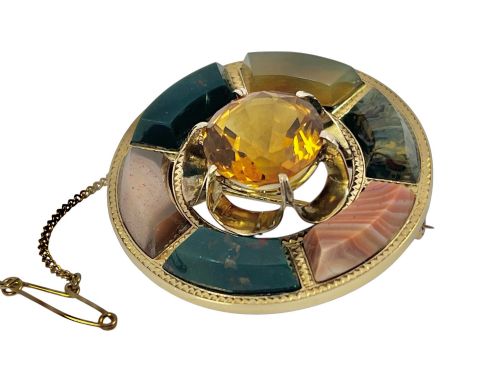
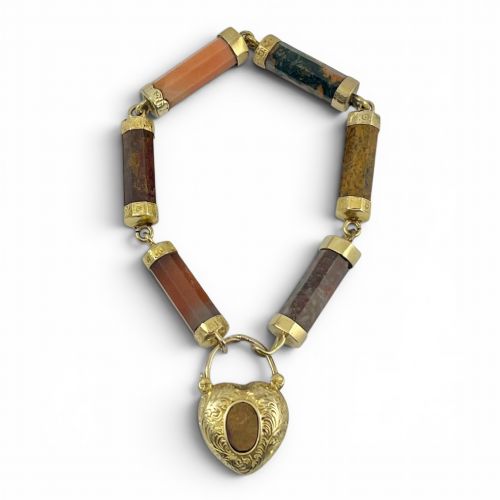
Antique scottish gold jewellery encompasses rings, bracelets, brooches, snuff boxes, and lockets originating from periods such as the Georgian, Victorian, and Edwardian eras. These pieces frequently incorporate traditional motifs and locally sourced hardstones set into yellow gold.
Beyond bracelets and brooches, the selection includes signet rings, lockets, and snuff boxes featuring stones like carnelian, smoky quartz, and jasper. Each object demonstrates the regional craftsmanship characteristic of nineteenth-century Scottish workshops.
How these pieces were made
Makers utilised 9ct and 18ct yellow gold as the primary metal base for mounting native hardstones, shaping rings, bracelets, and snuff boxes with traditional bench techniques. Gold stampings, cast mounts, and hand-engraved details provided secure settings for the heavy stones.
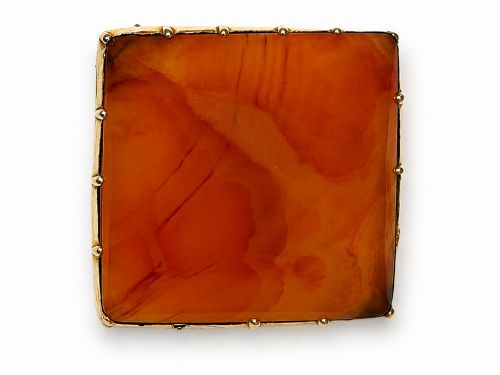
The stones themselves, including agate, carnelian, jasper, and smoky quartz, were cut and polished to display natural banding and colour variations before being fitted into bezels. Shell and chrysoberyl also appear, integrated alongside diamonds and opals in specific rings and brooches.
A tiny Glasgow cameo whispers secrets of nineteenth-century craft while sitting quietly inside a pocket.
What varies in quality
Quality in these pieces depends on the precision of the stone-cutting and the weight of the gold used in the mount. Substantial 18ct yellow gold settings and well-matched hardstones with distinct natural markings represent the finer end of the spectrum.
The complexity of the metalwork, such as deep engraving on a signet ring or articulated links in a bracelet, separates standard production from superior examples. Preservation of the original stones and the structural integrity of the gold mounts determine the overall standard.
The Antique Scottish Gold Jewellery Glossary
- Agate
- A form of chalcedony displaying distinct natural banding or concentric stripes, frequently utilised in Scottish hardstone jewellery.
- Hardstone
- Opaque or semi-opaque decorative stones, including jasper and carnelian, cut and polished for jewellery rather than faceted.
- Carnelian
- A brownish-red variety of the quartz mineral chalcedony, valued for its warm translucent colour in brooches and rings.
- Snuff box
- A small ornamented container designed to hold powdered tobacco, often fashioned in gold and stone during the Victorian period.
- Signet ring
- A finger ring featuring an engraved seal or heavy bezel, traditionally used for pressing into wax to stamp correspondence.
Antique Scottish Gold Jewellery: Frequently Asked Questions
What periods do these pieces date from?
The pieces span multiple centuries, with items recorded from the Georgian, Victorian, and Edwardian eras. Victorian examples dominate the selection, reflecting the height of regional Scottish jewellery production.
Specific items also link to the sixteenth century and later decades like nineteen-ten and nineteen-sixty, showing continuous traditional craftsmanship.
What materials are typically found in this jewellery?
Gold forms the primary metal structure, appearing in both 9ct and 18ct yellow gold variations. Native hardstones such as agate, carnelian, jasper, and smoky quartz are set into these gold mounts.
Additional materials include shell, chrysoberyl, amethyst, opal, and diamonds, depending on the specific object type.
How should I wear an antique agate bracelet?
Agate bracelets feature substantial gold links and polished stone panels designed for secure wrist wear. Pairing them with simple attire allows the natural stone banding to remain the focal point.
Care should be taken to protect the hardstone settings from sharp impacts during daily use.
How do I identify a Scottish Victorian brooch?
Scottish Victorian brooches typically combine yellow gold with sliced hardstones arranged in geometric or traditional motifs. Motifs often include thistles or regional symbols executed in the Scottish Revival style.
Examining the reverse reveals the construction methods and metal purity marks associated with nineteenth-century makers.