
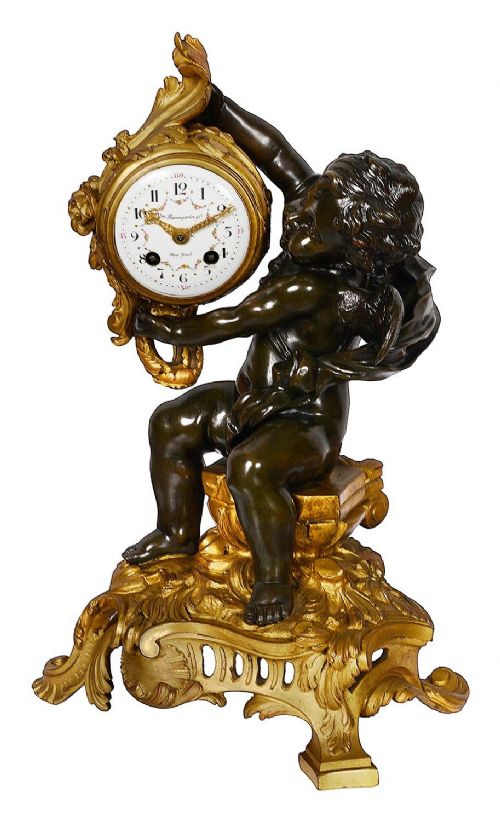



Antique Putto Desk Clock
An antique putto desk clock brings together winged figures and timekeeping, offering a glimpse into nineteenth-century domestic luxury.
Antique Putto Desk Clock
The versions most common on this page date from the Victorian era and the late nineteenth century, spanning periods such as 1880, 1890, and 1900. They frequently employ French Rococo Revival, Louis XVI style, and Neoclassical designs alongside English nineteenth-century makers.
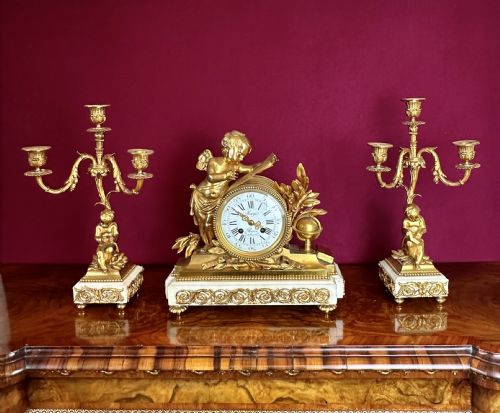
Formats vary from single bronze-cased clocks to elaborate sets incorporating marble stands and matching garnitures. Each piece integrates figural sculpture with a functional clock movement designed for desks, tables, or mantelpieces.
Judging quality and execution
The refinement of the cast metalwork separates standard production from superior pieces. Crisp chasing on the bronze or ormolu figures indicates skilled hand-finishing, whereas softer definition suggests mass production or excessive cleaning over time.
The integration between the figural putto and the clock housing dictates overall harmony. Finer examples balance the proportions of the marble base, the bronze casting, and the dial face without overcrowding the design.
The selection spans Victorian periods, Regency pieces, and specific dates from 1860 through 1910 originating from French and English workshops.
Le Roy Paris·Leon Message·Jollet et Cie·Bellenot Paris·John Bennett Cheapside London·Henry Berkeley Square London·F Marti
The Antique Putto Desk Clock Glossary
- Putto
- A plump, naked child figure, often winged, found in classical and renaissance art. In these clocks, putti support the dial or recline across the bronze case.
- Ormolu
- Gilded bronze produced by applying a mercury-gold amalgam to a bronze base. This technique creates a rich golden surface characteristic of French decorative arts.
- Garniture
- A set of matching ornamental objects for a mantelpiece, usually comprising a central clock flanked by two matching vases, urns, or candelabra.
- Fusee
- A conical pulley used in clock movements to maintain even tension on the chain as the mainspring winds down. This mechanism improves timekeeping accuracy.
- Rococo Revival
- A nineteenth-century design style reviving the asymmetry, scrollwork, and natural motifs of the eighteenth-century French rocaille movement.
Antique Putto Desk Clock: Frequently Asked Questions
Where should I place an antique putto desk clock?
These timepieces suit stable surfaces like mantelpieces, desks, or sturdy side tables where their weight and bronze or marble materials are properly supported.
Keep them away from direct sunlight, dampness, and heat sources to protect the enamel dials, gilding, and internal movements.
How do I wind and care for the movement?
Most nineteenth-century mechanical movements require a key to wind the spring barrels periodically depending on the specific gear train configuration. Avoid overwinding the mechanism to prevent tension damage to the mainspring.
Professional servicing every few years ensures the pivots and gear teeth remain clean and properly lubricated.
What is a clock garniture set?
A garniture set includes a central clock accompanied by matching decorative side pieces such as vases, urns, or candelabra designed to display together. These matched groupings created a balanced decorative arrangement on nineteenth-century mantelpieces.
Individual clocks often survived independently, while complete sets preserve the original ensemble.
How do I distinguish French from English models?
French examples frequently exhibit Rococo Revival, Louis XVI, or Neoclassical styling with extensive ormolu and figural marble bases. Makers such as Marti or Paris firms stamped their movements accordingly.
English pieces from shops in London often employ single fusee movements or traditional bracket clock proportions combined with gilt bronze cherub motifs.