
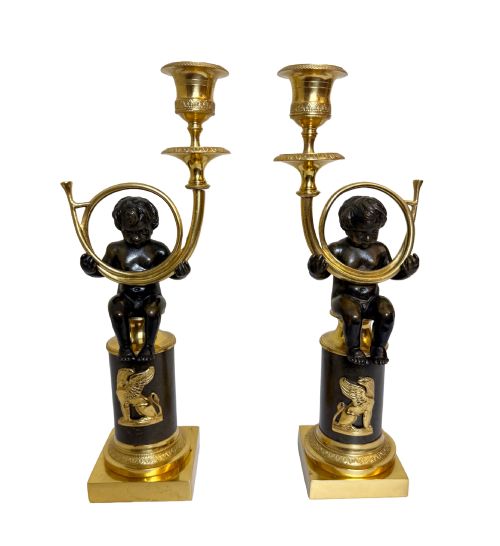


Antique Putti Candleholders
Antique putti candleholders bring classical charm to a room, cast in bronze, ormolu and porcelain to hold your taper candles aloft.
Antique Putti Candleholders
Antique putti candleholders depict winged infant figures supporting sockets for candles, drawing on classical motifs revived across the nineteenth century. These sculptural pieces take the form of single candlesticks or multi-branch candelabra, often paired for mantelpieces and side tables.
Most examples found here date from the Victorian era and the latter half of the nineteenth century, reflecting French and German design influences. Makers produced these decorative works in matching pairs, utilising bronze, marble, porcelain and gilt metals.
The figures themselves appear standing, sitting or entwined with floral branches and urns, serving both practical lighting and decorative sculpture. Buyers encounter styles ranging from Rococo Revival curves to the structured symmetry of Louis XVI designs.
Materials and Manufacture
Foundry workers cast bronze and ormolu elements using traditional lost-wax or sand-casting methods, then chased the metal surfaces by hand to sharpen details in hair, wings and drapery. Gilt bronze and gold leaf added rich surface shine, while patinated bronze provided darker, tonal contrast.
Makers integrated natural stone components, mounting heavy bronze figures onto turned marble or porphyry bases to ensure stability. Porcelain workshops in Germany moulded ceramic putti figures, firing and hand-painting the glazed details before attaching metal candle nozzles.
Some winged infants spend their days holding up heavy bronze branches without ever complaining about the weight.
Assessing Quality
The crispness of the metal chasing separates standard production from superior work, as finer castings retain sharp facial expressions and feather texture on the wings. Hand-painting on porcelain elements also dictates grade, with delicate brushwork and rich enamel depth marking out better examples.
The integration of materials influences overall merit, seen in how cleanly bronze figures fit onto their marble plinths and whether gilding remains intact across high-contact areas. Substantial weight and balanced proportion indicate superior foundry output during the nineteenth century.
Minton·Meissen Porcelain·Triebner, ENS & Eckert·Claude Clodion
The Antique Putti Candleholders Glossary
- Putti
- Plumed or unplumed infant figures derived from classical art, frequently mistaken for cherubs in nineteenth-century decorative pieces. They appear in art holding candle sockets or fruit.
- Ormolu
- Finely ground high-carat gold applied to a bronze base using a mercury amalgamation process, or simply polished brass imitating gold. This finish gives bright reflective highlights to the metalwork.
- Porphyry
- A very hard igneous rock with purple or red crystals, prized for classical bases and pedestals. It adds distinct geological grain beneath bronze figures.
- Candelabra
- A branched candlestick holding multiple lights from a single central stem. These multi-branch pieces often feature putti intertwined with floral arms.
Antique Putti Candleholders: Frequently Asked Questions
How do I clean bronze candleholders?
Dust metal surfaces gently with a soft dry cloth to protect the original patination or gilding from wear.
Avoid chemical polishes and water, which strip historic finishes and damage exposed marble or porcelain components.
How can I tell French from German pieces?
French pieces predominantly utilise cast bronze, ormolu and marble bases with Rococo or Louis XVI styling.
German works frequently employ hand-painted porcelain figures produced by major factories like Meissen or Volkstedt.
What is a go-to-bed candlestick?
A go-to-bed is a miniature candleholder designed for carrying up to the bedroom at night.
These small nineteenth-century pieces often incorporated putti figures into their compact handheld bases.