


Antique Porcelain Four Seasons
Antique porcelain four seasons figures capture allegorical representations of the year, crafted by historic European factories as decorative table sets and mantel ornaments.
Antique Porcelain Four Seasons
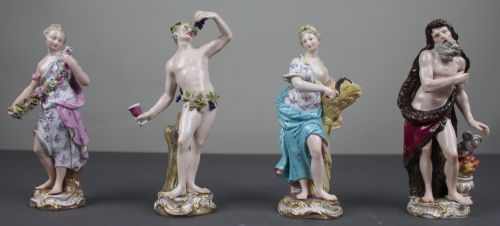
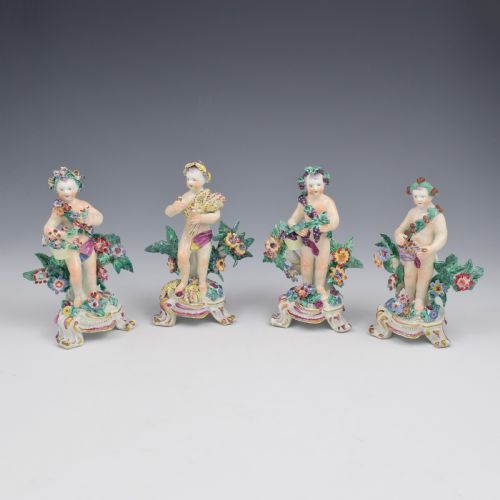
When you search for antique porcelain four seasons, you are looking at allegorical figures and groups that represent Spring, Summer, Autumn, and Winter through symbolic attributes like flowers, cornucopias, grapes, and braziers. These sculptural ceramics appear as sets of standing putti, individual figures, and components of larger mantel clocks.
The versions you are most likely to meet on this page span the eighteenth and nineteenth centuries, originating from English factories such as Bow and Derby, alongside continental works from Meissen, Carl Thieme Dresden, Frankenthal style, and Samson.
Materials and technique
These figures utilise soft-paste or hard-paste porcelain, moulded and fired before receiving detailed overglaze enamel painting to define garments, facial expressions, and naturalistic bases. Artisans applied gold leaf and gilding to highlight scrollwork, garment edges, and architectural details.
Modelters shaped the clay by hand or pressed it into moulds, building up complex allegorical scenes with intricate floral garlands and attributes that required immense skill during the high-temperature kiln firings.
Winter often hides inside a heavy cloak while warming frozen fingers over a small brazier.
Assessing quality and modeling
The depth and brilliance of the gilding also indicate the standard of production, with superior examples retaining burnished gold leaf that contrasts sharply with the smooth white porcelain body.
Meissen·Bow Porcelain·Derby·Carl Thieme Dresden·Samson
The Antique Porcelain Four Seasons Glossary
- Putto
- A plump, naked male child figure often depicted with wings, frequently used to personify the seasons in eighteenth-century porcelain.
- Allegorical figure
- A ceramic sculpture embodying an abstract idea, such as a season, through specific symbolic objects and human form.
- Hard-paste porcelain
- A dense, vitrified ceramic composed of kaolin and petuntse fired at very high temperatures, producing a bright white, durable body.
- Soft-paste porcelain
- An artificial porcelain paste made from white clay and frit, fired at lower temperatures to yield a slightly softer, creamier texture.
- Overglaze enamel
- Coloured glass pigments painted onto already fired and glazed porcelain before undergoing a second, lower-temperature fixation firing.
Antique Porcelain Four Seasons: Frequently Asked Questions
How can I tell eighteenth-century figures from nineteenth-century copies?
Examination of the paste, base finish, and enamel vibrancy reveals the period of manufacture. Eighteenth-century pieces often display softer contours and hand-mixed enamels.
Nineteenth-century revivals and copies, such as those by Samson or later factories, tend to feature brighter, more uniform gilding and harder paste bodies.
Were these figures sold as complete sets?
Factories produced the four seasons both as unified sets and as individual figures intended for purchase over time. Complete surviving sets remain particularly desirable for collectors seeking a unified decorative scheme.
Many figures were displayed on dining tables as sculptural centerpieces before moving to mantelpieces.
How should I care for antique porcelain figures?
Keep porcelain pieces away from direct sunlight and dust them gently with a soft, dry brush. Avoid harsh chemical cleaners that might damage delicate overglaze enamels and gilding.
Secure figures on stable surfaces, as their intricate protruding attributes like floral garlands and fingers are vulnerable to impact.