

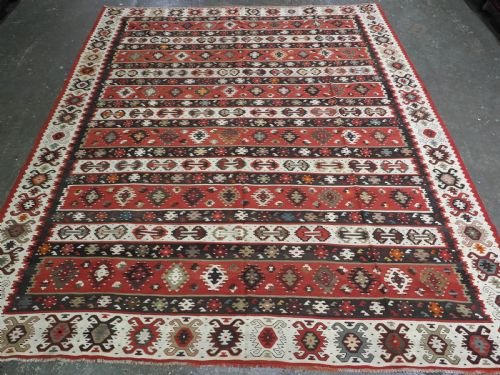
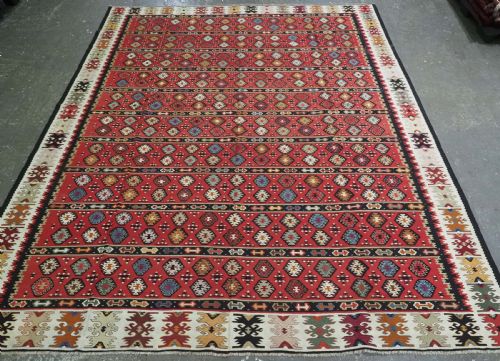


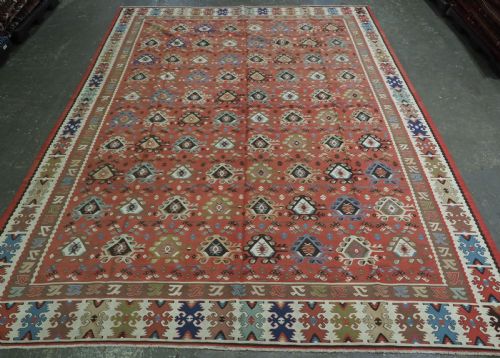


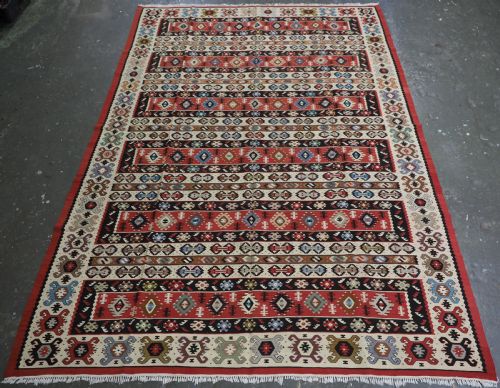


Antique Pirot Kilim
These antique pirot kilim examples are flat-woven textiles carrying distinctive Balkan folk art patterns that ground a room with traditional character.
Antique Pirot Kilim
When a buyer searches for an antique pirot kilim, they are looking at flat-woven rugs and carpets originating from the Balkan region. These textiles often carry alternate designations linking them to Sarkoy, reflecting shared regional traditions in weaving.
The pieces available here predominantly stem from the early decades of the twentieth century, specifically around nineteen twenty, alongside examples from nineteen ten and nineteen thirty. Buyers encounter large room sizes and area rugs configured in classic, banded, repeat, and flowering tree designs.
What varies in quality
Quality differences depend on the complexity of the design layout, such as scarce lattice work or flowering tree motifs versus simpler repeat patterns. Compositional balance and the nuance of the colour palette also distinguish finer examples.
The scale of the rug influences its character, with large room size formats presenting greater demands on the weaver's symmetry and planning. The crispness of the woven motifs indicates the precision applied during production.
Listings span the early twentieth century, capturing pieces produced around nineteen ten, nineteen twenty, and nineteen thirty using wool and cotton.
The Antique Pirot Kilim Glossary
- Kilim
- A flat-woven rug or carpet produced without a pile. These textiles are traditionally reversible and feature sharp geometric patterns.
- Pirot
- A town associated with distinctive flat-woven carpets from the Balkan region. Pirot kilims share stylistic traits with Sarkoy weaving.
- Sarkoy
- A regional designation often linked alongside Pirot for flat-woven Balkan textiles. These pieces display similar banded and repeat designs.
- Flat-weave
- A textile construction method formed by interweaving warp and weft threads directly. This technique creates a smooth surface without raised pile.
- Balkan Folk Art
- A traditional design vocabulary originating from Southeast Europe. These motifs appear across regional kilims in repeat and medallion layouts.
Antique Pirot Kilim: Frequently Asked Questions
What is an antique pirot kilim?
An antique pirot kilim is a flat-woven textile originating from the Balkan region, often associated with Sarkoy production centres. These rugs utilise wool and cotton materials to form traditional folk art patterns.
Such textiles function primarily as decorative floor coverings, bringing historical patterns and flat-woven textures into residential spaces. Their construction lacks a raised pile, making them distinct from traditional knotted carpets.
How do I style a kilim rug?
These flat-woven rugs suit placement in high-traffic areas or living spaces where a low profile is practical. Large room size formats anchor furniture groupings effectively.
Pairing these textiles with wooden flooring allows the geometric patterns and soft colours to stand out. Their reversible nature also offers flexibility in placement.
How are pirot and sarkoy kilims related?
Pirot and Sarkoy kilims share overlapping design vocabularies and flat-weaving techniques rooted in Balkan traditions. Many antique examples carry dual attribution due to these regional similarities.
Both groups utilise wool and cotton to create banded, repeat, and medallion layouts. Collectors often view them within the broader category of Balkan tribal and folk art weaving.
How do I date an antique kilim?
Dating these textiles involves examining material usage, structural clues, and stylistic consistency with known periods. Pieces on this site typically date from the early twentieth century, specifically around nineteen ten to nineteen thirty.
Construction details, such as being woven in multiple parts and joined together, point towards traditional production methods of the era. Colour palettes and dye characteristics also offer guidance on age.