






1920s Kilim Rug
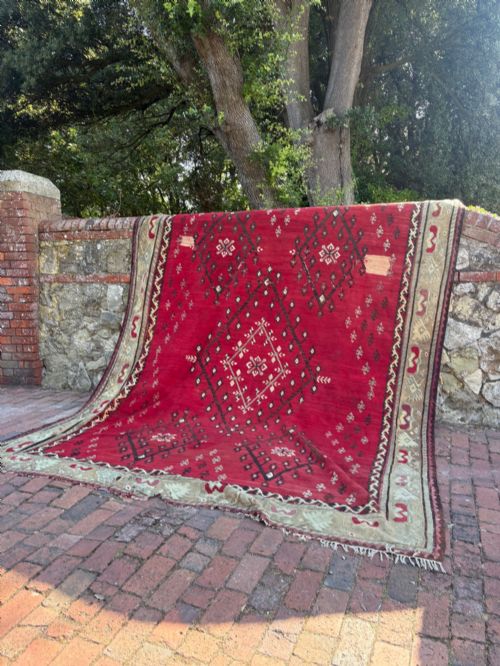
A 1920s kilim rug brings rich flatweave texture and traditional tribal patterns into a room.
1920s Kilim Rug
A 1920s kilim rug is a flatweave textile produced across diverse regions including Anatolia, the Balkans, and Persia. These pieces serve as floor coverings, runners, and wall hangings, bringing distinct folk art traditions into modern interiors.
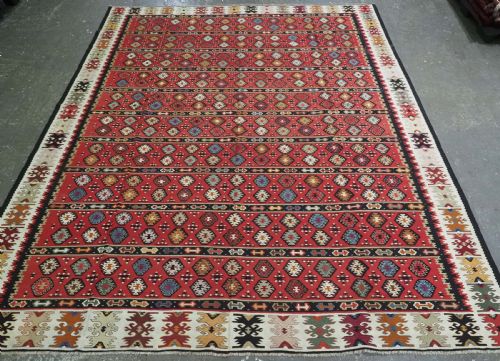
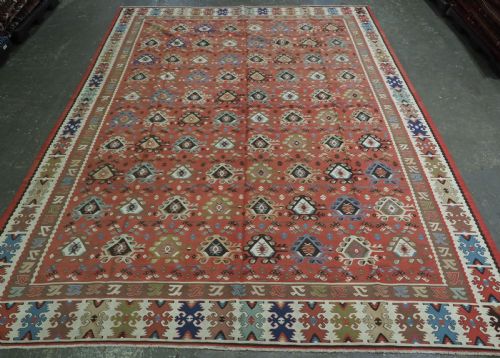
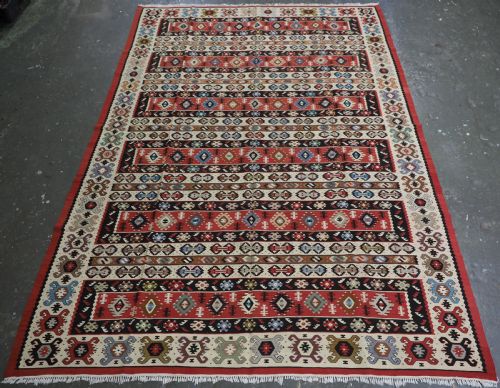
The version most commonly met on this page is the Pirot or Sarkoy kilim, alongside Anatolian, Afghan, and Baluch examples. They arrive in formats ranging from small village prayer sizes to large room dimensions and long runners.
Makers utilised traditional motifs such as banded chevron designs, flowering trees, lattice patterns, and repeat medallions. Each piece reflects the specific regional weaving heritage of its origin, from Persian tribal workshops to Balkan traditional compositions.
How they were made
These textiles are constructed primarily from wool and cotton, employing traditional flatweave techniques without a pile. Weavers interlocked the coloured weft threads tightly over the warp to create crisp geometric boundaries and flat, durable surfaces.
Many larger formats, such as Turkish Kayseri or Afghan pieces, were woven in two separate parts and skillfully joined down the middle. This structural method allowed makers to produce wide room-size carpets on narrower village looms.
Some weavers cleverly joined two narrow strips down the middle because their looms simply refused to build a wider room.
What varies in quality
Quality in these flatweaves rests upon the fineness of the weave, the precision of the geometric design, and the integrity of the structure. Tighter tension and careful joining of multi-part rugs indicate superior craftsmanship from the workshop or village.
The visual depth of the wool and the preservation of colour harmony separate standard examples from exceptional ones. Pieces that retain strong, warm soft colours or delicate pastel palettes demonstrate higher merit among surviving flatweaves.
The 1920s Kilim Rug Glossary
- Kilim
- A flatweave textile produced without a pile by tightly interweaving warp and weft threads. This technique creates a lightweight rug with pattern visible on both sides.
- Flatweave
- A method of rug construction that excludes knotting, resulting in a thin, flexible fabric. These pieces are well suited for layering or hanging.
- Warp
- The stationary vertical threads stretched on a loom that provide the foundational structure for the weaving. Weft threads are passed horizontally across these foundational strands.
- Weft
- The transverse threads passed through the warp to build the pattern and colour of the textile. In these pieces, the weft completely covers the warp.
- Medallion
- A central ornamental motif incorporated into the field design of the rug. Repeat medallions create rhythmic patterns across the expanse of the flatweave.
1920s Kilim Rug: Frequently Asked Questions
How do I care for a kilim rug?
Vacuum gently without a rotating brush roll to remove dust and debris from the flatweave surface. Rotate the textile periodically to ensure even wear across high-traffic areas.
Professionally clean the wool when necessary to preserve the integrity of the fibres. Avoid exposing the piece to direct sunlight for extended periods to protect the natural dyes.
Can I use these rugs on heated floors?
Wool and cotton flatweaves tolerate underfloor heating reasonably well due to their breathable natural composition. Ensure the subfloor remains dry before placing the textile down.
Utilising a breathable rug underlay prevents slipping and allows proper airflow beneath the flatweave. This protects both the floor and the underside of the textile from moisture buildup.
Are these rugs reversible?
Most traditional flatweaves display the pattern clearly on both sides because of how the weft threads are woven. This structural characteristic allows the rug to be flipped to distribute wear.
Check the reverse side for loose threads or repairs before placing it face down. Periodic flipping helps maintain an even appearance over years of use.
What is a two-part kilim?
Larger room-size flatweaves were frequently woven in two separate long strips on narrow village looms. Artisans then stitched these two halves together down the centre to achieve a wider format.
This historical construction technique is typical of specific regional production methods. The seam is an intentional feature of the manufacturing process rather than a later alteration.