
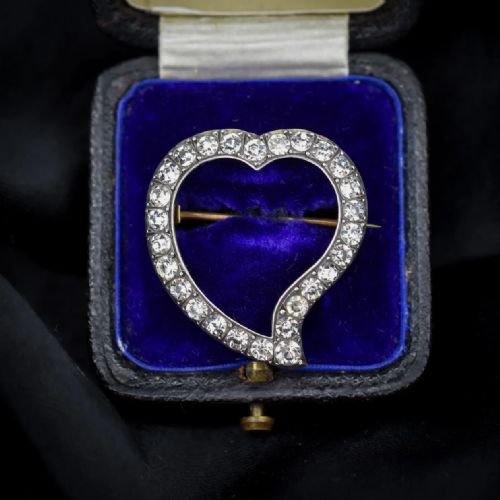


Antique Paste Stone Pin
These antique paste stone pin examples range from Victorian hearts to Art Deco lizards, offering brilliant sparkle using hand-set glass.
Antique Paste Stone Pin
An antique paste stone pin brings together historical lapidary skill and ornamental metalwork, forming versatile dress accessories that range from naturalistic animal shapes to symbolic love tokens. When you search for an antique paste stone pin, you encounter diverse forms including brooches, hair ornaments and complete jewellery sets. Victorian examples dominate the selection, often taking the shape of flowers, witches hearts, lizards or crescent moons.
The materials and periods span the nineteenth and early twentieth centuries, encompassing Georgian styles, Victorian Etruscan Revival, and 1920s Art Deco pieces. Makers utilised sterling silver, fine silver, 9ct gold, gilt metals and tortoise shell to mount the faceted glass stones. These items served as fashionable daily adornments for fastenings, lapels and hair, functioning as accessible luxuries that imitated fine gemstone jewellery.
How they were made
Craftsmen shaped and polished glass into faceted paste stones to imitate diamonds, garnets, chalcedony and coloured gemstones, setting them by hand into silver and gold mounts. The metalwork often involved sterling silver, fine silver, or 9ct gold, occasionally combined with base metals or gilt finishes to enhance the visual depth of the design. Tortoise shell provided an organic foundation for specialised hair accessories featuring mounted stone crowns.
Techniques varied from cast and chased silver settings to intricate wirework found in Victorian Etruscan Revival pieces and early 1920s articulated frames. Stones were typically foil-backed before setting to intensify their light reflection and colour, secured securely with claws, bezels or closed-back collets depending on the period.
Materials span sterling silver, 9ct gold, tortoise shell, and glass paste.
What varies in quality
The standard of an antique paste stone pin rests on the precision of the stone cutting and the integrity of the setting work. Hand-faceted paste with sharp edges and minimal abrasion reflects light distinctly differently from mass-produced or heavily worn glass stones. Metal fabrication also sets pieces apart, with solid silver, gold, and fire-gilt mounts showing superior durability compared to simpler plated alternatives.
Design complexity and structural preservation define the upper tier of these ornaments. Items retaining all their original foil-backed stones, secure pin stems, and undamaged metalwork demonstrate greater longevity and craftsmanship. Articulation in figurative pieces like lizards or secure stone placement in intricate flower baskets and giardinetti clusters further distinguishes finer examples.
The Antique Paste Stone Pin Glossary
- Paste
- Faceted glass created to imitate genuine gemstones, widely utilised in historical jewellery for its brilliant optical qualities. It is typically hand-cut and occasionally foil-backed.
- Giardinetti
- A jewellery design depicting a small garden, usually represented by a vase or basket overflowing with colourful floral paste stones. This style originated in the eighteenth century and persisted into the Victorian era.
- Witches Heart
- A specific talismanic jewellery motif featuring a heart shape with a twisted tail, often set with paste stones to ward off evil spirits. Victorian examples frequently appear as brooches.
- Collet
- A raised metal collar or band that surrounds and secures a gemstone or paste stone within a setting. It provides a clean, finished border to the stone.
- Etruscan Revival
- A nineteenth-century design movement inspired by ancient archaeological discoveries, characterised by granulation, filigree, and applied wirework on gold or gilt surfaces.
Antique Paste Stone Pin: Frequently Asked Questions
What is an antique paste stone pin?
An antique paste stone pin is a decorative accessory featuring hand-cut lead glass mounted in precious metals like silver or gold. These pieces were worn during the Victorian, Edwardian, and Art Deco periods.
Craftsmen designed them to imitate fine diamond and gemstone jewellery using accessible materials. They appear as brooches, hair combs, and fasteners in various motifs.
Were paste stones considered valuable in the past?
Historical paste was valued for its own artistic merit and brilliant light reflection rather than simply as a cheap imitation. Georgian and Victorian designers treated paste as a fine art.
Wealthy individuals often wore paste alongside or instead of real diamonds to deter theft while travelling.
How can you tell a Victorian paste pin from an Art Deco one?
Victorian pins often feature organic motifs like flowers, hearts, lizards, and Etruscan Revival details executed in silver or gold. They rely on detailed metalwork and naturalistic shapes.
Art Deco examples from the 1920s favour geometric lines, streamlined settings, and stylized symmetry. The mounting styles and overall silhouettes reflect the shifting design aesthetics of each era.