
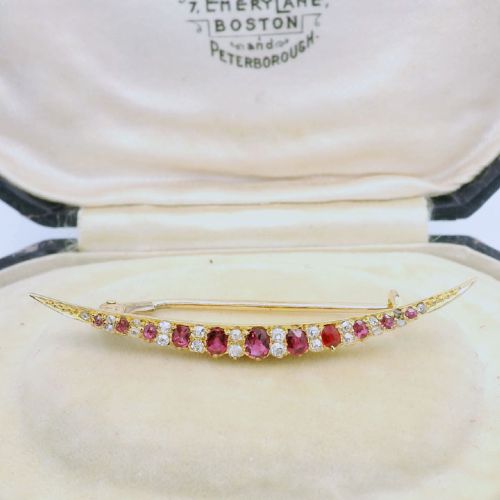


Victorian Moon Crescent Brooch
A victorian moon crescent brooch captures celestial romance in precious gold and gleaming gemstones.
Victorian Moon Crescent Brooch
A victorian moon crescent brooch takes the form of a celestial curve, often symbolising growth, change or female empowerment during the nineteenth century. These dress ornaments frequently combine the curved lunar motif with feathered birds, stellar elements or floral accents.
Most examples encountered here originate from the Victorian and Edwardian eras, spanning the late nineteenth century into the early decades of the twentieth. Makers rendered these pieces in varying sizes, ranging from small bar pins to substantial statement pieces set with precious stones.
How they were made
Goldsmiths utilised lower and higher karat yellow gold alongside silver and platinum settings to house the stones securely. Metalwork techniques included chased detailing, wirework and hollow or solid casting to shape the curved crescent profile.
Gemstones such as rubies, sapphires, diamonds, turquoise and pearls were meticulously flush-set, claw-set or mounted in closed-back collets. Seed pearls were often individually strung or pegged, while paste stones provided accessible brilliance in silver mounts.
Listings feature periods from the Victorian and Edwardian eras, spanning dates from eighteen eighty to nineteen ten.
What varies in quality
The choice of materials dictates much of the distinction, separating pieces set with fine natural rubies, sapphires and diamonds from those utilising seed pearls, turquoise or glass paste. Gold purity also ranges across different standards, from nine karat up to fifteen and eighteen karat alloys.
Construction finesse defines the finer examples, evident in the snugness of stone settings, the delicacy of proportional graduation along the crescent curve and the structural integrity of the pin mechanism. Superior workshops achieved balanced weight and refined finishing on the reverse.
The Victorian Moon Crescent Brooch Glossary
- Crescent brooch
- A curved ornament shaped like a waxing or waning moon. These jewels gained immense popularity for day and evening wear during the nineteenth century.
- Seed pearl
- A very small natural or cultured pearl, often undrilled or half-drilled and glued onto pins. Jewellers clustered them tightly to create luminous surfaces on crescent motifs.
- Paste
- Hand-cut and polished lead glass designed to imitate gemstones. Paste was widely utilised in antique jewellery for vibrant colour and sparkle.
- Bar brooch
- A slender metal pin featuring a decorative element centred along a straight shaft. Many moon crescent designs incorporate this configuration for secure fastening.
- Collet
- A small band or collar of metal that holds a gemstone in place. This setting style typifies nineteenth-century manufacturing methods.
Victorian Moon Crescent Brooch: Frequently Asked Questions
How do I wear a crescent brooch safely?
Fasten the pin securely through sturdy fabrics rather than delicate silks to prevent tearing.
Utilise a brooch converter if you wish to suspend the piece from a chain as a pendant.
Are these brooches made from solid gold?
Many examples are fashioned from solid nine, fifteen or eighteen karat yellow gold.
Some silver and paste pieces utilise alternative metal compositions typical of the period.
How do I distinguish Victorian from Edwardian pieces?
Victorian examples tend to display heavier gold weights and rich ornamentation.
Edwardian pieces often introduce platinum and lighter, airier gemstone arrangements.
Did these brooches originally include other motifs?
Makers frequently paired the moon crescent with stars, swallows or floral sprays.
These combined symbols held specific sentimental meanings during the nineteenth century.