
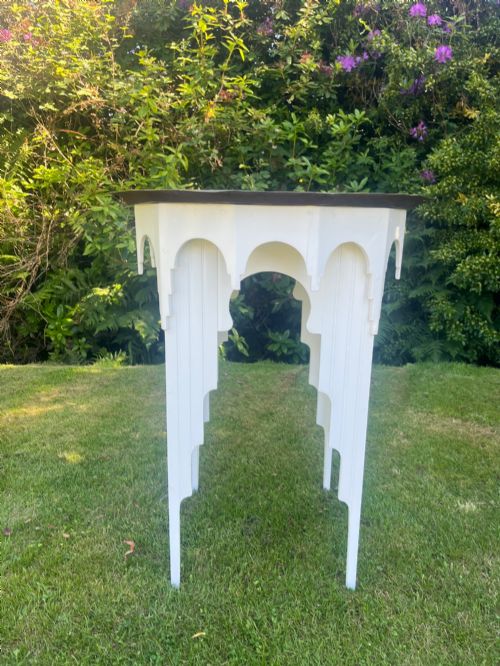


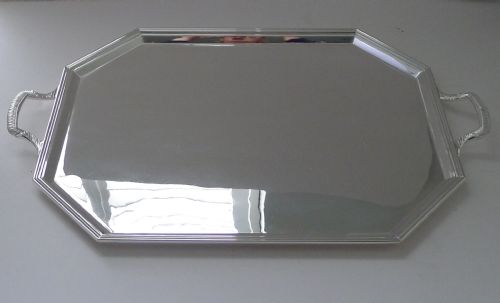


Antique Octagonal Tea Tray
An antique octagonal tea tray brings eight-sided geometry and practical hospitality together, offering a distinct alternative to standard round or oval serving pieces.
Antique Octagonal Tea Tray
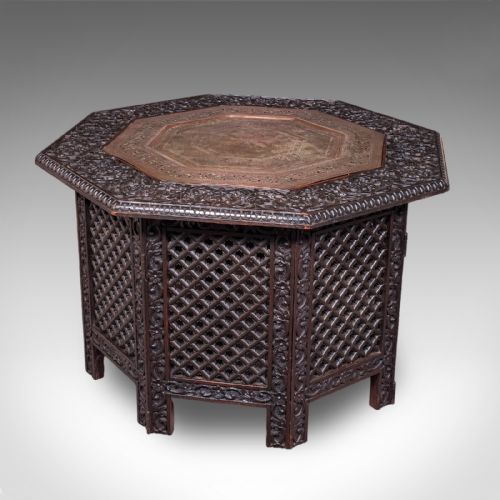
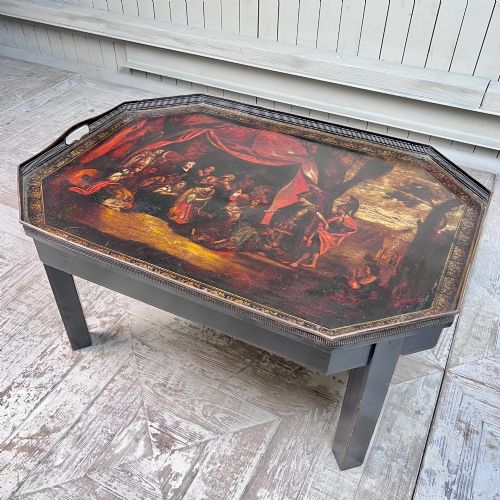
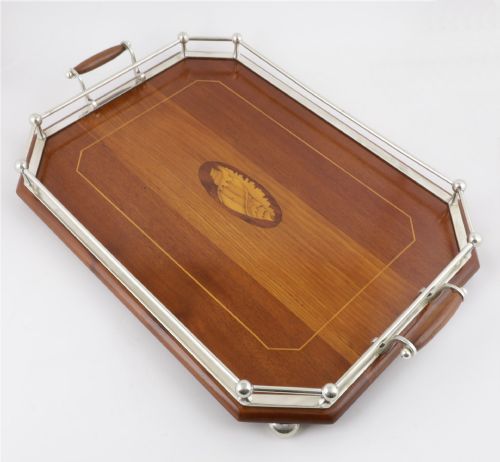
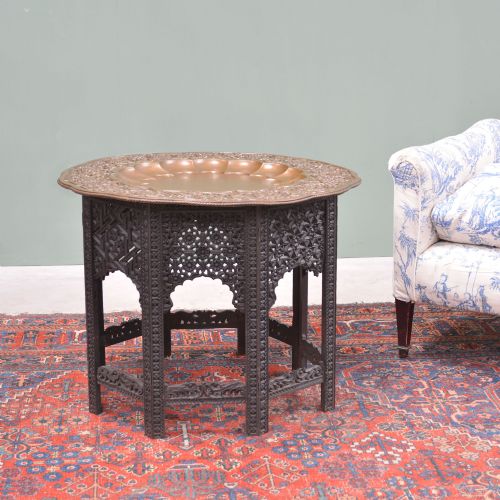
An antique octagonal tea tray appears in materials ranging from painted toleware and papier-mâché to silver plate with wood, mahogany, brass, and copper. These eight-sided vessels serve drinks or rest upon folding bases to form occasional tables.
The pieces on this page span several periods, including Georgian examples alongside 19th-century works, Victorian pieces, and designs from the 1900s through the 1930s. Styles stretch from Regency and Sheraton Revival to Anglo-Indian, Moorish Revival, and Art Deco.
Serving trays share space here with occasional tables, coffee tables, side tables, and tiered stands that utilise the same octagonal top format. You find both straightforward handled trays and complex multi-part table assemblies.
How they were made
Wood construction involves mahogany, sometimes combined with shell inlay or raised galleries, while metal examples utilise silver plate, brass, and copper. Papier-mâché and painted toleware provide smooth surfaces for detailed pictorial or decorative schemes.
Specialist techniques include Anglo-Indian carving from places such as Hoshiarpur, reticulated metalwork, and applied shell details. Makers shape these eight-sided forms to function independently as trays or to sit firmly upon folding and fixed wooden stands.
One nineteenth-century tray depicts the family of Darius before Alexander, turning tea service into an ancient historical drama.
What varies in quality
Quality rests upon the crispness of the eight-sided geometry, the integrity of the joins in wood or metal, and the depth of surface decoration. Hand-carved details and inlaid shell elements separate standard production from more ambitious workshop pieces.
The execution of painted surfaces on papier-mâché and toleware dictates the visual success of the piece, alongside the weight and finish of silver plate or copper tops. Maker attribution, seen in marks by firms such as J B Chatterley & Sons or Lee & Wigfull, adds distinct documentary interest.
J B Chatterley & Sons·Lee & Wigfull
The Antique Octagonal Tea Tray Glossary
- Gallery tray
- A tray featuring a raised border or gallery around its edge to secure glasses and teacups during transport. This rail is often pierced or reticulated.
- Toleware
- Metalware, typically iron or steel, that is painted and varnished with decorative motifs. It provides a durable surface often found on Georgian and nineteenth-century trays.
- Papier-mâché
- A composite material made of paper pulp or reinforced paper layers mixed with glue, then moulded and lacquered. It forms light yet strong trays decorated with scarlet or black finishes.
- Reticulated
- Describes metalwork decorated with openwork patterns or pierced designs. This technique lightens the visual weight of silver plate serving trays.
- Hoshiarpur
- A North Indian town known for intricate woodwork and inlay traditions. Tables and trays from this centre feature dense carved wooden ornament.
Antique Octagonal Tea Tray: Frequently Asked Questions
What is an antique octagonal tea tray used for?
These eight-sided pieces function primarily for serving tea or drinks across various formal and domestic settings. Many examples also operate as surface tops for occasional tables when placed upon folding or fixed stands.
The geometric eight-sided shape provides additional corner space compared to round trays, making them practical for arranging multiple cups and teapots.
How do I care for papier-mâché or toleware?
Painted surfaces require dry dusting and protection from excessive moisture or direct heat sources. Avoid using harsh chemical cleaning agents on lacquered or painted finishes to preserve the original decoration.
Gentle wiping with a soft cloth maintains the polish on nineteenth-century surfaces without disturbing the underlying material.
Are these trays sturdy enough for daily use?
Solid wood and heavy metal plate examples handle regular service well when handled with reasonable care. Lighter papier-mâché and painted toleware items suit lighter duties or display purposes rather than heavy daily service.
Checking the stability of gallery rails and corner joints helps determine the practical capacity of each individual piece.
How do I identify the period of a tray?
Georgian and Regency pieces often employ papier-mâché or painted toleware with classical motifs, whereas nineteenth-century works introduce elaborate galleries and shell inlay. Pieces from 1900 to 1930 span Anglo-Indian carved wood, Moorish details, and marked silver plate.
Maker marks, screw types, and construction methods offer further clues to the exact manufacturing decade.