


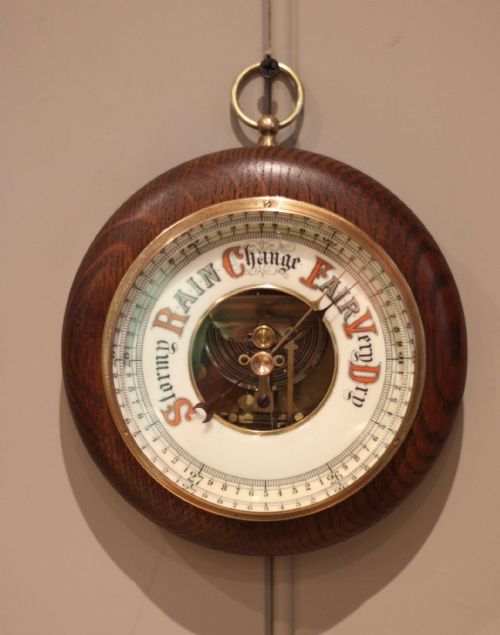


Antique Nautical Barometer
These antique nautical barometers are practical marine instruments housed in timber and brass, offering both coastal character and functional atmospheric tracking for the home.
Antique Nautical Barometer
When you search for an antique nautical barometer, you encounter marine instruments designed to measure atmospheric pressure at sea or within coastal properties. The selection on this page spans the Victorian, Edwardian, and Georgian periods, alongside pieces from the 19th and early 20th centuries.
The most common forms appearing here include marine stick barometers, banjo clock barometers, circular aneroid examples, and specialised types such as the barocyclonometer or hypsometer. These pieces originate from British workshops and makers, utilising traditional maritime designs intended for wall mounting or shipboard use.
Materials range from figured woods like oak, mahogany, rosewood, and walnut to polished brass, chrome, and glass dials with enamel scales. Whether you seek a simple ships barometer or a complex scientific travelling instrument, the core design remains rooted in maritime utility.
Materials and construction methods
Cabinetmakers and instrument makers constructed these bodies using dense hardwoods such as mahogany, rosewood, oak, and walnut, often featuring carved details or circular wooden housings. These timbers were selected to withstand marine environments while providing a stable frame for delicate internal mechanisms.
Dials and indicators combine brass bezels, silvered or white enamel scales, and protective glass covers to record barometric pressure accurately. Makers integrated precision engineering for mercury tubes or aneroid capsules, housing them securely within wall-hung cases or bulkhead mountings.
The selections here include instruments utilising brass, glass, oak, mahogany, rosewood, walnut, enamel, and wood across Victorian, Edwardian, and Georgian periods.
Distinguishing quality in marine barometers
Quality in an antique nautical barometer rests on the precision of its movement and the execution of its housing. Instruments signed by notable makers demonstrate superior calibration and finer mechanical execution in their mercury tubes or aneroid mechanisms.
The choice of cabinet timber and the crispness of the carving dictate visual merit. Solid rosewood, figured walnut, and detailed oak cases with intact glass and clear enamel dials represent the higher tiers of surviving examples.
Elliott Brothers·Bate of London·Negretti & Zambra·James Murray·Gowland London
The Antique Nautical Barometer Glossary
- Aneroid barometer
- An instrument that measures air pressure without liquid, using a small flexible metal box called an aneroid cell. This capsule expands or contracts with pressure changes, moving the indicator needle on the dial.
- Marine stick barometer
- A vertical mercury barometer designed for use at sea, typically featuring a Gimbal mounting or restricted bore tube to prevent the mercury column from breaking under motion. These are often housed in slender mahogany or rosewood cases.
- Bulkhead clock and barometer
- Matching timekeeping and atmospheric instruments set into heavy brass or chrome housings meant to be screwed directly to the interior wall of a ship's cabin. They offer a distinct maritime aesthetic.
- Hypsometer
- A specialised scientific instrument used to calculate atmospheric pressure and altitude by measuring the boiling point of a liquid. It represents a more complex variation of meteorological equipment.
- Barocyclonometer
- An advanced meteorological instrument designed in the early twentieth century to track tropical cyclones and typhoons by monitoring rapid barometric fluctuations. These are uncommon precision items.
Antique Nautical Barometer: Frequently Asked Questions
How do I mount an antique nautical barometer?
Most wall-hung barometers feature a secure hanging bracket or brass eyelet at the top of the timber case, designed to be fastened firmly to a wall stud using an appropriate screw.
Ensure the instrument hangs completely plumb, particularly for stick barometers containing mercury columns, so the indicator functions accurately without binding against the glass or scale.
Were these barometers actually used on ships?
Many examples on this page, including marine stick barometers, ships barometers, and bulkhead pairs, were built specifically for maritime service aboard vessels to assist with navigation and weather forecasting.
Others, such as domestic banjo barometers and circular aneroid models, were designed for coastal homes and maritime offices, adopting the aesthetic of the sea for interior decoration.
How do I set and read the dial?
You read an aneroid or clock barometer by tapping the glass lightly with your finger, which settles the internal mechanism, then observing whether the black needle points toward rain, change, or fair.
Many barometers include a manual brass setting pointer that you align over the current reading so you can track whether atmospheric pressure rises or falls over the course of the day.
How do I tell Victorian barometers apart from Edwardian ones?
Victorian barometers often feature rich, heavily carved rosewood, walnut, or oak cases with ornate architectural details, reflecting the diverse stylistic revivals of the nineteenth century.
Edwardian and later pieces tend to favour simpler circular wooden frames, cleaner lines, and more restrained decoration, aligning with early twentieth-century domestic design preferences.