
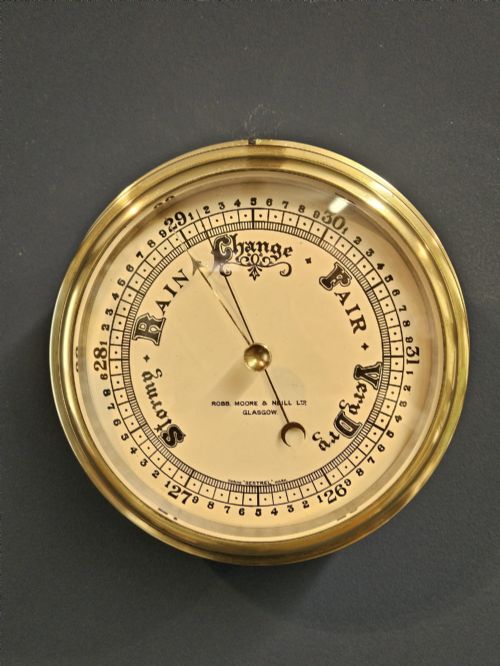


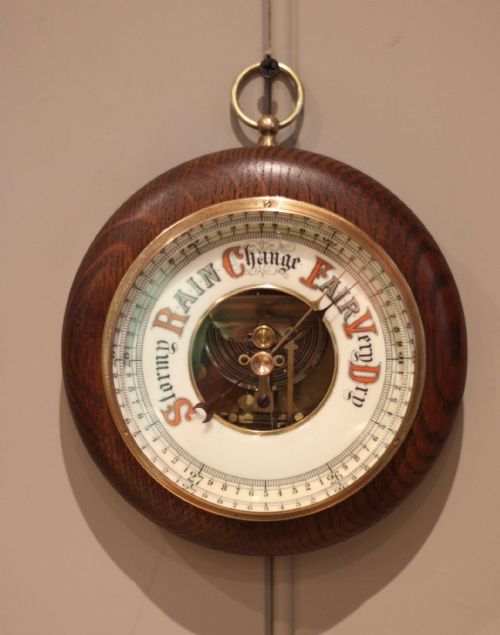


Nautical Wall Barometer
A nautical wall barometer brings practical maritime heritage into a room, measuring atmospheric pressure with the same precision once relied upon at sea.
Nautical Wall Barometer
A nautical wall barometer is an instrument designed to measure atmospheric pressure, taking forms ranging from stick barometers to banjo and ships aneroid designs. Buyers searching this phrase encounter pieces dating from the Victorian and Edwardian eras, alongside Georgian and Regency examples.
The most common versions met on this page are Victorian carved oak and walnut banjo clock barometers, and traditional marine stick barometers. These objects reflect Britain's maritime history, housed in timber cases intended to be mounted securely on a wall.
How they were made
Makers constructed these instruments using dense timbers such as oak, mahogany, rosewood, and walnut, often carving the cases with decorative detail. Glass protects the dial face, while internal components utilise brass and bone elements.
Enamel dials feature crisp lettering and numerals to record barometric changes clearly. Metal components like chrome appear in later twentieth-century bulkhead pairings.
Listings span the nineteenth and early twentieth centuries, featuring Victorian, Edwardian, and Georgian periods.
What varies in quality
Quality separates simple utility pieces from finer examples through the choice of timber and the depth of case carving. Richly grained rosewood and walnut, paired with crisp bone scales and signed brass plates, mark out superior specimens.
The sophistication of the movement and the legibility of the enamel dial dictate the upper tier of the range. Maker signatures, such as those by London firms, elevate an instrument beyond standard anonymous workshop production.
Elliott Brothers·Bate of London·Gowland London
The Nautical Wall Barometer Glossary
- Aneroid barometer
- An instrument that measures air pressure without liquid, using a flexible metal box that expands or contracts. This mechanical design allowed barometers to be adapted into compact banjo and wall-mounted ship formats.
- Stick barometer
- A tall, vertical instrument containing a glass tube filled with mercury to measure atmospheric pressure. These typically feature exposed scales and verniers for precise reading.
- Banjo barometer
- A wall barometer housed in a distinctive curved wooden case shaped like a banjo. They frequently incorporate thermometer scales and hygrometers alongside the main dial.
- Bulkhead
- A retaining wall within a ship, which gave its name to instruments designed to be mounted flush against cabin walls. These often match clocks in identical metal housings.
Nautical Wall Barometer: Frequently Asked Questions
How do I read a stick barometer?
A stick barometer is read by observing the height of the mercury column against the scale, noting whether it rises or falls.
Matching the vernier scale allows precise measurement of pressure changes over the course of a day.
Where should I hang a wall barometer?
Wall barometers should be hung on interior walls away from direct sunlight, radiators, and heavy draughts.
Stable ambient temperatures ensure the internal metal components or mercury columns respond accurately to genuine barometric shifts.
What is the difference between aneroid and mercury barometers?
Aneroid barometers use a sealed metal vacuum capsule that moves a pointer via levers, requiring no liquid.
Mercury stick barometers rely on a column of liquid metal balancing against atmospheric pressure in a glass tube.
How do I date a Victorian barometer?
Dating relies on the style of the timber case, the typography on the enamel dial, and construction methods.
Makers' signatures or registration marks stamped onto the brass backplate provide specific chronological markers.