


Antique Music Canterbury Castors
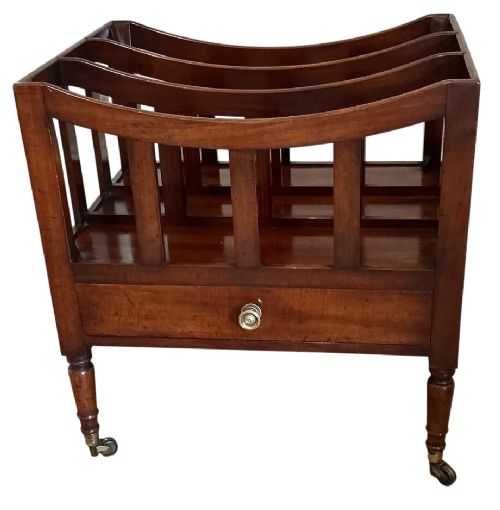
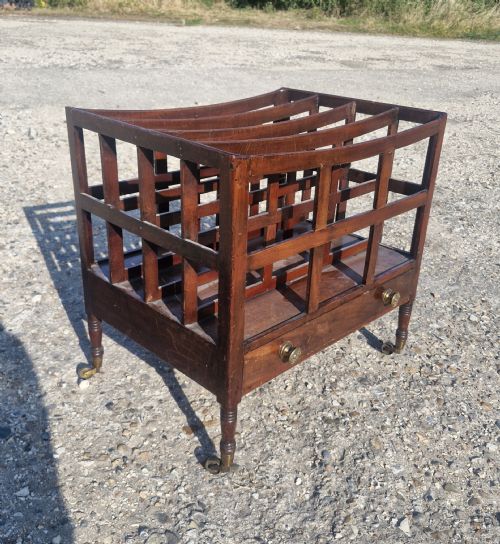
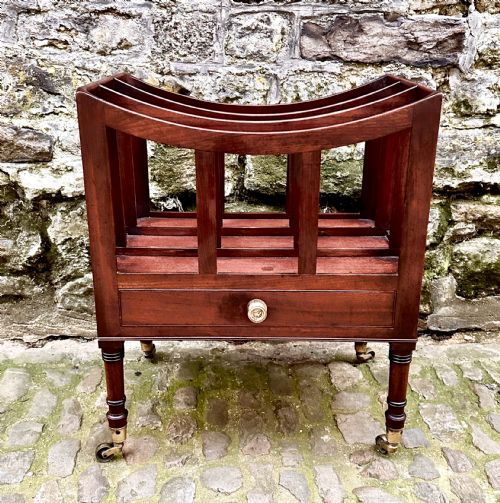
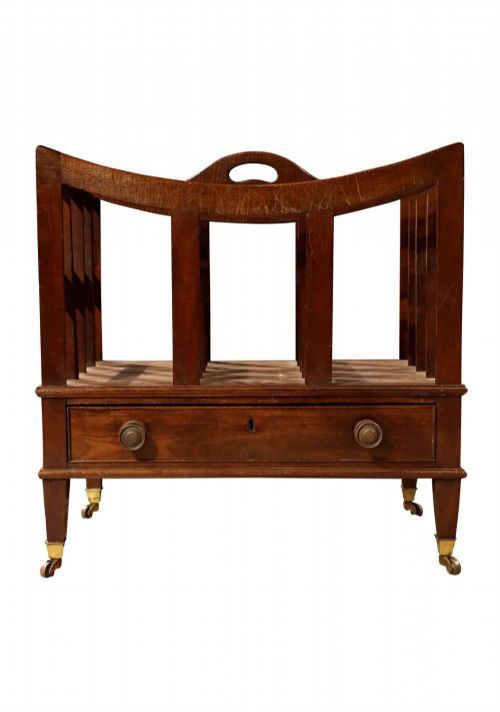
These antique music canterbury castors combine compartmentalised timber frames with mobile supports, offering a practical solution for storing sheet media.
Antique Music Canterbury Castors
An antique music canterbury castors search brings up low wooden storage stands designed to hold sheet music, folios, newspapers and magazines. These pieces commonly date from the Georgian, Regency, William IV, Victorian and Edwardian periods.
The dominant forms on this page include boat-shaped designs, multi-division racks, and models combined with drawers or lower shelves. Woods such as mahogany, rosewood, walnut and burr walnut form the primary structures seen in the listings.
Construction and Materials
Cabinet makers constructed these stands using solid timbers and veneers of mahogany, rosewood, walnut and burr walnut. Details such as marquetry inlay, ebony banding, wreath carving and ebonised finishes appear across the selection.
Lower supports integrate brass castors to allow smooth movement across floor surfaces. Slatted divisions divide the upper sections to keep folios upright and organised.
Some oversized country house examples double as folio stands for sheets wider than the typical music cabinet.
Quality Variations
Differences in quality depend upon the selection of timber grain, such as figured mahogany or burr walnut, and the precision of decorative elements like marquetry inlay or ebony banding. Architectural proportions and crispness in carved details separate standard utility pieces from finer examples.
The inclusion of practical additions, such as fitted drawers, turned legs, or folio stand dimensions, influences the character of each piece. Superior execution is visible in the joinery of the vertical divisions and the stability of the wheel mounts.
Gillows of Lancaster·J.C.Loudon
The Antique Music Canterbury Castors Glossary
- Canterbury
- A low stand with upright divisions, originally designed for holding sheet music or loose papers. Later examples also served as magazine and newspaper racks.
- Castor
- A small wheel fitted to the legs of furniture to allow easy rolling across floors. These are frequently made of brass on the pieces listed here.
- Boat Shaped
- A curved outline given to the upper tiers of certain Regency pieces. This profile tapers smoothly towards the ends.
- Folio Stand
- A large storage frame intended for oversized sheets of paper or bound volumes. Several oversized examples function similarly to large canterburys.
- Marquetry Inlay
- Decorative patterns formed by fitting contrasting pieces of wood veneer into a prepared surface. This technique appears on Victorian walnut items.
Antique Music Canterbury Castors: Frequently Asked Questions
What is a music canterbury used for?
These stands hold sheet music, folios, magazines, and newspapers in vertical compartments.
Their open divisions allow quick access to scores while keeping papers organised near a piano or seating area.
How do I identify a Regency canterbury?
Regency pieces often feature boat-shaped frames, mahogany or rosewood timbers, and turned legs fitted with brass castors.
Many date from around eighteen-twenty and display clean structural lines without heavy Victorian ornamentation.
Are all canterburys made of mahogany?
While mahogany is common across Georgian and Regency examples, other woods appear frequently.
Listings also include rosewood, walnut, burr walnut, and ebonised mahogany from the Victorian era.
What is the difference between a canterbury and a magazine rack?
The terms often overlap because both describe compartmentalised wooden stands on castors.
Earlier pieces were designed specifically for sheet music, whereas later Victorian and Edwardian iterations frequently functioned as newspaper and magazine racks.