

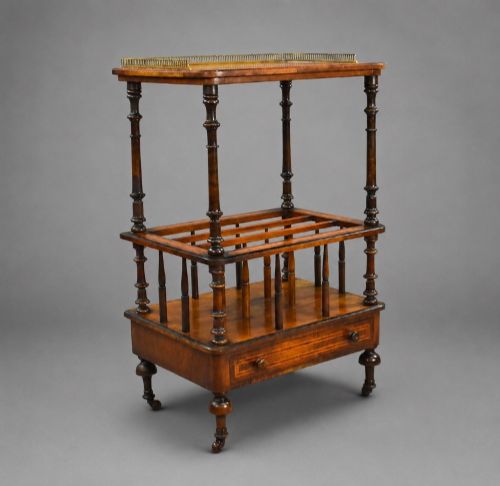


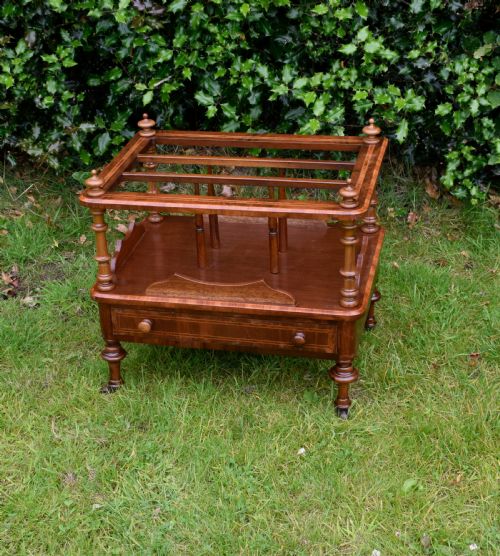


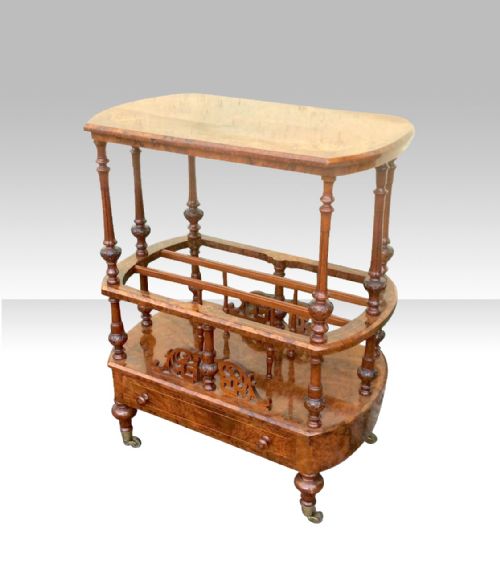
Inlaid Walnut Sheet Music Rack
Burr walnut and marquetry inlaid sheet music racks are practical Victorian folio stands that bring warmth and organised charm to a music room or sitting area.
Inlaid Walnut Sheet Music Rack
An inlaid walnut sheet music rack is typically encountered as a Victorian Canterbury, music stand, or tiered whatnot designed to hold folios and scores off the floor. These nineteenth-century pieces combine compartmented sections for paper with turned supports, lower drawers, and occasional table surfaces.
The examples gathered here date primarily from the nineteenth century, spanning the eighteen-sixties and eighteen-seventies under Victorian manufacture. Most take the form of a freestanding Canterbury or magazine rack constructed to stand beside a piano or seating group.
How they were made
Maker's hands built these stands using solid and veneered walnut, frequently selecting highly figured burr walnut for the primary display surfaces. Fretwork carving, boxwood stringing, and detailed marquetry inlay ornament the panels and divisions.
Structural elements incorporate contrasting ebony details, brass castors for mobility, and secondary woods like mahogany or pine for interior framing and drawer construction. Turned pillars and ceramic castors often support the lower tiers.
Inlaid Walnut Sheet Music Rack Retail Price Guide 2026
Typical asking prices for inlaid walnut sheet music rack among the pieces listed under this phrase on Sellingantiques today, from the lower quarter to the upper quarter. They describe what is for sale here now, not the wider market.
Current items span the Victorian era, utilising burr walnut, boxwood, marquetry inlay, and brass hardware.
What varies in quality
The distinction between standard production and finer pieces lies in the choice of burr veneer and the precision of the marquetry and boxwood inlay. Rich figuring across the walnut surfaces and crisp fretwork denote superior workshop execution.
Proportion and utility also separate examples, with heavier pieces incorporating fitted drawers, multiple tiers, and finely turned corner columns rather than simpler partitions.
The Inlaid Walnut Sheet Music Rack Glossary
- Canterbury
- A low stand with upright divisions, originally designed for holding sheet music or portfolios. Victorian examples frequently combine this function with a lower drawer or table top.
- Burr walnut
- A wood veneer showing twisted, knotted growths that create intricate natural patterns. Cabinet makers prized this timber for decorative top panels.
- Marquetry inlay
- The art of fitting decorative wood veneers into a contrasting background to form patterns. Boxwood and darker timbers are often used for this detail.
- Whatnot
- A piece of open shelving supported on pillars, used for displaying or storing small objects. These often merge with music stands in nineteenth-century workshops.
Inlaid Walnut Sheet Music Rack: Frequently Asked Questions
What is a music Canterbury?
A music Canterbury is a dedicated nineteenth-century rack featuring vertical partitions designed to keep sheet music upright and sorted. They emerged during the Victorian era as essential furniture for domestic piano rooms.
Many versions also include a shallow drawer beneath the partitions and small castors on the feet for easy movement across carpets.
How are these racks dated?
Dating relies on construction methods, timber choices, and stylistic traits associated with the nineteenth century. Victorian pieces often display characteristic turnings and marquetry work typical of the eighteen-sixties and eighteen-seventies.
Secondary woods and the presence of ceramic castors or brass hardware provide further clues to the manufacturing decade.
Where should I place one?
These stands suit sitting rooms, studies, or music corners where their compartments can hold contemporary magazines, books, or art folios. The top surface of a table-form Canterbury also functions as an end table next to a sofa.
Keeping them away from direct heat sources protects the walnut veneer and delicate wood inlay from drying out.
What distinguishes burr walnut?
Burr walnut comes from growths on the walnut tree, yielding dense, swirling grain patterns that look entirely different from straight-sawn timber. Nineteenth-century cabinet makers reserved these decorative veneers for the most prominent display surfaces.
Because every burr formation is unique, each piece of furniture finished in this material possesses a completely individual appearance.