
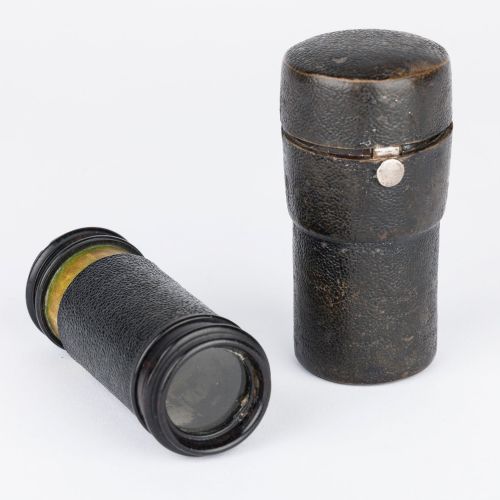


Antique Maritime Telescope
An antique maritime telescope is a brass and leather instrument designed to bring distant horizons into sharp focus at sea.
Antique Maritime Telescope
When you search for an antique maritime telescope, you encounter navigational instruments that span the Georgian, Regency, Victorian, and Edwardian periods. These pieces include pocket spyglasses, single-draw marine tubes, and multi-draw terrestrial scopes used by officers on watch.
You are most likely to meet Victorian and Edwardian examples on this page, often formed with multiple sliding brass draws and leather or wood grips. Many of these instruments bear the signatures of notable London makers along their final barrel sections.
The selection ranges from compact pocket models suited for land observation to substantial naval telescopes built for use upon the deck of a ship. Each piece reflects the optical technology and craftsmanship of its specific decade of production.
How they were made
Maker workshops constructed the barrels primarily from polished brass, turning the metal on lathes to ensure each draw tube slid smoothly within the next. Optical lenses of glass gathered and magnified light, housed carefully at either end of the brass cylinders.
Many outer tubes feature coverings of stitched leather, mahogany, or walnut, which provided a secure grip and protected the metal beneath during handling at sea. Cardboard liners occasionally sat within the brass draws to maintain proper alignment of the sliding sections.
Some nineteenth century officers relied on day or night lenses to peer through sea fog when standard glass simply showed a blank wall of grey.
What varies in quality
The distinction between ordinary utility pieces and the finest work lies in the clarity of the glass optics and the precision of the brass machining. Signed examples by renowned makers demonstrate superior attention to detail in their engraved barrel inscriptions and lens fittings.
The choice of materials also marks the tier of the instrument, with finely figured walnut or mahogany and well-stitched leather dressings separating luxury presentation pieces from standard military issue equipment.
Ross of London·Voigtländer and Sohn AG·W and T Gilbert·Clarkson London·Newton and Co·Broadhurst Clarkson and Co·Cary London·L Casella London·Davis of London·John Gilbert·W Harris·J Sewill
The Antique Maritime Telescope Glossary
- Draw
- A sliding brass tube that extends to lengthen the telescope. Multiple draws allow a long focal length to collapse into a compact pocket size.
- Spyglass
- A small, portable refracting telescope used for quick observations. These handheld instruments were popular for both terrestrial and marine use.
- Achromatic
- An optical lens designed to reduce chromatic and spherical aberration. This correction produces clearer images with truer colour separation.
- Day or night
- A specialised telescope configuration featuring larger objective lenses to gather more light. This design permitted use in low light conditions at dawn or dusk.
Antique Maritime Telescope: Frequently Asked Questions
How do I use a draw telescope?
Grip the main body firmly and pull each brass section outward until fully extended. Adjust the smallest eyepiece draw back and forth until the distant view comes into sharp focus.
Keep the lenses clean and store the instrument in a collapsed position to protect the interior tubes from dust and knocks.
What is the difference between a spyglass and a marine telescope?
A spyglass generally refers to a smaller, portable handheld instrument designed for quick reconnaissance. Marine telescopes are often larger multi-draw instruments built specifically for naval and deck use.
Both types rely on brass and glass construction, but marine versions frequently include protective leather or wood casing to withstand harsh sea air.
How can I date an antique telescope?
Examine the barrel inscriptions for maker signatures and address details that correspond to known working dates. The number of draws, the materials used, and the style of the lettering provide further clues to the decade of manufacture.
Victorian and Edwardian models often feature mechanical improvements and maker marks that help narrow down their exact period.
How do I care for brass and leather telescope bodies?
Wipe the brass gently with a soft cloth to maintain its finish without removing desirable historic patina. Treat leather grips sparingly with appropriate conservation dressings to prevent them from drying out.
Avoid using harsh chemical polishes on signed barrel engravings, as these can wear away the maker details over time.