

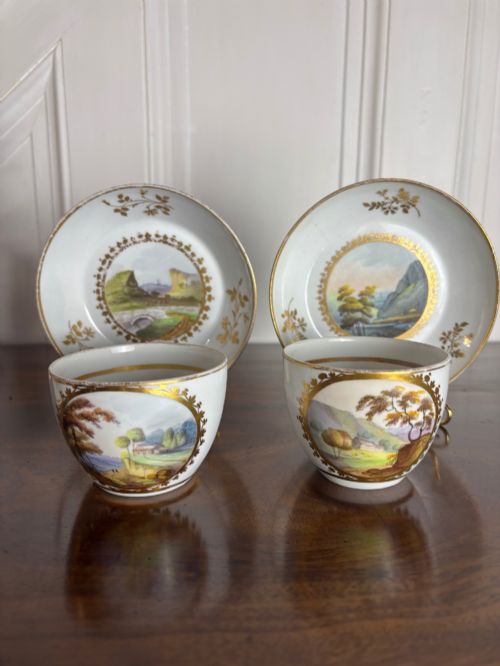


Antique Landscape Porcelain Cups
Antique landscape porcelain cups bring painted vistas to the table, offering miniature views of the countryside on fine ceramic forms.
Antique Landscape Porcelain Cups
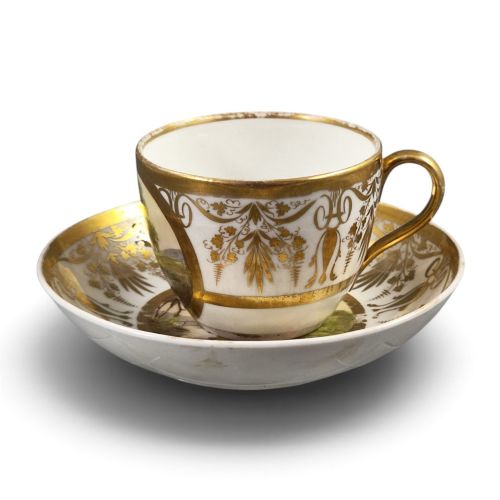
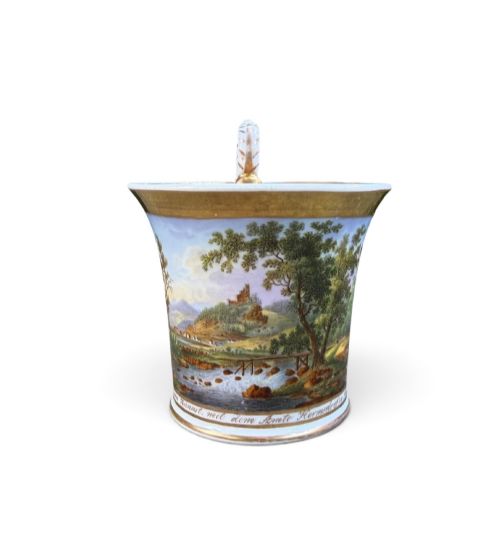
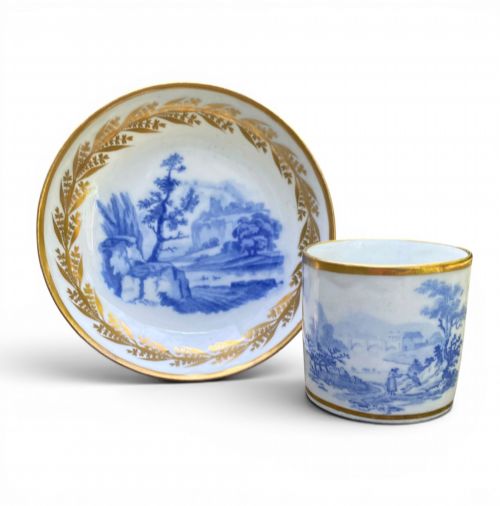
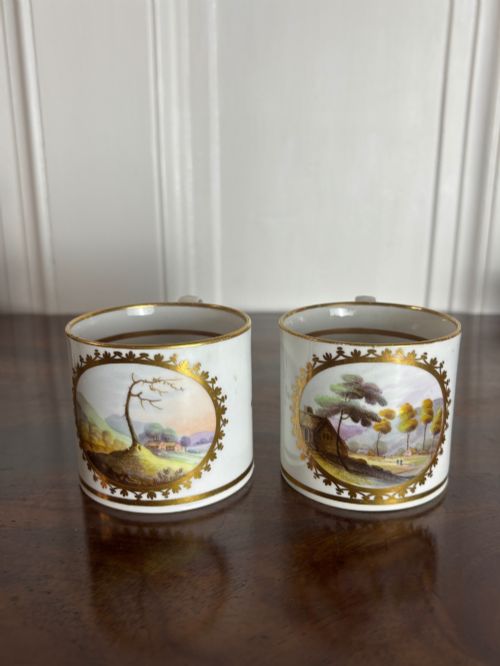
These antique landscape porcelain cups span tea and coffee vessels produced across the eighteenth and nineteenth centuries. The selection encompasses cabinet cups, coffee cans, porter mugs, and matching saucers decorated with topographical scenes and rural views.
Makers from various European centres employ styles ranging from Georgian and Regency to Biedermeier and Victorian. Forms include individual cabinet pieces alongside elements from larger tea services and dessert sets.
Buyers encounter Meissen, Berlin, and English factories such as Worcester, New Hall, Minton, and Derby within the available selection. Hand-painted scenery forms the unifying characteristic across these diverse regional outputs.
How they were made
Potters shape hard-paste porcelain and bone china into cups, cans, and mugs before applying enamel paints by hand. Artists render landscapes with fine brushwork, capturing architectural details and natural scenery within framed panels or across the vessel body.
Gilding and gold leaf accent rims, handles, and borders to frame the central painted views. Subsequent firing fixes both the polychrome enamel pigments and the gold highlights to the ceramic body.
Materials across these listings include porcelain, bone china, hard-paste porcelain, enamel, gold leaf, paint, gilding, and ceramic.
What varies in quality
The precision and detail of the hand-painted landscape dictate the visual calibre of each piece. Skilled artists achieve depth and botanical accuracy in rural views, whereas simpler output relies on stylised foliage.
The crispness of the porcelain body and the richness of the gilding separate standard production from finer cabinet pieces. Preservation of the enamel colours and intact gold leaf across handles and rims determine the condition standard.
KPM Berlin·Flight & Barr Worcester·New Hall·Minton·Derby Porcelain·Meissen·Hicks, Meigh & Johnson·Ridgeway
The Antique Landscape Porcelain Cups Glossary
- Cabinet cup
- A decorative cup and saucer intended for display rather than daily use, often featuring superior painted decoration. These pieces frequently rest on dedicated stands or within glass-fronted furniture.
- Coffee can
- A small, straight-sided cylindrical cup designed for drinking strong coffee during the Georgian and Regency periods. They lack the curved bowl shape of standard tea bowls.
- Porter mug
- A larger drinking vessel with a sturdy handle, suited for malt liquor or substantial quantities of tea. Examples feature wide cylindrical bodies that provide a large canvas for landscape paintings.
- Hard-paste porcelain
- A vitrified ceramic composed of kaolin and petuntse, fired at high temperatures to create a dense, durable body. It resists scratching and possesses a cold, hard translucency.
- Topographical
- A style of painting that depicts specific, recognisable geographical locations and real views rather than imagined fantasies. These scenes often record actual country houses, towns, or rural landmarks.
Antique Landscape Porcelain Cups: Frequently Asked Questions
What is a coffee can?
A coffee can is a cylindrical cup without a foot ring, made to hold strong coffee during the Georgian era.
They pair with matching saucers and often display detailed painted scenes on the exterior wall.
Were these cups used for tea?
Certain pieces function as teacups, while others serve as cabinet cups meant purely for display in a cabinet.
Form varies from handleless tea bowls to large porter mugs and specialised dessert set components.
How do I identify a Meissen piece?
Meissen pieces originate from the German factory and often feature hand-painted scenes from the mid-eighteenth century.
Examinations of the ceramic body and painting style help distinguish them from English equivalents.
What periods do these cups cover?
The available pieces span the Georgian, Regency, Biedermeier, Victorian, and Edwardian eras.
Manufacturing dates range from the mid-eighteenth century through to the early twentieth century.
Are saucers always included?
Many listings offer cups paired with their original matching saucers, particularly cabinet cups and coffee cans.
Some larger items, such as porter mugs or loving cups, exist as standalone vessels without saucers.