
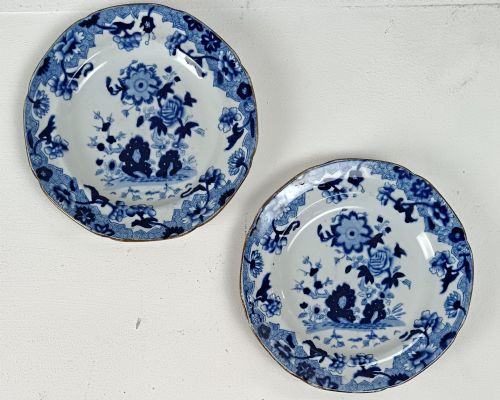


Antique Ironstone Tableware
These pieces of antique ironstone tableware offer the robust utility and decorative charm that collectors prize for everyday service.
Antique Ironstone Tableware
When you search for antique ironstone tableware, you encounter sturdy ceramic wares designed for rigorous domestic and institutional dining. The selection spans utilitarian serving vessels and complete sets produced primarily during the nineteenth century.
The objects take many forms, ranging from large soup tureens and meat dishes down to individual tea plates and salts. Most pieces originate from the Georgian, Regency, and Victorian eras, reflecting shifting tastes in surface decoration.
Masons ironstone dominates the selections, alongside unmarked ceramic vessels and wares associated with Spode. Buyers encounter both blue and white transfer-printed designs and vivid polychrome patterns such as Chinoiserie Mandarin and Japan Basket.
How they were made
Potters utilised a dense earthenware body known as ironstone, formulated to resist chipping far better than traditional porcelain or creamware. This heavy ceramic mixture provided a durable foundation for large dinner services, tureens, and heavy meat dishes.
Surface patterns were frequently applied using transfer printing in blue and white, which allowed for intricate landscapes and floral motifs. Artisans then enhanced certain details with enamel colours and gold leaf, particularly on Regency and Victorian table services.
An institutional mess bowl once served Royal Navy officers their daily rations before finding its way to the antique market.
What varies in quality
The distinction between ordinary utility wares and finer cabinet pieces rests largely on the ambition of the decoration and the crispness of the moulding. Elaborate hand-coloured patterns, such as the Green Mandarin or Japan Basket designs, indicate a higher grade of production than simple monochrome transfer prints.
Completeness and scale also govern the hierarchy of these ceramics, as large soup tureens with matching ladles and intact multi-piece dinner services command greater attention than dispersed plates or salts. The preservation of the original glaze and the brightness of any gilt highlights determine the visual impact of the finished object.
Spode·Mason
The Antique Ironstone Tableware Glossary
- Ironstone
- A heavy, durable ceramic body patented in the nineteenth century to imitate porcelain while offering superior strength. It served as the primary material for robust domestic tableware.
- Transfer Print
- A method of decorating ceramics by transferring an engraved ink design from a copper plate onto paper and thence onto the biscuit ware. This technique allowed for consistent replication of intricate landscape and floral scenes.
- Tureen
- A deep, covered vessel designed for serving soup, sauce, or vegetables at the dining table. Many survive with accompanying ladles and matching stands.
- Chinoiserie
- A European artistic style reflecting Chinese motifs and decorative schemes. It appears frequently in nineteenth-century ironstone patterns.
- Gilt
- A thin layer of gold leaf applied to ceramic surfaces for accent decoration. It highlights moulded relief details on plates and serving dishes.
Antique Ironstone Tableware: Frequently Asked Questions
Can I use antique ironstone daily?
These dense ceramic pieces were originally built for heavy dining use and remain quite sturdy for modern service.
Hand washing is generally recommended to preserve any delicate enamel colours or gold leaf accents over time.
How do I date ironstone pieces?
Dating relies on maker stamps, ceramic body characteristics, and the style of the transfer-printed or hand-painted patterns.
Nineteenth-century examples often display specific patent marks or stylistic cues from the Georgian and Victorian periods.
What is the difference between ironstone and porcelain?
Ironstone is a heavy, opaque earthenware developed for durability, whereas traditional porcelain is vitreous and translucent.
This robust ceramic composition allowed makers to produce thick, utilitarian serving dishes and large dinner services.
Why do some tureens include ladles?
Covered vessels were supplied with matching ladles to serve soups and sauces directly at the table during formal meals.
Finding a tureen with its original ladle intact is a notable bonus for collectors assembling traditional table settings.