
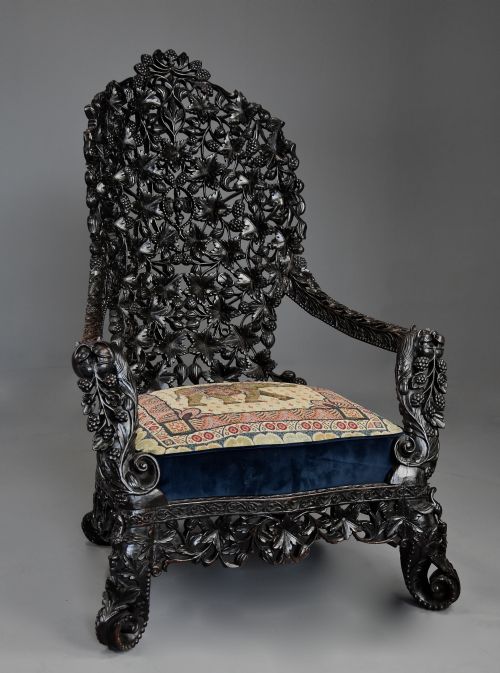
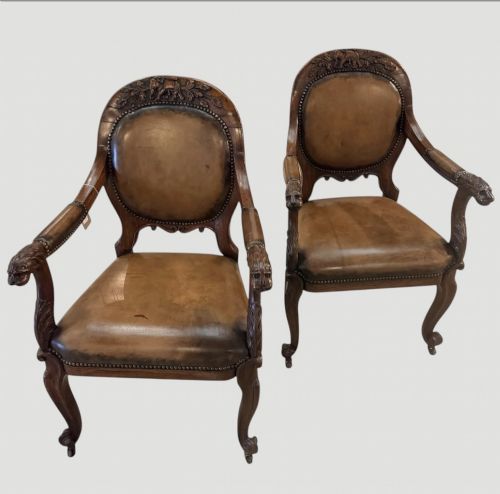


Antique Indian Rosewood Chairs
Antique Indian rosewood chairs combine dense timber with intricate carving, offering collectors striking colonial forms for domestic use.
Antique Indian Rosewood Chairs
When you search for antique indian rosewood chairs, you encounter seating fashioned in styles ranging from Georgian and William IV adaptations to Moorish Revival and distinct Anglo-Indian colonial designs. These forms include armchairs, side chairs, dining chairs, and larger sets or suites suitable for principal rooms.
The pieces appearing on this page span the eighteenth, nineteenth, and early twentieth centuries, capturing a period of notable cross-cultural cabinet making. You are most likely to meet pairs or sets of side and dining chairs, alongside heavier carved armchairs and planters chairs originating from workshops in the Indian subcontinent.
How they were made
Cabinet makers utilised dense tropical timbers, primarily rosewood and padauk, often described broadly in the evidence as hardwood or blackwood. These heavy woods supported deep, elaborate carving work executed by skilled hands.
Seating surfaces integrated natural materials such as cane alongside upholstered pads covered in velvet, leather, or fabric. Detail work occasionally incorporated brass elements to accent the robust wooden frames.
Listings feature pieces spanning the eighteenth, nineteenth, and early twentieth centuries, utilising rosewood, teak, padauk, cane, and leather.
What varies in quality
Quality rests principally on the crispness and depth of the carved ornamentation across the rosewood or hardwood frames. Pieces featuring sharp, well-defined botanical or geometric motifs stand apart from softer, more generalized carving.
The structural integrity of the joints and the preservation of original caning or secondary materials also dictate the standing of an individual chair. Cohesion within matched sets or pairs maintains greater interest than disparate assembled groups.
The Antique Indian Rosewood Chairs Glossary
- Anglo-Indian
- A descriptive term for furniture made in India under British colonial rule, combining European furniture forms with local carving traditions. These pieces frequently employ native timbers like rosewood.
- Planters chair
- A distinctive armchair featuring extended, pivoting arms designed for reclining, commonly associated with colonial verandahs. They often incorporate caned seats and backs for ventilation in warm climates.
- Padauk
- A heavy, durable tropical hardwood with a reddish hue, utilised by colonial makers for structural stability and rich colour. It shares similar working properties with rosewood.
- Caning
- A weaving technique utilising split rattan to create porous, supportive panels for chair seats and backs. This method provided comfort and air circulation in tropical environments.
Antique Indian Rosewood Chairs: Frequently Asked Questions
How do I identify Anglo-Indian rosewood chairs?
These chairs combine British furniture forms, such as Georgian or William IV silhouettes, with dense Indian carving traditions. Examine the timber grain and the depth of the floral or geometric relief work.
Makers frequently utilised rosewood, padauk, or blackwood, resulting in considerable weight compared to domestic European equivalents.
Were these chairs used for dining?
Makers produced specific dining chairs alongside library chairs, elbow chairs, and large armchairs. Sets of dining chairs appear in the evidence, designed for formal colonial households.
Their sturdy hardwood construction ensured they withstood daily use around the dining table.
What is a planters chair?
A planters chair is a specialised armchair featuring remarkably long, flat arms designed to support stretched legs. They originate from the nineteenth century and reflect colonial domestic life.
The extended arms and reclining posture prioritize comfort in warm climates.
How do I care for rosewood and hardwood furniture?
Maintain stable indoor humidity levels to prevent the dense tropical timber from splitting or warping over time. Dust the intricate carvings regularly with a soft, dry cloth.
Avoid placing these chairs near direct heat sources or strong sunlight, which can dry out the wood and fade the finish.