

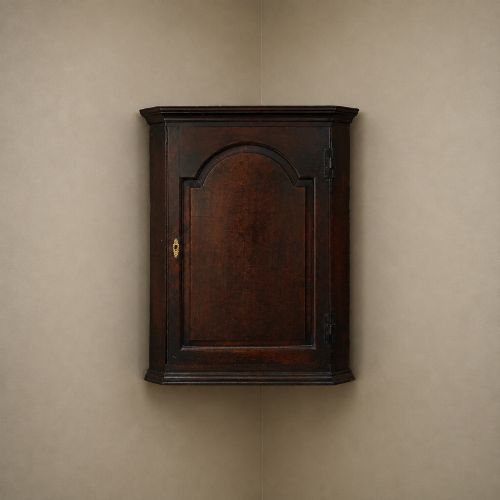


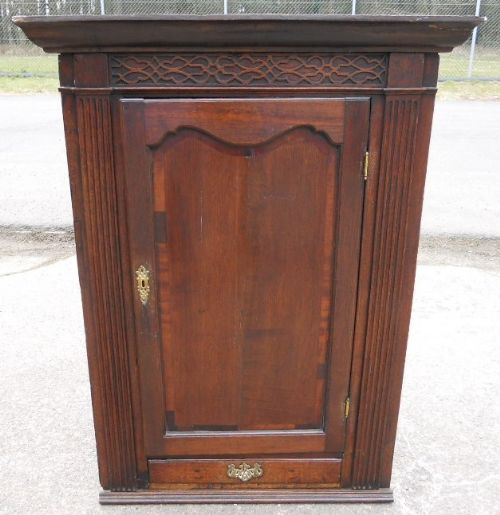


Antique Hanging Wall Locker
An antique hanging wall locker is a practical storage piece designed to secure possessions off the floor, usually rendered in rich oak or mahogany.
Antique Hanging Wall Locker
When you search for an antique hanging wall locker, you are looking at corner cabinets, wall cabinets, and cupboards designed to be mounted above the ground. The examples seen on this page span the Georgian and Victorian periods, alongside earlier 17th and 18th-century pieces originating from England, Wales, and continental Europe.
The most common form you will meet is the oak corner cupboard, often attributed to the Georgian era or the 18th century. These pieces are built to utilise empty room angles efficiently, offering panelled doors and fitted interior shelving while remaining suspended from the wall.
Regional variations appear regularly among these listings, ranging from rustic French Provincial manoir cellars to Welsh workshops. They utilise local timbers such as walnut and oak, occasionally featuring bow fronts or double doors to suit domestic spaces of differing scales.
How they were made
Construction relies heavily on solid timbers, with oak and mahogany dominating the structural framework. Cabinetmakers shaped these woods using traditional joinery methods to build sturdy frames capable of supporting weight while hanging.
Metalwork played a functional role in assembly and operation, incorporating wrought iron and brass for hinges, escutcheons, and latches. These fixtures were secured by hand to timber doors and frames, providing both reinforcement and decorative contrast.
Antique Hanging Wall Locker Retail Price Guide 2026
Typical asking prices for hanging wall locker among the pieces listed under this phrase on Sellingantiques today, from the lower quarter to the upper quarter. They describe what is for sale here now, not the wider market.
Listings span the 17th, 18th, and 19th centuries, incorporating Georgian, Victorian, and French Provincial styles.
What varies in quality
Quality rests in the selection of timber and the precision of the cabinetmaker's joinery. Superior pieces display carefully matched grain patterns on solid panels and doors that close flush without warping.
The sophistication of the timber preparation and the subtlety of mouldings separate standard utilitarian cupboards from finer Georgian and continental Baroque examples.
The Antique Hanging Wall Locker Glossary
- Bow front
- A cabinet front that curves outward in a convex shape. This stylistic choice softens the angles of a room.
- Corner cupboard
- A storage unit built specifically to fit into the internal angle of a room. These units maximise floor space by utilising neglected corners.
- Chippendale Revival
- A later stylistic movement reproducing or drawing inspiration from 18th-century designs associated with Thomas Chippendale. It appears on pieces manufactured during the Victorian period.
- French Provincial
- Furniture styles originating from the rural regions of France during the 18th and 19th centuries. These items prioritise sturdy construction and simpler ornamentation over courtly extravagance.
Antique Hanging Wall Locker: Frequently Asked Questions
Where were antique hanging wall lockers used?
These lockers and cupboards were traditionally hung in domestic rooms, kitchens, or cellars to store provisions, tableware, or valuables safely away from damp floors and pests.
Because they attach directly to the wall, they freed up valuable floor space in smaller period homes and utilitarian spaces.
How do I hang a heavy antique cupboard safely?
Hanging period cupboards safely requires locating structural wall studs or using heavy-duty fixings appropriate for solid masonry walls. The weight of solid oak and mahogany demands professional assessment of the wall substrate.
Distributing the load securely prevents the antique mounting points from failing under the mass of the timber.
Are most of these cupboards made of oak?
Oak is indeed the predominant timber found across these listings, spanning multiple centuries and regional workshops. Cabinetmakers valued it for its strength and availability.
Mahogany and walnut also appear in specific Georgian and continental pieces, offering darker tones and finer grain patterns.
How can I tell a Georgian piece from a Victorian revival?
Georgian pieces date from the 18th and early 19th centuries, displaying construction methods and timber ageing typical of that era. They reflect the primary design periods of their actual manufacture.
Victorian pieces labelled as Chippendale Revival date from the later 19th century while mimicking earlier aesthetic traditions through deliberate stylistic choice.