






Antique Green Barware
Antique green barware brings together tactile drinking vessels and serving pieces in rich jade and forest tones, offering both striking display and genuine period character.
Antique Green Barware
When you search for antique green barware, you encounter a diverse collection of drinking vessels and serving equipment spanning the nineteenth century through the art deco period. These pieces encompass decanters, cocktail shakers, champagne coupes, and wine coolers designed to elevate home entertaining.
The selection ranges from Victorian spirit flagons and flash-cut hock decanters to twentieth-century cocktail accessories featuring vibrant glass, silver plate, and pewter mountings. You frequently meet pieces created in distinct regional styles, from English arts and crafts metalwork to continental glass production.
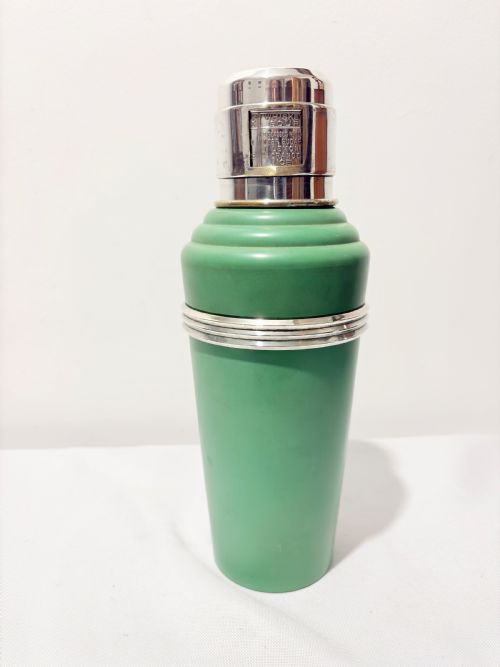
Decanters and decanter sets dominate the earlier eras, while cocktail shakers and coupes emerge strongly in the 1930s offerings. Each object serves a practical function within historical social rituals while introducing distinctive colour to a modern interior.
Materials and construction
Makers utilised glass as the primary medium, often employing colour-over-crystal techniques or rich green saturation to achieve depth. Metal components including silver plate, pewter, chrome-plated metal, and brass provide structural mounts, handles, and shaker tops.
Craftsmen shaped glass through blowing and cutting, occasionally pairing it with specialised pewter frameworks such as Tudric pewter. Surface decoration relies on enamelling and applied metal details rather than complex casting across the glass itself.
Antique Green Barware Retail Price Guide 2026
Typical asking prices for green barware among the pieces listed under this phrase on Sellingantiques today, from the lower quarter to the upper quarter. They describe what is for sale here now, not the wider market.
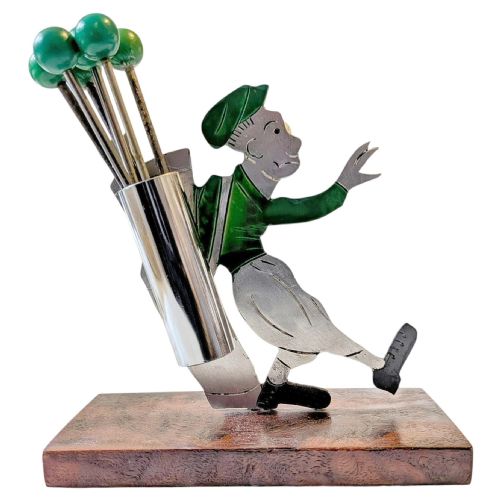
One exceptional piece pairs art deco style with sporting enthusiasm through a comical golfer man holding caddy cocktail sticks.
Assessing quality in green barware
The standard of execution rests on the crispness of glass cutting, the weight and purity of the metal mounts, and the integration between different materials. Superior examples display harmonious proportions where metalwork secures the glass vessel without stiffness.
Makers with notable design credentials achieve greater precision in surface enamelling and mechanical fittings, such as the snug seals on shaker lids and flagons. The depth of the green coloration and the clarity of the underlying crystal further distinguish finer pieces from standard production.
Archibald Knox for Liberty Co·Sudre·C S Green & Co
The Antique Green Barware Glossary
- Flash glass
- A thin layer of coloured glass applied over a clear crystal base before cutting. This technique allows deep facets to reveal the clear glass underneath.
- Tudric pewter
- A trade name used by Liberty and Co for a specific alloy of pewter. It frequently appears in arts and crafts metalwork combined with glass vessels.
- Spirit flagon
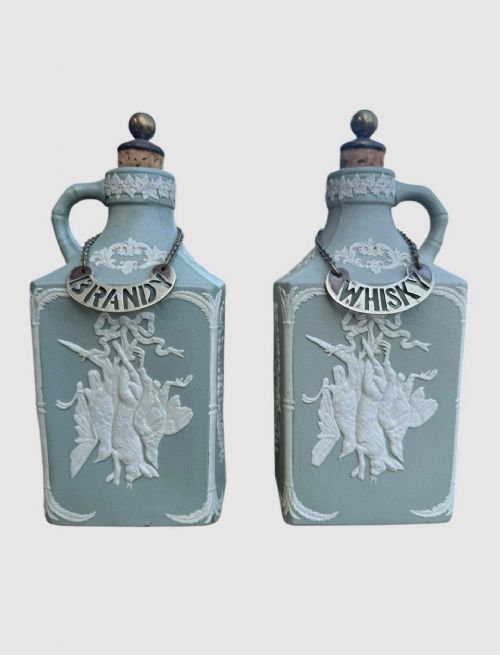
- A large bottle designed to hold spirits, often fitted with a stopper or label. Nineteenth-century examples often feature dense ceramic or glass bodies.
- Hock decanter
- A tall, slender bottle traditionally used for German white wine. They often feature coloured glass and elaborate cut or engraved decoration.
- Champagne coupe
- A broad, shallow bowl on a stem designed for sparkling wine. Period examples showcase coloured crystal bowls that catch ambient light.
Antique Green Barware: Frequently Asked Questions
What is antique green barware?
Antique green barware comprises drinking vessels, decanters, and cocktail equipment produced in various shades of green glass or mounted in metal during the nineteenth and early twentieth centuries.
These items range from Victorian spirit flagons to art deco cocktail shakers and champagne coupes designed for social gatherings.
How do I date green glass decanters?
Dating relies on stylistic markers such as the heavy cutting of the nineteenth century compared to the streamlined geometric forms of the 1930s art deco period.
Material combinations also provide clues, as pewter mounts suggest arts and crafts origins while chrome and silver plate point towards later twentieth-century manufacturing.
How were these pieces used originally?
Victorian decanters and flagons served spirits directly from the sideboard during formal dinners and evening entertaining.
Twentieth-century cocktail shakers and coupes supported the rise of home cocktail culture, facilitating the mixing and serving of mixed drinks.
How should I display barware at home?
Displaying these pieces benefits from placement near natural light to highlight the varied tones of the green glass and the polished surfaces of metal mounts.
Grouping decanters with matching coupes or combining different textures like brass and glass creates an engaging focal point on a sideboard or bar cart.