



Antique Glass Dessert Sets
These antique glass dessert sets bring period elegance to the table, offering matched services and matched components from the nineteenth century.
Antique Glass Dessert Sets
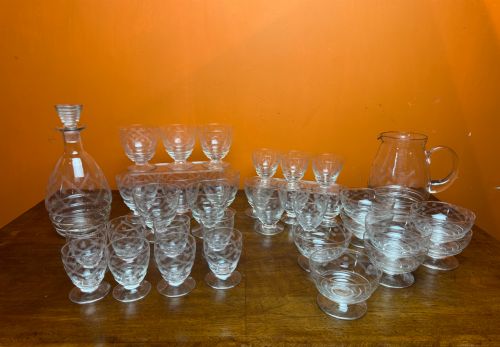
Antique glass dessert sets comprise matched assemblages of tableware intended for the final course of a formal meal, ranging from large drinking suites to dedicated serving pieces. When you search for antique glass dessert sets, you meet varied collections including finger bowls, custard cups, jelly glasses, and ice plates alongside comprehensive drinking and tableware services. The nineteenth century yields the majority of these formations, spanning early Victorian, Grand Regency, and later Victorian production.
Compositions vary from compact sets of four finger bowls or custard cups to large suites comprising dozens of matching vessels. Pieces originate from English, French, and Austrian workshops, reflecting diverse regional table service traditions of the period. Individual items frequently combine practical utility with decorative surface work suited to formal dining.
How they were made
Makers utilised clear glass, crystal, lead crystal, and flint glass, shaped through free blowing and moulding techniques. The resulting vessels possess the weight and clarity characteristic of nineteenth-century glasshouses.
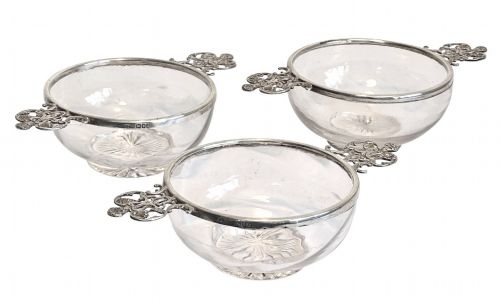
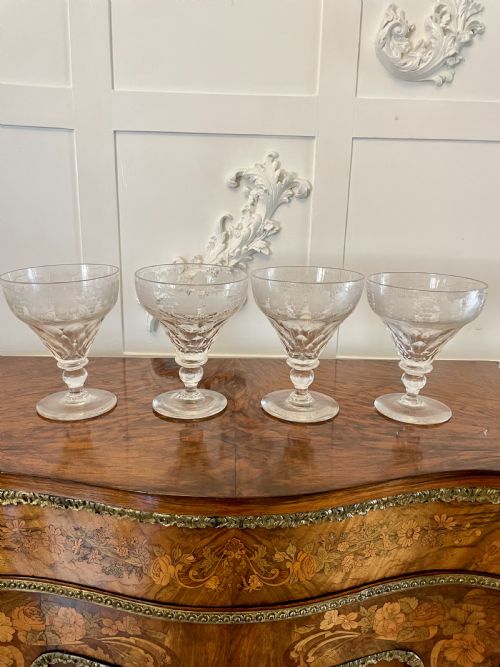
Surface decoration relies heavily on wheel engraving and etching, creating geometric patterns such as the Greek Key motif alongside naturalistic foliage. Selected vessels incorporate sterling silver mounts executed by silversmiths to frame or support the glass elements.
Listings for antique glass dessert sets span the nineteenth century, Victorian era, and Art Deco period, incorporating materials like sterling silver and lead crystal.
What varies in quality
The distinction between standard table service and superior production lies in the weight of the metal, the depth and crispness of the cut or engraved decoration, and the overall consistency across a matched set. Full suites featuring numerous uniform elements demonstrate greater coordination than smaller, assembled groupings.
The presence of precious metal mountings and fine free-blown crystal forms elevates the status of a service. Clarity of the glass and precision in decorative motifs separate utilitarian wares from ambitious exhibition pieces.
William Comyns
The Antique Glass Dessert Sets Glossary
- Custard cup
- A small, handled or unhandled vessel designed for serving individual portions of custard or cream during the dessert course. These pieces often feature cut or moulded decoration.
- Finger bowl
- A small bowl filled with water, placed before diners after a meal to rinse the fingers. Examples in this category frequently display engraved Greek Key borders.
- Flint glass
- A heavy, brilliant form of glass containing lead oxide that increased refractive index and weight. This material provides the substantial feel found in finer nineteenth-century tableware.
- Ice plate
- A small glass plate specifically intended to support an ice cream or chilled dessert vessel. They are commonly free blown from crystal.
- Jelly glass
- A tall, tapered vessel used for serving jellies and syllabubs in historical table settings. They often exhibit simple dish tops and heavy moulded bases.
Antique Glass Dessert Sets: Frequently Asked Questions
What is an antique glass dessert set?
An antique glass dessert set is a collection of matching glass vessels designed for the final course of a meal. They include items such as finger bowls, custard cups, jelly glasses, and ice plates.
These pieces reflect the dining customs of the nineteenth century, providing coordinated tableware for formal entertaining.
How were dessert glasses used historically?
Dessert glasses served specific functions during the multi-course meals of the Victorian and Regency periods. Finger bowls cleaned the hands between rich courses, while custard cups and jelly glasses held individual sweet dishes.
Larger services accommodated guests at formal dinners, ensuring visual harmony across the table setting.
How do I identify Victorian glass dessert sets?
Victorian sets are identified by their characteristic forms, heavy lead crystal or flint glass materials, and specific decorative techniques like wheel engraving and etching. The evidence shows pieces associated with distinct periods from the early nineteenth century through the 1890s.
Stylistic markers such as Greek Key patterns and silver mounts also help establish the era.
Are these glass sets suitable for daily use?
While these pieces were made for dining, their age and delicate engraved decoration require careful handling. Many collectors reserve them for special occasions or display them as part of a decorative arrangement.
Hand washing in lukewarm water preserves the surface integrity of the glass and any silver mountings.