
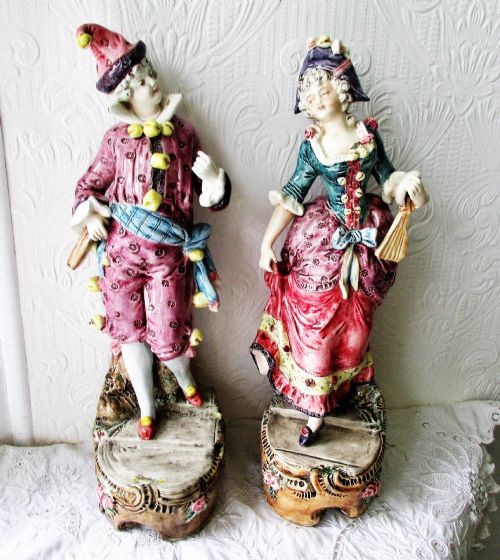
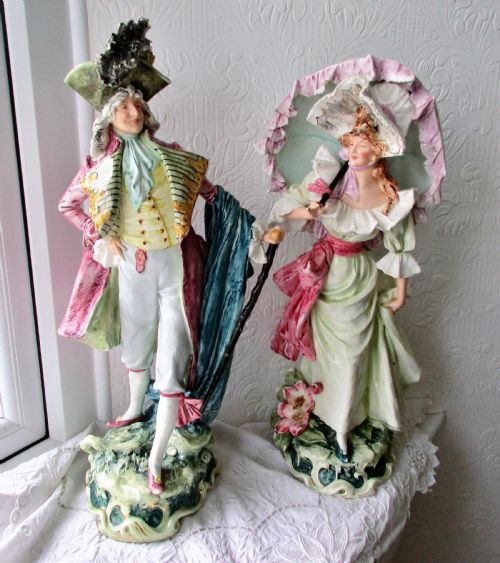


Antique French Ceramic Couple
These antique french ceramic couple pieces bring ornamental charm to a room, offering romantic figures and classical pairs crafted in porcelain and faience.
Antique French Ceramic Couple
When you search for an antique french ceramic couple, you encounter decorative figurines and table lamps depicting galants, ladies, musicians, and romantic pairs. The forms span the nineteenth century and the early twentieth century, capturing historical revivals in domestic interiors.
You are most likely to meet glazed earthenware and bisque porcelain figures modelled in pairs. These pieces range from faience groups to Paris porcelain lace figures and large biscuit porcelain mantel ornaments.
Materials and construction
Makers utilised porcelain, earthenware, and faience, shaping them into detailed figural groups and decorative table lamps. Surface decoration often includes painted glaze, enamel highlights, and applied gold leaf or gilt details.
Biscuit porcelain and bisque porcelain provide a matte, unglazed finish that imitates marble, while specialised glaze and enamel bring rich colour to faience and earthenware pieces.
Listings feature pieces spanning the nineteenth century, nineteen-thirty, and the Victorian era, utilising porcelain, earthenware, and gold leaf.
Distinctions in quality
Quality separates in the precision of the modelling and the fineness of the hand-painted enamels. Superior examples display crisp facial expressions, delicate lace details, and carefully applied gold leaf.
The attribution to known Paris houses or documented factories elevates a piece above standard unmarked figures. Finer modelling in biscuit porcelain achieves greater depth in drapery and botanical elements.
Bourdois and Bloch Paris·Letu and Mauger Paris·Vion et Baury·Chantilly·Samson
The Antique French Ceramic Couple Glossary
- Biscuit porcelain
- Unglazed white porcelain fired to a matte texture that resembles marble. It allows sculptural details to remain sharp and unmasked by glossy finishes.
- Faience
- Tin-glazed earthenware produced in France and decorated with coloured pigments. This technique yields vibrant surfaces on figural subjects.
- Gilt
- A thin layer of gold applied to ceramic surfaces for decorative emphasis. It highlights garments and bases on nineteenth-century figures.
- Rococo Revival
- A decorative style reviving eighteenth-century asymmetry and scrollwork. It appears frequently on nineteenth-century French figures and table lamps.
Antique French Ceramic Couple: Frequently Asked Questions
What periods do these ceramic couples come from?
The pieces originate primarily from the nineteenth century, with Victorian examples and works dated around eighteen-eighty to nineteen-thirty.
Makers adopted historical styles such as French Rococo Revival and Second Empire aesthetics during these periods.
How were ceramic figures used originally?
Owners displayed these decorative figurines on mantelpieces, side tables, and in cabinets as symbols of refinement and taste.
Some pieces were adapted into table lamps later in their history, combining illumination with ornamental display.
What is the difference between bisque and porcelain?
Biscuit or bisque porcelain remains unglazed after firing, producing a smooth, matte surface ideal for detailed figurative work.
Standard porcelain receives a glossy glaze that seals the ceramic body and adds reflectivity to the colours.
How do I identify factory marks on these pieces?
Factory marks appear on the underside of bases as impressed stamps, painted initials, or blue underglaze symbols.
Some nineteenth-century French workshops produced unmarked figures in the style of larger manufacturers like Vion et Baury or Samson.