



Antique Flatware Canteen
An antique flatware canteen organises dining utensils within a fitted chest, offering a complete set ready for the table.
Antique Flatware Canteen
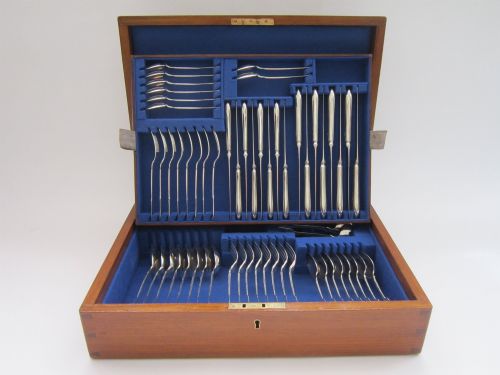
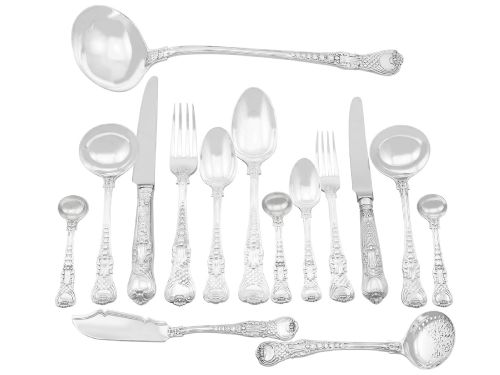
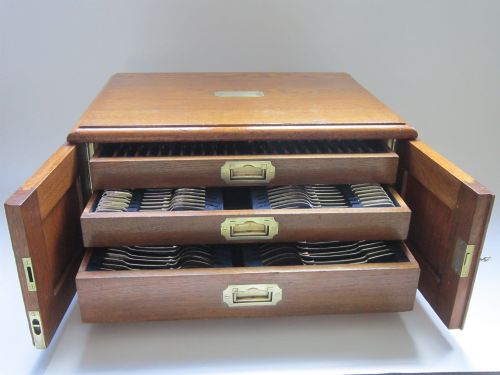
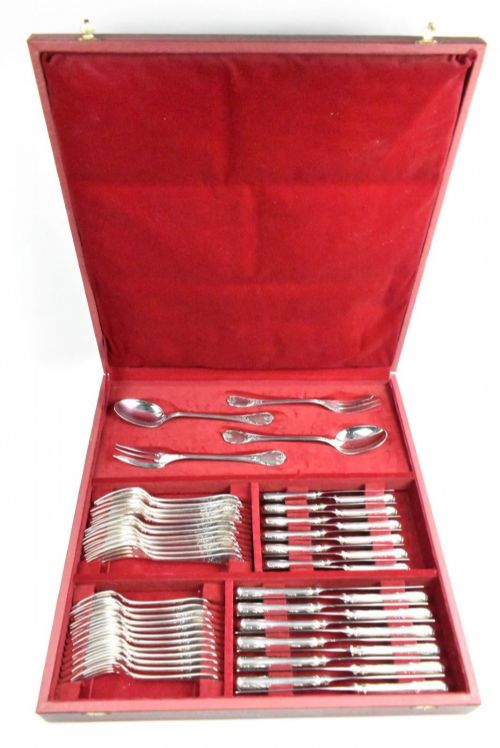
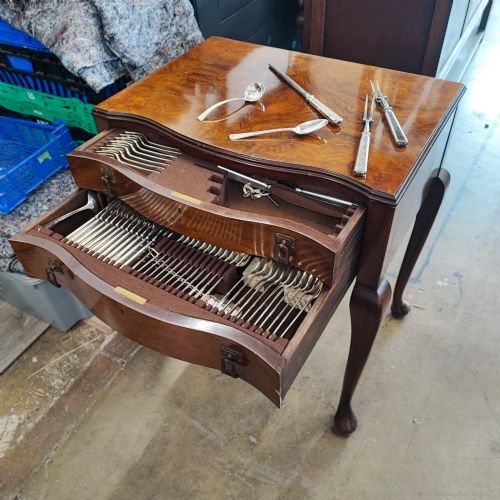
An antique flatware canteen provides a dedicated housing for dining implements, grouping spoons, forks and knives by service and size. These sets appear as fitted boxes, chests, cabinets or canteen tables designed to keep entire services orderly.
The selections here span from the nineteenth century into the twentieth century, taking forms such as the Victorian sterling silver service or the expansive Art Deco flatware set. Oak, walnut and mahogany predominate for the outer cases, whilst velvet, felt and fitted interiors secure the contents.
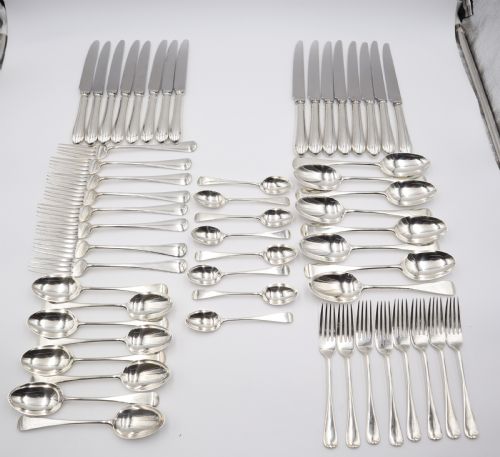
Buyers encounter both sterling silver services and silver-plated alternatives, often configured for eight or twelve persons. Makers such as Christofle, Tiffany, Walker & Hall and Mappin & Webb appear among the English and continental examples.
Materials and construction
Makers constructed the exterior cases from dense timbers including oak, mahogany, walnut and coromandel, building robust chests and tables with specialised internal compartments. Interiors received linings of felt or velvet to protect the individual metal pieces from friction and tarnishing.
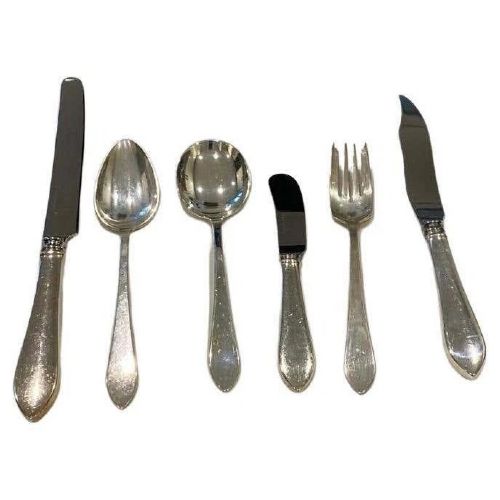
The cutlery itself combines sterling silver or silver plate with steel for cutting edges, employing traditional silversmithing techniques like stamping and chasing for patterns such as Fiddle or Faneuil. Cases feature brass fittings, hinges and locks to secure the heavy contents.
Materials range from sterling silver and silver plate to oak, walnut, mahogany, felt and velvet.
Quality and craftsmanship
Superior examples distinguish themselves through the completeness of the service and the integrity of the fitted interior, where every original slot matches the surviving cutlery. Maker attribution to established firms like Mappin & Webb or Tiffany elevates a piece above anonymous workshop production.
The quality of the timber housing and the precision of the joinery set finer chests apart from simpler utilitarian boxes. Heavy-gauge silver or thick silver-plate plating ensures the utensils endure decades of polishing and use.
Walker & Hall·Mappin & Webb·Christofle·Tiffany
The Antique Flatware Canteen Glossary
- Canteen
- A fitted box, chest or cabinet designed specifically to hold a set of cutlery. These enclosures contain specialised slots and trays for every spoon and fork.
- Fiddle Pattern
- A nineteenth-century silver handle design featuring a distinctive tapered shape resembling a violin. This style occurs frequently on Victorian flatware services.
- Silver Plate
- A base metal coated with a layer of pure silver through electroplating or older methods. This technique allowed makers to produce durable tableware at a lower cost than solid sterling.
- Faneuil Pattern
- An Art Deco geometric flatware style characterised by clean architectural lines. Tiffany utilised this design on silver services during the early twentieth century.
- Coromandel
- A dense, dark exotic timber with striking contrasting grain patterns used for luxury nineteenth-century boxes. This material denotes high status in decorative chest production.
Antique Flatware Canteen: Frequently Asked Questions
How are flatware canteens organized?
Interiors feature tiered trays, vertical partitions and slotted wooden blocks designed to hold specific quantities of knives, forks and spoons. Each implement rests in a custom recess to prevent movement during transport.
Larger canteens house multiple layers, placing serving pieces and carving implements in the top tray whilst dinner services occupy the drawers below.
What is the difference between silver plate and sterling silver?
Sterling silver consists of solid precious metal marked with assay office stamps indicating its purity standard. Silver plate applies a thin layer of silver over a base metal such as nickel brass or copper.
Canteens housing sterling silver carry higher intrinsic value, whilst silver-plated sets from major firms offer robust everyday utility with bright polished surfaces.
How do I care for an antique wooden canteen?
Wood surfaces require periodic treatment with appropriate furniture wax to nourish the grain and prevent the timber from drying out. Keep the chest away from direct heat sources and drastic humidity changes to protect the internal felt or velvet linings.
Checking the brass hinges and locks ensures the structural integrity of the case remains sound over years of opening and closing.
Are these sets complete for modern dining?
Many canteens retain services sized for eight or twelve persons, making them practical for hosting formal dinner parties. Some larger twentieth-century sets exceed one hundred pieces to accommodate multi-course meals.
Reviewing the individual item counts helps determine if the specific set matches your required seating capacity.