




Antique Extendable Side Table
An antique extendable side table offers adaptable surface space in mahogany or oak, combining period craft with practical daily utility.
Antique Extendable Side Table
Mahogany and oak dominate the forms, frequently resting on brass castors or barley twist legs depending on whether the piece hails from the eighteenth century or the early twentieth century. These tables served multifunctional roles in historic homes, moving easily from a compact perimeter position to the centre of a room for dining or writing.
Materials and construction
Cabinet makers relied heavily on solid mahogany and oak for structural integrity, often applying figured veneer or burr walnut to visible surfaces for decorative richness. Brass fittings such as castors and hinges provided functional durability on folding leaves and movable legs.
Joinery methods involved traditional hinges, gateleg pivoting frames, and drop-leaf supports that allowed flaps to lock securely into position when extended. Timber selection balanced weight and strength to ensure the folding mechanisms endured decades of daily lifting and lowering.
Listings span multiple eras from the 1700s through 1910, showcasing both formal Georgian mahogany and sturdy Edwardian oak constructions.
Judging quality in extendable tables
Quality rests on the crispness of the timber grain, the originality of brass hardware, and the stability of the folding mechanism when fully extended. Superior examples display carefully matched veneers and uncompromised pivot joints that keep the leaves level.
The finesse of the leg turnings - whether pad feet, reeded Regency pillars, or barley twists - separates standard utility pieces from finer workshop productions. Preservation of the original surface patina further elevates the standing of an individual table.
The Antique Extendable Side Table Glossary
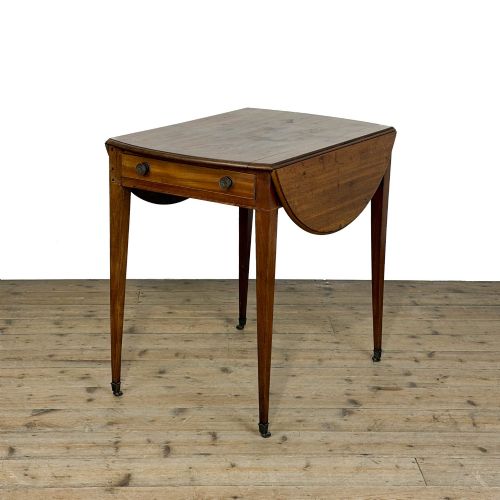
- Pembroke table
- A small rectangular table with two hinged drop leaves on opposing sides, frequently fitted with a frieze drawer. It gained popularity in the eighteenth century as a versatile breakfast or writing table.
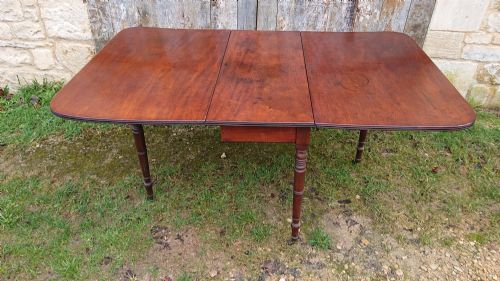
- Drop-leaf table
- A table featuring a fixed central section and one or two hinged flaps that fold down when not in use. Supporting swing legs or brackets hold the leaves horizontal.
- Gateleg table
- A table with hinged leaves supported by legs that swing outward like a gate to hold the flaps aloft. This form dates back centuries and provides exceptional load-bearing support.
- Pad foot
- A rounded foot resting flat on the floor, commonly found on cabriole legs of the Georgian era. It distributes weight evenly without sharp corners.
- Patina
- The surface sheen and colour developed over decades of handling, polishing, and natural ageing. Collectors prize untouched patinas for their historic depth.
Antique Extendable Side Table: Frequently Asked Questions
How do drop leaf tables extend?
Drop leaf tables extend by lifting the hinged side flaps and swinging out a dedicated leg, gate, or wooden bracket from beneath the frame to lock the leaf level.
This simple mechanical action allows the footprint of the table to double or triple within seconds depending on how many leaves are raised.
What is a Pembroke table used for?
A Pembroke table served historically as a light tea, writing, or occasional work table that could stand neatly against a wall when folded.
Raising the leaves created a functional surface for small gatherings or correspondence without dominating the floor space of a parlour.
How do I date a mahogany side table?
Dating relies on observing the timber species, secondary woods, handle styles, and leg architecture such as Georgian pad feet or Regency reeding.
Construction marks and the presence of original brass castors also offer reliable clues to whether a piece belongs to the eighteenth or nineteenth century.
Are oak or mahogany tables older?
Oak tables generally represent earlier periods, particularly the seventeenth and early eighteenth centuries, while mahogany became the dominant timber of choice from the mid-Georgian period onward.
Revival pieces from the Edwardian era occasionally returned to oak using earlier vernacular styles like barley twist legs.