


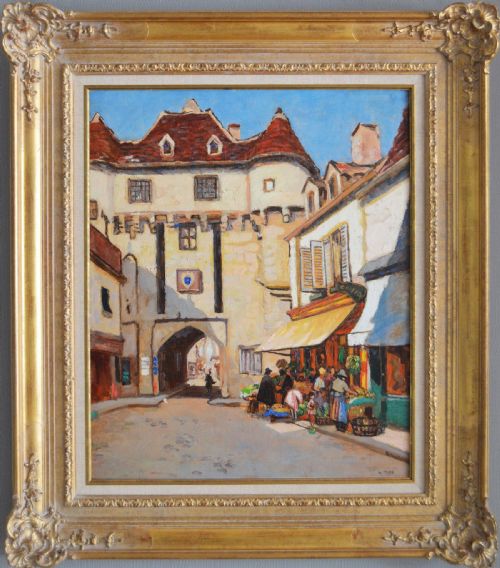
Antique European Street Painting
These antique european street painting works capture bustling urban thoroughfares and quiet Continental squares on canvas and paper.
Antique European Street Painting
When you search for an antique european street painting, you find artworks portraying townscapes, market days, and architectural views across the Continent. The pieces presented here encompass works created across the nineteenth and twentieth centuries.
You are most likely to encounter oil on canvas works and watercolours depicting Flemish scenes, French towns, and Belgian markets. These pieces range from Georgian urban landscapes to mid twentieth-century impressionist cityscapes.
The assortment includes framed works featuring wood and giltwood surrounds, alongside smaller watercolours and oil on board studies. Artists recorded daily life, cathedral backdrops, and bustling arches in various regional styles.
How they were made
These works rely primarily on oil paint applied to canvas or board, alongside watercolours on paper. Painters utilised brushwork and pigments to capture light and atmosphere in urban settings.
Many of these paintings retain their original framing materials, including wood frames finished with gold leaf and giltwood. The physical construction combines traditional stretcher frames with protective surface varnishes.
Market days and quiet archways remain busy forever.
What varies in quality
Quality in these street scenes rests upon the artist's ability to render perspective, architectural detail, and atmospheric light effectively. Stronger compositions demonstrate confident handling of paint and balanced tonal relationships across the urban landscape.
The sophistication of the framing and the preservation of the original paint surface influence the overall character of the piece. Works that retain their period giltwood or wood frames offer a more complete historical presentation.
L. De Gent·William George Meadows·Lewis J Wood·Joseph W. Milliken·Paul Paul·Christiaan Pieter Snyders·Letitia Marion Hamilton
The Antique European Street Painting Glossary
- Oil on canvas
- A painting technique where oil paints are applied to a stretched canvas support. This medium allows for rich colour blending and textured brushwork.
- Impressionism
- An art style focused on capturing light and fleeting moments rather than precise details. Works in this style often feature loose brushstrokes and vibrant colour palettes.
- Watercolour
- A painting method using water-soluble pigments on paper. This medium produces translucent washes and delicate paper works.
- Giltwood
- Wood carved and coated with gold leaf or gold paint. This material is frequently found on period picture frames.
- Townscape
- A painting or drawing depicting an urban scene, streets, or buildings. These views document historical architecture and daily life.
Antique European Street Painting: Frequently Asked Questions
What periods do these paintings cover?
The available selection spans from the Georgian era through the nineteenth century and into the early decades of the twentieth century. You will find pieces reflecting Victorian sensibilities as well as later impressionist movements.
Artists worked across different decades, producing everything from formal architectural views to looser twentieth-century realist and post-impressionist interpretations of European towns.
What materials were used?
Makers predominantly employed oil paint on canvas, oil on board, and watercolours on paper. These were supported by traditional wooden stretchers and presented in wood or giltwood frames.
Gold leaf finishes appear frequently on the period frames accompanying these urban scenes, adding decorative depth to the presentation.
How do I identify a townscape?
Townscapes focus on streets, markets, architectural views, and European cityscapes rather than rural landscapes or portraits. They often feature buildings, cathedrals, and figures engaged in daily commerce.
Signatures, inscriptions, and subject matter pointing to specific locations like French villages or Belgian markets help confirm the regional context.
Where were these scenes painted?
The artwork originates from various European locations, capturing continental towns, market squares, and specific places such as Semur and Lannion. Artists travelled abroad to record local architecture and street life.
Many pieces document Flemish, French, and Belgian settings through the eyes of visiting or local painters.