


Antique English Pistols
These antique English pistols are functional pieces of history from the eighteenth and nineteenth centuries, offering collectors precision steel mechanisms and traditional walnut or hardwood stocks.
Antique English Pistols
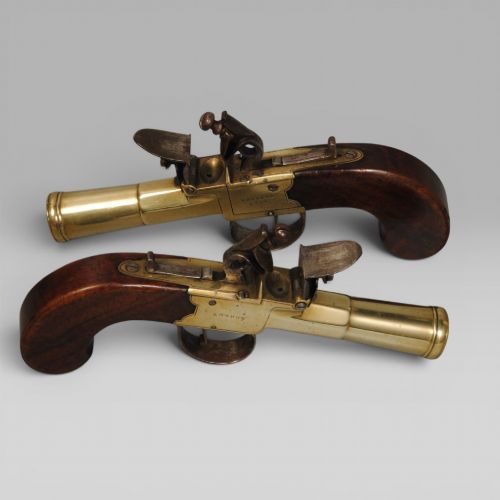
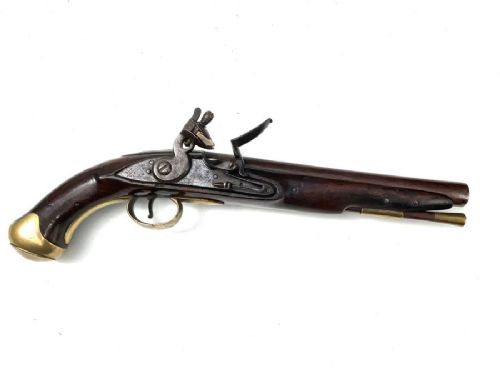
When you search for antique English pistols, you encounter various firearm forms ranging from pocket pistols to duelling sets and holster pistols. The pieces listed span the eighteenth and nineteenth centuries, including Georgian and Regency periods.
Pocket pistols and boxlock blunderbuss pistols appear frequently, alongside percussion systems and traditional flintlock mechanisms. Makers such as Mortimer, Twigg and John Manton represent the origins found within this selection.
Queen Anne types and turn-off barrel designs feature prominently in the eighteenth-century examples. Later nineteenth-century items include pepper pot revolvers and transitional six-shot revolvers.
Materials and construction
Makers utilised forged steel for barrels and actions, pairing them with stocks fashioned from walnut, mahogany or other hardwoods. Silver wire inlay and cast silver grotesque butt caps appear on select eighteenth-century models.
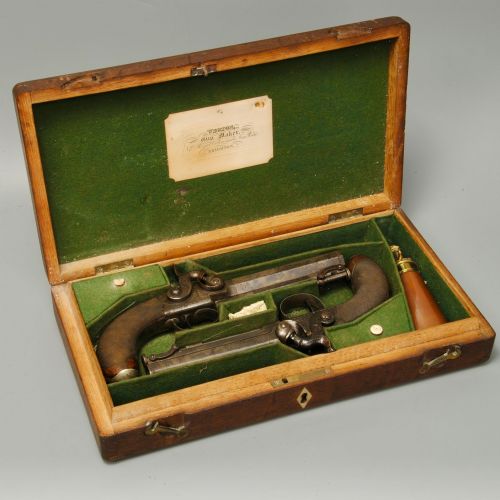
Fittings often incorporate brass for trigger guards and mounts, whilst storage solutions utilise baize-lined wooden cases. Metal components display proof marks from London and Birmingham.
The listings on this site encompass steel, walnut, mahogany, and brass across the eighteenth and nineteenth centuries.
Distinctions in quality
Quality rests upon the crispness of the engraving, the integration of silver wire inlay, and the original matching of cased pairs. Signed locks by known London makers command attention through superior mechanical execution.
The survival of original finishes on the steel and the precise fitting of the woodwork determine the standing of an individual piece. Superior examples retain legible proof marks and sharp, unpolished metal surfaces.
Harrison of London·Mortimer·Twigg·James Barber·Thomas Henshaw·R. Willoughby·John Rimes·John Manton·J. Robinson·George Sherwood·Dutton·A.W Spires
The Antique English Pistols Glossary
- Flintlock
- An ignition mechanism utilising a piece of flint held in a cock to strike a steel frizzen, creating sparks to ignite the gunpowder. This system dominated European firearms production for centuries.
- Percussion cap
- A small metal cup containing priming compound placed on a nipple, struck by the hammer to fire the charge. This mid-nineteenth-century innovation replaced the earlier flintlock system.
- Boxlock
- A firearm design where the lock mechanism is integrated directly into the breech frame rather than mounted on a separate sideplate. It provides a clean, compact profile often seen on pocket pistols.
- Turn-off barrel
- A barrel that unscrews from the breech to allow loading from the front of the chamber. This feature appears commonly on eighteenth-century Queen Anne pistols.
- Regency
- A period of British history spanning the early nineteenth century, characterised by distinct stylistic refinements in arms manufacture.
Antique English Pistols: Frequently Asked Questions
What is a Queen Anne pistol?
A Queen Anne pistol is a distinctive type of firearm featuring a breech and trigger plate forged as a single piece with a turn-off barrel. These pieces date primarily from the early eighteenth century.
They often include a rounded butt and minimal external sideplate hardware, offering a streamlined aesthetic popular for personal defence.
How do flintlock and percussion pistols differ?
Flintlock pistols rely on a piece of flint striking steel to generate sparks for ignition. This mechanical process requires a pan filled with priming powder.
Percussion pistols use a hammer that strikes a chemical cap placed on a nipple, providing a faster and more reliable ignition in wet weather.
Were these pistols used for duelling?
Certain examples, such as cased pairs by makers like Mortimer, served specifically as duelling pistols. These were manufactured with precision barrels and adjustable triggers for accuracy.
Other forms, including pocket pistols and sea service pieces, were intended for self-defence or military service rather than formal gentlemanly disputes.
How should I display a cased pistol set?
Cased pistol sets are best displayed flat within their original fitted wooden boxes, which usually feature baize or velvet linings. This protects the finish and keeps related accessories together.
Keep the display area away from direct sunlight and excessive humidity to preserve the wooden stocks and steel components.