


Antique Ebony Mirror
An antique ebony mirror brings deep, dark timber tones and reflective depth to a room, ranging from Anglo-Indian carvings to Regency convex glasses.
Antique Ebony Mirror
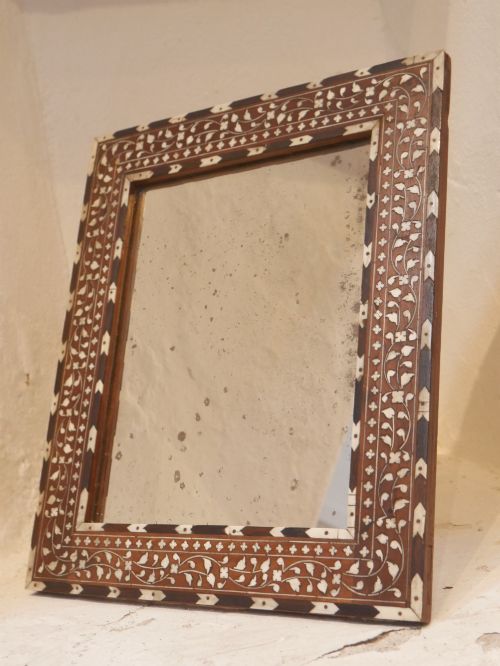
When you search for an antique ebony mirror, you encounter items spanning the Georgian, Regency, Victorian, and Edwardian periods, alongside regional craft traditions like Anglo-Indian Hoshiarpur work. These pieces take various forms, from small wall-hanging glasses to dressing mirrors and elements of larger furniture suites.
The selection on this page demonstrates that true solid ebony sits alongside ebonised wood and hardwood frames enriched with bone or brass details. Many retain their original mirror glass, showing the characteristic slight imperfections and soft silvering of earlier centuries.
Geographic origins vary widely, encompassing English cabinet work, Italian console pairings, and intricate bone-inlaid Hoshiarpur craftsmanship from the late nineteenth century. Collectors find that each period handles the dark timber differently, shifting from Georgian inlaid stringing to Victorian Aesthetic Movement boldness.
How they were made
Maker workshops utilised dense tropical hardwoods as a foundation, often applying a deep black ebonising finish to imitate costly solid ebony when working with pear or fruitwood. Craftsmen combined these dark surfaces with contrasting materials, embedding bone, brass, or giltwood details into the frames.
Intricate piercing and carving define pieces such as the Hoshiarpur mirrors, where artisans worked bone and timber into dense floral and geometric reliefs. Glaziers cut glass by hand, frequently creating bevelled edges that catch the light differently than modern machine-cut panes.
Listings feature periods spanning the eighteenth century through to the Edwardian era, incorporating glass, bone, brass, and giltwood alongside ebony and ebonised wood.
What varies in quality
The standard of an antique ebony mirror rests on the precision of its joinery and the integrity of its surface decoration. Finely executed bone inlay remains tight within its channels, while lesser examples show shrinkage gaps and missing tesserae.
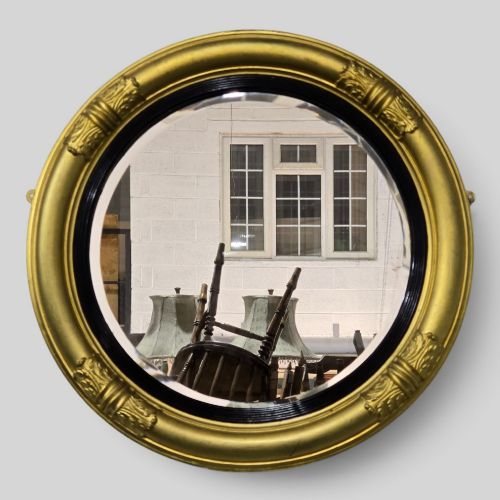
Originality dictates value, meaning frames that retain their untouched surface patination and initial bevelled glass plates hold greater integrity than those with replaced elements or modern silvering. The depth of the carving in Anglo-Indian work or the crispness of the gilt and ebony contrast in Regency convex pieces marks the distinction between workshop output.
The Antique Ebony Mirror Glossary
- Ebonised wood
- Timber treated with stain or paint to imitate the dense, dark appearance of true ebony. This technique was widespread in nineteenth-century cabinet making.
- Hoshiarpur
- A North Indian centre renowned for intricate woodwork featuring bone or ivory inlay set into dark timber bases. Pieces from this tradition often display dense floral motifs.
- Bevelled glass
- Mirror glass with edges ground and polished to an angled slope. This method produces a prismatic light effect around the perimeter.
- Convex mirror
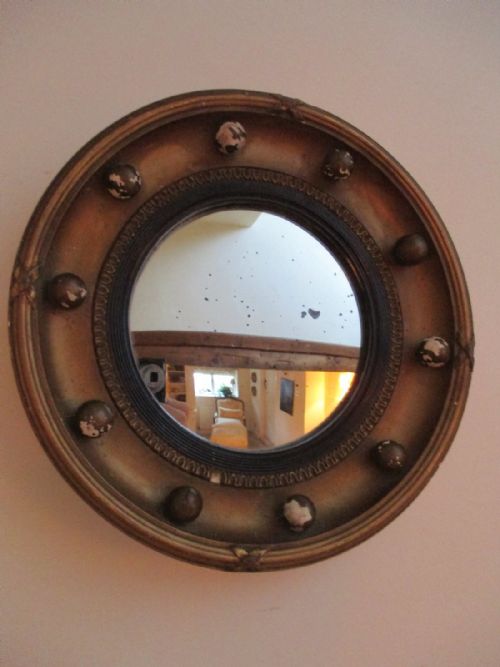
- A circular glass formed with a bulging surface that reflects a wide-angle, curved view of the interior. These often feature gilt and ebony reeded frames.
- Stringing
- Thin strips of contrasting wood or bone inlaid into channels in the primary timber. Georgian pieces frequently utilise this to outline drawers and mirror frames.
Antique Ebony Mirror: Frequently Asked Questions
How do I clean an antique mirror?
Use a soft, dry cloth to remove dust from the frame and glass surface without applying moisture to old timber or vulnerable bone inlay. Avoid commercial chemical sprays that can seep behind the glass plate and damage the historical silvering.
Take care around carved sections where dried polish or dust accumulates in the recesses. A gentle brush works well for clearing intricate Hoshiarpur relief work without disturbing the materials.
Are these mirrors heavy?
Solid ebony and dense hardwoods add significant weight to wall mirrors, particularly larger nineteenth-century examples. The inclusion of heavy glass and wooden backing boards requires robust wall fixings.
When hanging these pieces, ensure the fixings engage directly with wall studs or utilise appropriate structural wall plugs. Relying on simple picture wire alone is rarely sufficient for heavier frames.
How do I date an ebony mirror?
Examine the construction methods, backing boards, and glass characteristics to determine the period of manufacture. Hand-bevelled edges, old screw types, and secondary woods visible on the reverse provide reliable chronological clues.
Stylistic markers also help, as Regency convex glasses differ markedly from Edwardian valet sets or Victorian Aesthetic Movement designs. Comparing the inlay style against known period pieces narrows down the decade.