
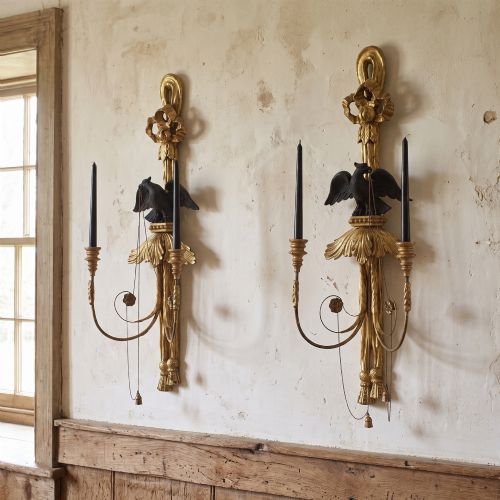


Antique Eagle Light
These antique eagle light pieces bring spirited neoclassical character and bold carved form to a room, perfect for brightening dark corners with historic presence.
Antique Eagle Light
When you search for an antique eagle light, you encounter a striking array of wall sconces, table lamps, and candelabra that incorporate the majestic bird into their design. The evidence shows these pieces span from the eighteenth century through the Edwardian era and the early decades of the twentieth century, capturing distinct periods of revival and classical taste.
You are most likely to meet wall sconces and table lamps fashioned from giltwood, brass, and bronze, often echoing Regency and George III styles. The selection also includes girandole mirrors and glass lustres that utilise the same commanding avian motif to anchor a room's decorative scheme.
How they were made
Makers shaped these fixtures using traditional casting and carving methods, employing metals such as brass, bronze, and ormolu alongside rich giltwood and mahogany timber. Gilded surfaces required meticulous application of gold leaf over prepared bases, while metal components were cast and chased to achieve sharp detail in the plumage and surrounding classical ornaments.
Many designs incorporate reflective glass elements, including mirror plates and cut glass lustres, which served to multiply the illumination from candles or early electric bulbs. Fabric elements occasionally appear in the construction, completing lamps designed for domestic table use.
Even a stern bronze eagle must occasionally share its post with a winding serpent.
What varies in quality
The distinction between standard examples and the finest pieces lies in the crispness of the carving or casting. Superior items display deep, intentional chisel work on giltwood surfaces or refined chasing on bronze and ormolu, where every feather and curve retains distinct definition rather than soft, rounded edges.
Materials and structural integrity further divide the range, as heavier cast metals, genuine period gilding, and integrated antique mirror plates elevate the presence of the fixture. The harmony of proportion between the eagle motif and the supporting arms or columns determines the visual success of the piece.
The Antique Eagle Light Glossary
- Ormolu
- Finely ground high-carat gold applied to a bronze base using a mercury amalgamation process, or simply gilded bronze. This technique creates a rich, durable golden finish found on fine Regency lighting.
- Giltwood
- Timber, commonly lime or pine, carved and coated with gold leaf over a gesso ground. It provides a brilliant reflective surface for wall sconces and girandole mirrors.
- Girandole
- A branched wall sconce featuring a mirrored backplate to multiply the light in a room. The reflective glass enhances the visual impact of carved giltwood frames.
- Lustre
- A freestanding ornamental candlestick hung with cut glass pendants. These drops refract candlelight to create a sparkling display.
- Candelabra
- A multi-branched lighting fixture designed to hold several candles or bulbs. Regency examples often combine bronze and ormolu in elaborate classical forms.
Antique Eagle Light: Frequently Asked Questions
What periods do these lights come from?
The pieces span from the eighteenth century through the Regency period and into the Edwardian era and the early twentieth century. Many items also reflect later revivals of earlier classical styles.
This broad timeline means you will find both authentic Regency creations and later twentieth century interpretations that mirror the same aesthetic.
Where were these lights placed originally?
Wall sconces and girandole mirrors were typically mounted in principal reception rooms to reflect candlelight and brighten dark panelled walls. Table lamps and candelabra occupied central tables, sideboards, and mantlepieces.
Their commanding presence made them focal points in formal domestic interiors.
How do I identify a Regency piece?
Regency items often utilise bronze and ormolu, featuring strict neoclassical motifs, Empire influences, and adjustable arms. The workmanship displays a focus on classical antiquity and military or imperial symbols like the eagle.
Comparing the metalwork quality and structural proportions helps separate these from later revival pieces.