

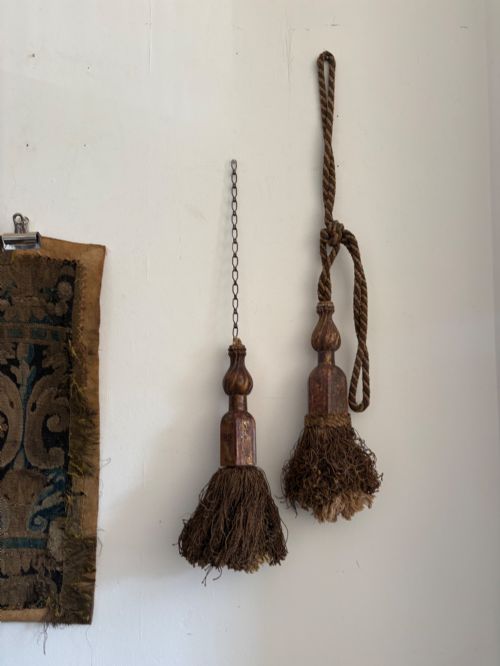


Antique Drapery Holdbacks
Antique drapery holdbacks secure heavy window dressings with cast metals and carved wood, bringing practical elegance to period interiors.
Antique Drapery Holdbacks
Antique drapery holdbacks are functional wall-mounted hardware designed to gather and hold curtains back from windows, shaping the fall of heavy fabrics. These pieces combine structural utility with decorative flair, serving as ornamental accents beside the window frame.
The selection on this page centres on examples from the eighteenth and nineteenth centuries, spanning Georgian, Victorian, and continental European traditions. Buyers will frequently encounter French ormolu, brass, and giltwood formations among these offerings.
Object types on display include curtain tie backs and curtain tiebacks, often presented in matched pairs. These items range from compact brass mountings to large carved wooden pulls measuring forty-three centimetres.
How they were made
Maker's hands shaped these objects using foundational metalworking and woodworking techniques of their respective eras. Craftsmen cast brass and ormolu into intricate relief patterns, whilst others carved timber directly for giltwood applications.
Gilding was applied to bronze, brass, and wood surfaces to achieve a luminous finish that caught ambient candlelight and daylight. Enamel elements were also integrated into eighteenth-century compositions for added colour and texture.
Listings span the Georgian and Victorian eras, utilising materials such as ormolu, brass, enamel, and giltwood across French and British designs.
What varies in quality
The distinction between standard utility hardware and superior examples lies in the crispness of the casting and the depth of the chasing. Finer specimens display sharp relief in the ornamental motifs, whether representing Gothic dragons or French Rococo scrollwork.
Material composition and the integrity of the original surface finish dictate the standing of a piece. Retained gilding and carefully preserved enamel details elevate the visual presence of the hardware.
Henri Picard
The Antique Drapery Holdbacks Glossary
- Ormolu
- Gilt bronze produced by applying a finely ground high-carat gold-mercury amalgam to a bronze object. This technique imparts a rich, warm golden lustre characteristic of luxury French metalwork.
- Giltwood
- Timber, commonly carved gessoed wood, coated with gold leaf or metallic powder. It provides a lighter alternative to solid cast metal while permitting elaborate sculptural forms.
- Tie Back
- A hardware fixture or fabric band secured to the wall beside a window to hold curtains open. They prevent fabric from obscuring light and frame the window aperture.
- Rococo Revival
- A nineteenth-century design movement drawing inspiration from the asymmetrical curves and naturalistic motifs of the eighteenth-century French Rococo style. It favours shellwork, C-scrolls, and floral asymmetry.
Antique Drapery Holdbacks: Frequently Asked Questions
What are antique drapery holdbacks?
Antique drapery holdbacks are decorative metal or wooden fixtures mounted to the wall beside a window to keep curtains neatly gathered back.
They combine robust structural brackets with ornate decorative faces, reflecting the prevailing design styles of their manufacturing period.
How were drapery holdbacks used?
These pieces were screwed directly into the window frame or surrounding wall to manage heavy drapery fabrics and control room lighting.
By looping or gathering the curtain behind the projecting arm of the holdback, the fabric remained orderly and displayed the window dressings to advantage.
How do I install antique holdbacks?
Installation requires securing the mounting plate firmly into wall studs or using appropriate masonry anchors to support the weight of the hardware and pulled fabric.
Care must be taken during fitting to ensure the projecting arm is level and positioned at the correct height for the curtain drop.
How do I distinguish 18th and 19th-century styles?
Eighteenth-century examples often feature refined enamel work and restrained Georgian brass casting, whereas nineteenth-century pieces frequently embrace exuberant Rococo Revival or Gothic Revival motifs.
Examining the casting technique and the specific decorative vocabulary helps align a piece with its production era.