

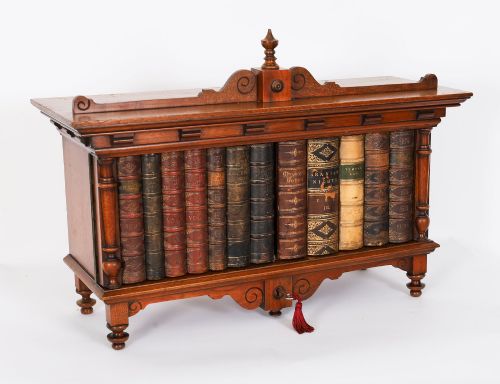


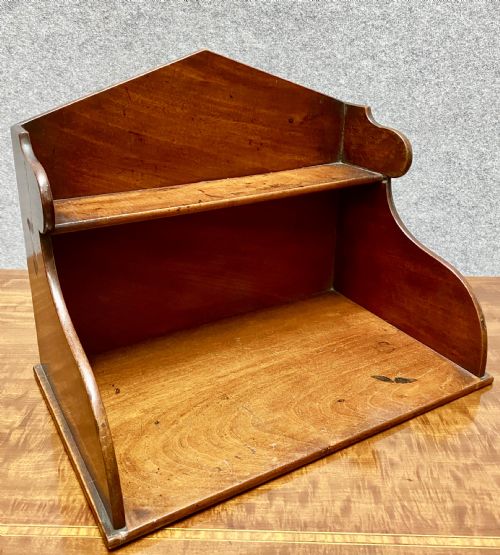

Antique Desktop Bookcase
An antique desktop bookcase keeps reference volumes close at hand on a writing surface, combining compact storage with cabinet-maker's craft.
Antique Desktop Bookcase
An antique desktop bookcase serves as a compact repository for volumes, letters and papers, sitting directly upon a desk or table rather than standing on the floor. These pieces span periods from the Georgian and Regency eras through the Victorian and Edwardian decades, reflecting changing domestic habits and the increasing need for accessible reference material.
The versions most commonly met on this page include revolving book stands in oak or mahogany, extending book slides in rosewood and coromandel, and small tabletop cabinets or cartonnieres. Forms range from simple open book troughs and carrier stands to intricate display cabinets and revolving cases fitted with brass or ormolu mounts.
Makers produced these desktop pieces to suit various settings, from institutional libraries and merchant counting houses to private studies and drawing rooms. The selection includes specialist items such as satinwood cheverets, counter-top shop cabinets, and tiered gold book troughs executed in the Italian Rococo taste.
Materials and construction
Cabinet-makers relied heavily on dense timbers such as mahogany, oak, walnut and rosewood, frequently selecting figured veneers and inlay to finish the visible surfaces. Satinwood and coromandel appear on select pieces, providing striking contrast and rich grain patterns across writing slides and shelf panels.
Metal components played a crucial role in both function and decoration, with brass hinges, handles and extending mechanisms supporting daily use. Ormolu mounts and fine glass panels elevate specific Victorian and revival pieces, while revolving designs depend on concealed internal pivot systems.
Antique Desktop Bookcase Retail Price Guide 2026
Typical asking prices for desktop bookcase among the pieces listed under this phrase on Sellingantiques today, from the lower quarter to the upper quarter. They describe what is for sale here now, not the wider market.
The listings span the eighteenth, nineteenth and early twentieth centuries, featuring oak, mahogany, rosewood and walnut across revolving, sliding and cabinet forms.
Judging quality and execution
Quality rests upon the selection of timber and the precision of the joinery, particularly where moving parts or revolving mechanisms are concerned. Superior examples exhibit tightly fitted dovetail joints, smooth action in extending book slides, and well-balanced rotation on tabletop carousels.
Decorative restraint and refined proportions distinguish finer pieces from simpler utility items. The integration of brass work, matched veneer grains, and careful carving separates standard desk accessories from exceptional cabinet-work.
The Antique Desktop Bookcase Glossary
- Cartonnier
- A desktop cabinet fitted with pigeon holes or drawers designed to hold papers, documents and cartons.
- Cheveret
- A small mobile writing table or stand featuring an upper tier of bookshelves or a letter rack, popular in the late eighteenth century.
- Book slide
- An extending desktop rack with sliding ends that adjusts to hold a varying number of volumes upright.
- Ormolu
- Gilded bronze applied as decorative mounts and feet on nineteenth-century furniture.
- Revolving bookcase
- A compact rotating book stand engineered to sit upon a table and provide access to volumes from any angle.
Antique Desktop Bookcase: Frequently Asked Questions
How do I use a desktop bookcase today?
These pieces sit neatly on modern desks, sideboards or kitchen counters to hold cookbooks, current reading, or everyday reference volumes.
They keep workspaces tidy while displaying handsome bindings within arm's reach.
Were these made for offices or homes?
Makers supplied them for both domestic studies and commercial premises such as shops and counting houses.
Simpler oak troughs served trade environments, while inlaid mahogany and rosewood revolving cases graced private libraries.
How do I tell an Edwardian piece from a Victorian one?
Victorian pieces often favour heavier solid timbers like walnut and mahogany with robust construction, reflecting mid-nineteenth-century taste.
Edwardian items frequently display lighter Arts and Crafts influences, delicate inlay work, and inventive revolving mechanisms.
Do extending book slides require special care?
The sliding wooden actions benefit from occasional light waxing to ensure the mechanism moves smoothly along its track.
Avoid placing them in overly dry rooms to prevent timber shrinkage that might bind the moving parts.