


Antique Catholic Pendant
An antique catholic pendant brings devotional iconography into wearable form, offering miniature gold medals and charms shaped by early twentieth-century French craftsmanship.
Antique Catholic Pendant
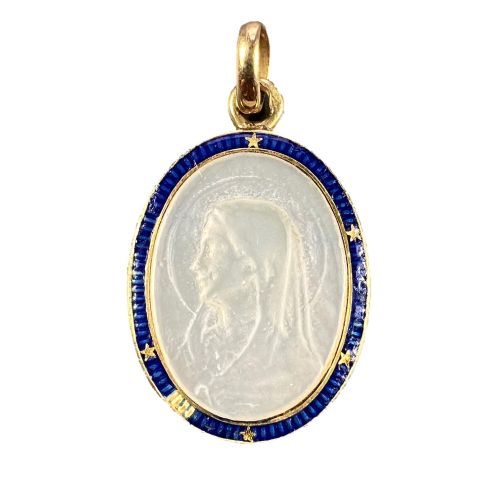
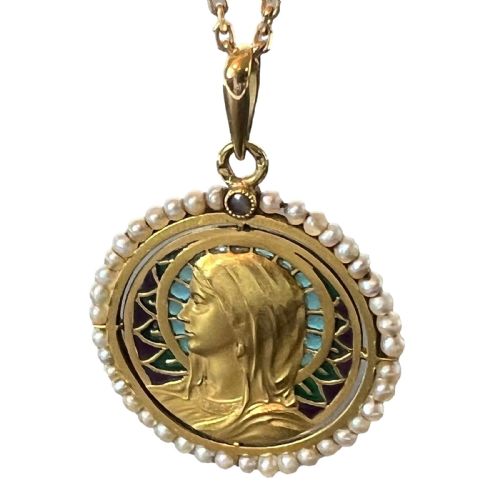
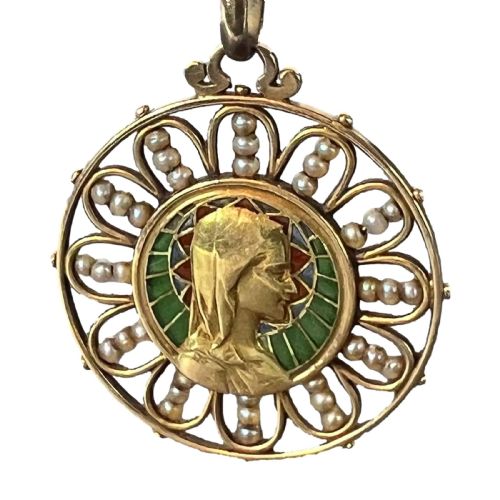
Every antique catholic pendant on this page originates primarily from French workshops spanning the late nineteenth century through the mid-twentieth century. These items manifest as small medals, charms, and pendant necklaces dedicated to religious figures including the Virgin Mary, the Madonna and Child, Saint Christopher, and the Sacred Heart.
The predominant forms are circular or oval gold medallions designed to be worn close to the body. Most examples combine traditional iconography with the stylistic influence of Art Nouveau and ecclesiastical design.
Materials and Technique
Makers shaped these devotional objects predominantly in eighteen-carat yellow, rose, and white gold. Artisans frequently integrated translucent plique-a-jour enamel to let light pass through the halo and background details of the sacred imagery.
Surface decoration relies on fine hand-engraving, relief casting, and the setting of delicate seed pearls and mother-of-pearl plaques. These combined techniques give the medals depth and texture within a very small compass.
Antique Catholic Pendant Retail Price Guide 2026
Typical asking prices for catholic pendant among the pieces listed under this phrase on Sellingantiques today, from the lower quarter to the upper quarter. They describe what is for sale here now, not the wider market.
Several makers hid their signatures so subtly within the folds of a Madonna's robe that you need a loupe just to spot the artist.
Evaluating the Workmanship
The presence of named medallist signatures and the preservation of fragile glass-like enamel elevate an individual medal. Simpler stamped charms exist alongside master-engraved works of devotional art.
Emile Monier·Emile Dropsy·Mazzoni·Pageli Perriat·Sellier·Tairac·Becker·Guilbert·Vernon
The Antique Catholic Pendant Glossary
- Plique-a-jour
- An enamelling technique where the enamel is applied without a backing, resembling miniature stained glass. It allows light to illuminate the coloured glass cells.
- Miraculous Medal
- A specific devotional medal design depicting the Blessed Virgin Mary based on apparitions reported in the nineteenth century. It is traditionally associated with protection and grace.
- Sacred Heart
- A Christian symbol representing the physical heart of Jesus Christ as a manifestation of his divine love for humanity. It frequently appears surrounded by flames or rays of light.
- Seed Pearl
- Very small natural or cultured pearls used as delicate decorative borders or accents on jewellery. They add a soft lustre against polished gold backgrounds.
Antique Catholic Pendant: Frequently Asked Questions
What subjects appear on these pendants?
The pieces predominantly portray the Virgin Mary, the Madonna and Child, and various saints such as Saint Christopher and Saint John the Baptist. Other common motifs include the Sacred Heart, holy doves, and communion chalices.
These devotional subjects reflect Catholic piety in France during the late nineteenth and early twentieth centuries. Each iconography served a specific protective or commemorative purpose for the wearer.
How are these gold pendants worn?
These items function as pendants or charms typically suspended from fine gold chains around the neck. Their small scale allows them to be worn daily as personal devotional tokens.
Historically, they were worn beneath clothing for privacy or displayed openly as expressions of faith. Today, they pair well with both antique chains and modern neckwear.
Are these medals signed by artists?
Many French religious medals bear the tiny signature or stamp of the original medallist near the lower edge. Master craftsmen signed their sculpted metalwork just as painters signed canvases.
Identifying the signature reveals the specific Parisian or provincial studio responsible for the carving. This attribution adds historical context to the piece.
How do I date these pendants?
Dating relies on stylistic clues such as Art Nouveau curves, hallmarks stamped on the gold, and recorded active dates of the individual medallists. The majority on this page date from the decades around nineteen-ten.
French gold standard marks, typically eagle heads for eighteen-carat gold, provide a reliable guide to the period of manufacture. Comparing the lettering styles and mounting techniques further narrows the decade.