
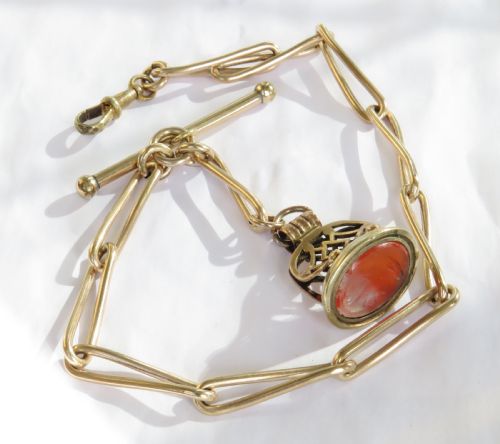
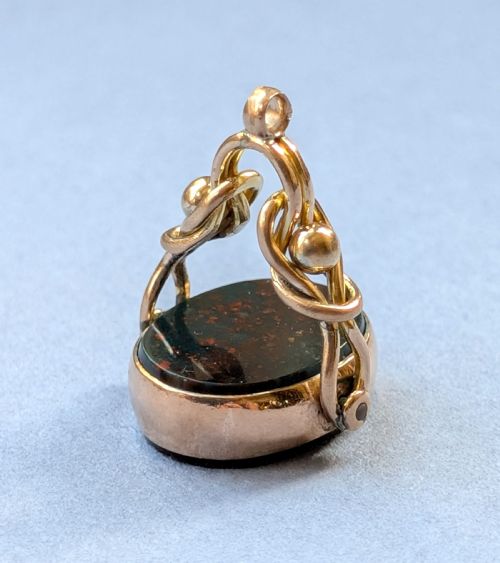

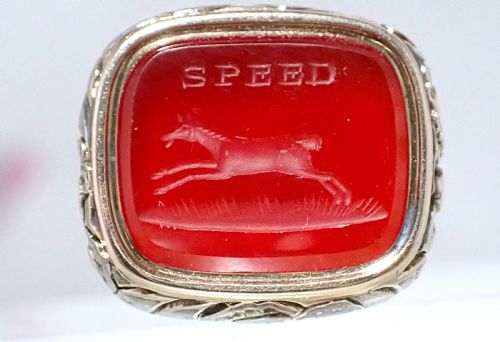


Antique Carnelian Fob
An antique carnelian fob sits on a watch chain as a dense piece of pocket history, cut with an intaglio to stamp wax or simply turned as a pendant.
Antique Carnelian Fob
When you search for an antique carnelian fob, you encounter pocket watch accessories and swivel seals that originally hung from waistcoats. The pieces take the form of spinning fobs, signet seals, watch keys, and charms suspended from albert chains.
Victorian and Georgian examples dominate the selections, alongside Edwardian and Art Deco iterations. The stones appear mounted in 9ct gold, rose gold, rolled gold, and gilt metal, often paired with bloodstone or agate.
Most items feature either a fixed stone or a rotating swivel mechanism housing carnelian on one side. Intaglio carvings range from Greek figures and Roman emperors to carved horses and initials.
Materials and construction
Goldsmiths utilised 9ct gold, 9ct rose gold, and gilt metal to house the polished chalcedony stones. Rolled gold also appears frequently in chain mounts and swivel rings.
The carnelian and cornelian stones are hand-carved with intaglio motifs, reverse-engraved so the wax impression stands in relief. Swivel mounts allow the stone to rotate within a metal frame.
Listings span Georgian, Victorian, Edwardian, and Art Deco periods, utilising carnelian, 9ct gold, rose gold, rolled gold, and bloodstone.
Distinguishing quality in seals and pendants
Quality rests in the crispness of the intaglio carving and the weight of the metal mounting. Deeply cut figures and heraldic seals command greater attention than plain polished stones.
The complexity of the surrounding metalwork also sets pieces apart, from simple gilt bezels to ornate scrolled frames and fully operational spinning mechanisms.
The Antique Carnelian Fob Glossary
- Carnelian
- A brownish-red variety of chalcedony quartz used widely for seal stones and signet rings. It takes a high polish and releases cleanly from sealing wax.
- Intaglio
- A design incised into the flat face of a stone so that an impression in wax creates a raised image. This technique was essential for personal signet seals.
- Swivel fob
- A pendant mounted on a central axis that rotates to display two different stones or faces. Many combine carnelian on one side and bloodstone on the reverse.
- Albert chain
- A pocket watch chain designed to be worn across a waistcoat or attached to a buttonhole. They frequently carry swivel fobs and watch keys as dangling attachments.
- Watch key
- A small winding key for pocket watches fashioned into a decorative pendant. They often incorporate carnelian panels matching the wearer's fob seal.
Antique Carnelian Fob: Frequently Asked Questions
How do I wear an antique carnelian fob?
These pieces hang from a pocket watch chain across a waistcoat or attach to a charm bracelet. Many collectors also suspend them individually from a modern chain as a pendant.
The scale of the swivel seals and charms suits daily wear, provided the jump rings remain secure.
What is the difference between carnelian and cornelian?
The terms describe the exact same orange-red chalcedony mineral. Older British and Georgian pieces often use the spelling cornelian on inventory records.
Both descriptions refer to the translucent quartz stone utilised for intaglio signet seals.
What are watch keys used for?
Watch keys were originally required to wind mechanical pocket watches before keyless winding mechanisms became standard. Jewelers shaped the ends to fit standard winding squares.
Today they survive as decorative fob pendants set with carnelian.
How can I date my fob?
Stylistic clues such as neoclassical motifs point toward Georgian origins, while heavier yellow and rose gold mounts typically suggest Victorian manufacture. Hallmarks on gold rings provide specific assay office letters and date stamps.
Edwardian and later 1920s pieces often feature lighter rolled gold chain work and sleeker Art Deco framing.