
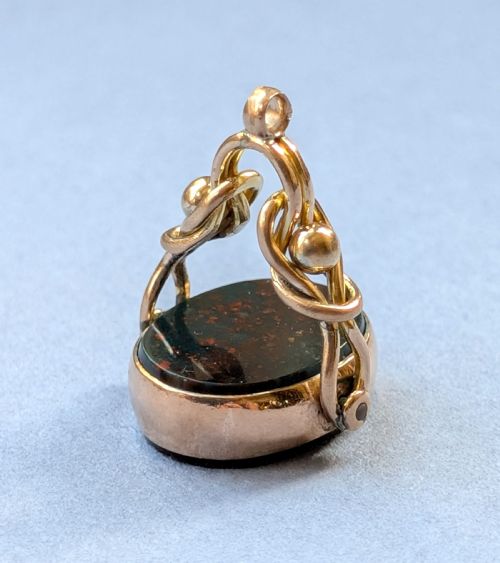


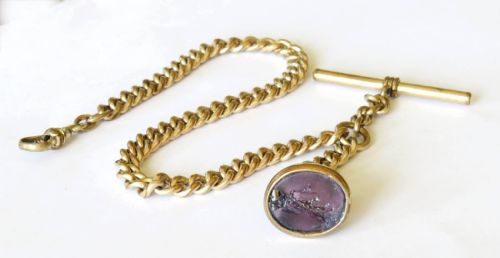


Gold Pocket Watch Seal
These gold pocket watch seal pieces are pocket watch accessories designed for stamping hot wax, combining precious metals with hardstones.
Gold Pocket Watch Seal
A gold pocket watch seal is a small pendant traditionally hung from a watch chain or albert chain to authenticate correspondence. These items serve primarily as fob seals, fob pendants, and watch keys, functioning as both practical tools and decorative jewellery.
The pieces listed on this page span the Victorian, Edwardian, and early twentieth century periods, running from eighteen eighty through to nineteen twenty. You will encounter various forms, including spinning fobs that rotate to display dual faces and carved chalcedony figures such as elephants or Roman emperors.
Materials range from solid nine carat and eighteen carat yellow and rose gold to rolled gold and gold cased variants. Hardstone insertions are prominent, featuring carnelian, bloodstone, agate, and chalcedony alongside occasional enamel work.
Materials and construction methods
Construction relies heavily on precious metals shaped into ornate bezels and swivel mounts, housing hardstone panels securely within claw or bezel settings. Goldsmiths employed casting and hand engraving techniques to decorate the metalwork and cut intaglio initials or crests into the stone faces.
Stones such as carnelian and bloodstone were carefully selected, shaped, and polished to fit rotating mechanisms or fixed pendant frames. Rolled gold and gold cased alternatives provided an accessible exterior layer of gold over a base metal core while maintaining the appearance of solid gold items.
Distinctions in quality and execution
Quality rests upon the weight and purity of the gold, moving from rolled gold and nine carat variations up to substantial eighteen carat pieces. Solid metal construction and clear hallmarks indicate superior manufacture compared to gold cased or unmarked examples.
The depth and clarity of hand engraving on both the metal mount and the hardstone intaglio dictate the level of artistry. Intricate carvings like Roman emperors or animal figures demonstrate greater skill than plain polished stones.
The Gold Pocket Watch Seal Glossary
- Fob seal
- A small pendant featuring an engraved base used for stamping wax seals on letters and documents. These items hang from pocket watch chains and double as decorative charms.
- Intaglio
- A design carved into the flat surface of a stone so that the impression produced in wax is in relief. This technique requires precise reverse cutting by hand.
- Carnelian
- A brownish-red variety of quartz chalcedony frequently used for signet seals. It provides a smooth surface for hand engraved monograms and crests.
- Bloodstone
- A dark green jasper flecked with red spots of iron oxide, utilised historically for signet stones. This durable material holds a sharp impression in sealing wax.
- Spinning fob
- A swivel-mounted pendant that rotates on a central axis to display two different faces or stones. Users can flip the piece to reveal alternative intaglios or a plain panel.
Gold Pocket Watch Seal: Frequently Asked Questions
What is a gold pocket watch seal?
A gold pocket watch seal is a small hanging accessory designed to impress personal crests or initials into hot wax. They attach to watch chains and function as both tools and decorative pendants.
These items combine precious metal mounts with carved hardstones like carnelian or bloodstone, originating mainly from the nineteenth and early twentieth centuries.
How were watch seals used historically?
Owners attached these seals to long watch chains known as albert chains, worn across the waistcoat or tucked into a pocket. When a letter required sealing, the owner detached the pendant and pressed the engraved stone into melted sealing wax.
They also served as decorative fobs and watch keys, displaying the social standing and personal taste of the wearer through engraved initials or family crests.
How do I date a Victorian or Edwardian fob?
Dating relies on assay office marks, maker stamps, and stylistic cues present on the metal mount or suspension ring. Victorian pieces often display heavy ornamentation and deep yellow gold tones.
Edwardian examples from the early nineteen hundreds tend to feature lighter constructions, sometimes utilising rose gold or refined geometric motifs alongside traditional hardstones.
What is the difference between solid gold and rolled gold?
Solid gold pieces consist of precious metal throughout, commonly found in nine carat or eighteen carat purities as indicated by hallmarks. These items maintain their metallic composition right through the core.
Rolled gold items feature a thin layer of gold mechanically bonded to a base metal substrate. This technique offered the visual appeal of gold at a lower production cost.
Can these antique seals still be used for sealing wax?
These seals remain fully functional for impressing wax provided the stone intaglio is intact and clean. The reversed carving transfers a raised image into the cooling wax just as it did historically.
Collectors often clean old wax residue from the carved crevices using a soft brush before using them for personal correspondence or decorative projects.