





Antique Bombe Desk
These heavy, curved writing pieces known as an antique bombe desk bring sweeping profile lines and substantial fitted storage straight from eighteenth and nineteenth century European workshops.
Antique Bombe Desk
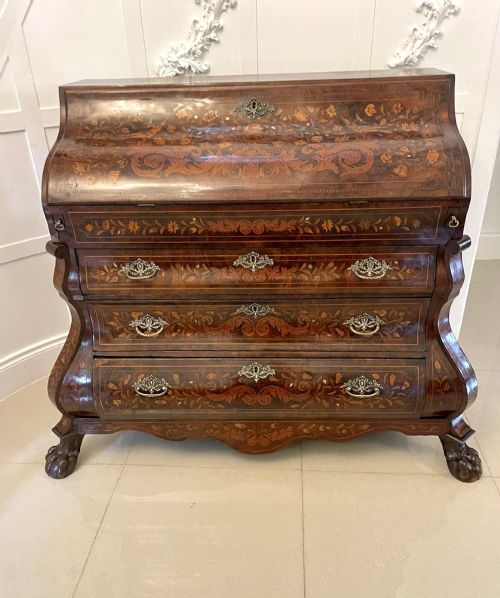
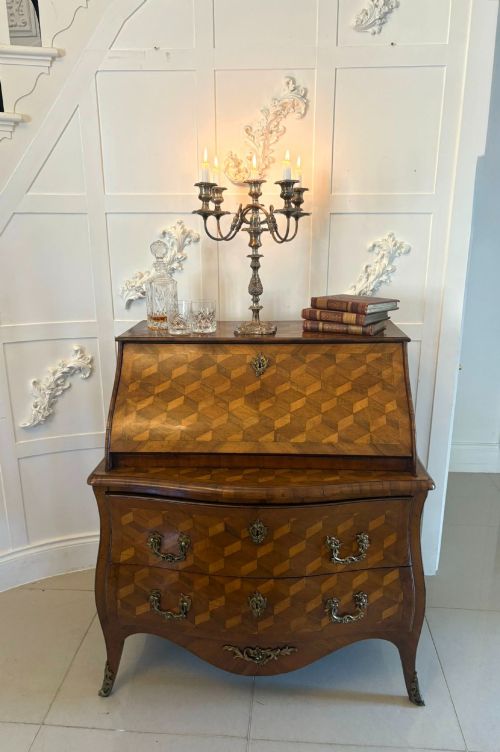
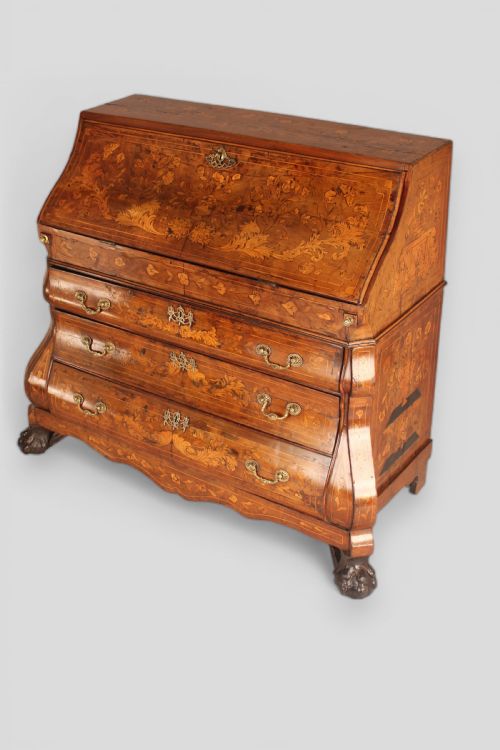
An antique bombe desk is a writing cabinet defined by swelling, convex lower fronts and sides that taper outward before curving back in toward the base. The form appears most frequently as a bureau with a sloping fall-front flap, or as a taller bureau bookcase combining glazed upper shelving with a bulging lower desk section.
Most examples originate from the eighteenth century, particularly Dutch workshops adhering to Baroque and Rococo styles, alongside later nineteenth century revivals. Walnut and burr walnut dominate the selection, heavily embellished with floral marquetry, fruitwood inlay, and parquetry patterns across the curved surfaces.
How they were made
Cabinetmakers constructed the swelling profile of a bombe desk by building up solid timber frames or utilising thick carcases of walnut, mahogany, fruitwood, yew, and elm. These curved carcasses provided a stable foundation for complex veneering work.
Craftsmen applied burr walnut veneers and intricate fruitwood marquetry in floral motifs across the undulating drawer fronts and sloping lids. Brass hardware, including drop handles and key escutcheons, was fitted to complete the exterior.
Listings feature walnut, burr walnut, mahogany, fruitwood, yew, and elm, spanning the Georgian period and the nineteenth century.
What varies in quality
Quality rests in the harmony of the swelling proportions and the precision of the curved joinery across the facade. Pieces with balanced, deeply contoured curves show superior cabinetmaking skill compared to stiffer, flatter variants.
The sophistication of the surface decoration sets the tier of the piece. Finely executed floral marquetry and well-matched burr walnut veneers indicate a higher grade of craftsmanship than simpler plain timber surfaces.
Morison of Edinburgh
The Antique Bombe Desk Glossary
- Bombe
- A French term describing furniture with a swelling or bulging outward contour on the front and sides. This distinctive shape requires specialised carpentry to achieve the curved profile.
- Marquetry
- Decorative veneer work formed by fitting together small pieces of various woods, bone, or ivory into pictorial or floral patterns. On these desks, floral marquetry often covers the entire fall front and drawer faces.
- Bureau
- A sloping desk used for writing, typically featuring a hinged flap that opens to reveal internal pigeonholes and small drawers. Many examples on this page are paired with upper bookcase cabinets.
- Parquetry
- Geometric patterns created by small strips of wood laid down in mosaic designs. It differs from marquetry through its reliance on angular, repeating geometric layouts rather than naturalistic pictures.
- Burr Walnut
- Wood taken from the knotty growths of walnut trees, yielding turbulent, highly figured grain patterns. Cabinetmakers prized this timber for its decorative impact on prominent surfaces.
Antique Bombe Desk: Frequently Asked Questions
How do I identify a true bombe desk?
Look for the characteristic outward-bulging profile on the lower drawers and sides, which distinguishes these pieces from straight-fronted furniture. The swelling contour should feel organic and continuous rather than sharply angular.
Examine the construction of the fall-front writing flap and the integration of the wood veneers across the curved surfaces. Genuine examples utilise period construction methods appropriate to eighteenth or nineteenth century European cabinetmaking.
Where were these desks made?
The majority of pieces originate from Dutch workshops influenced by Baroque and Rococo design movements. French cabinetmakers also produced comparable swelling forms during the eighteenth century and subsequent revival periods.
Regional preferences show up in the choice of veneers, with Dutch pieces frequently displaying elaborate floral marquetry over burr walnut. British and Scottish makers occasionally produced influenced designs or imported continental styles.
How should I care for burr walnut veneer?
Keep the wood away from direct sunlight and steady heat sources to prevent the burr walnut veneer from drying out or lifting. Maintaining consistent indoor humidity protects the delicate fruitwood marquetry and underlying timber.
Dust the curved surfaces regularly with a soft, dry cloth and apply a quality furniture wax sparingly when the wood appears dry. Avoid commercial silicone polishes that can damage antique finishes over time.
Can I use a bureau desk for daily writing?
The interior fitted with pigeonholes and small drawers provides practical desktop storage for letters and modern stationery. Dropping the hinged writing flap reveals a usable surface supported by the bureau structure.
Take care not to overload the fold-down flap, as the writing surface relies on internal support arms rather than heavy legs. Most users balance laptop use or light correspondence without issue.