




Anglo Indian Document Box
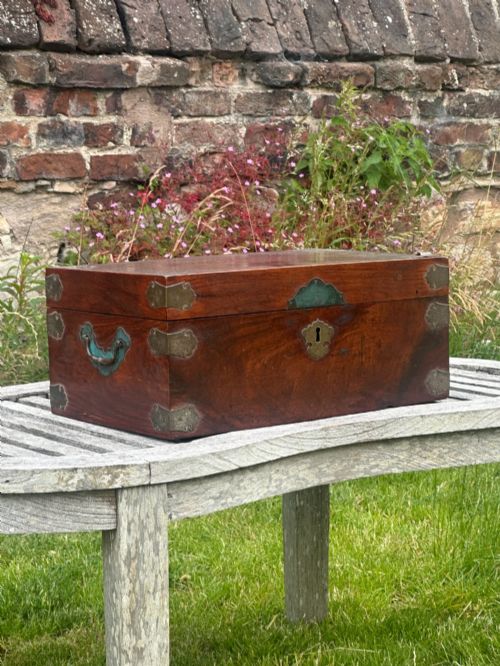
An anglo indian document box is a sturdy receptacle built for travel and safekeeping, combining British form with intricate Eastern craftsmanship.
Anglo Indian Document Box
The search phrase anglo indian document box covers a specific group of portable containers designed to hold correspondence and legal papers during the colonial era. Most pieces encountered on this page date from the nineteenth century and the Victorian period.
Makers shaped these items into writing slopes, stationery boxes, and miniature trunks, often incorporating campaign styles for ease of transport. The forms reflect the practical demands of officials and merchants moving across the empire.
Origins span regions such as Ceylon, Burma, and India itself, resulting in distinct regional interpretations of British utilitarian forms. Each piece bridges two design traditions through its specific construction and silhouette.
Materials and construction
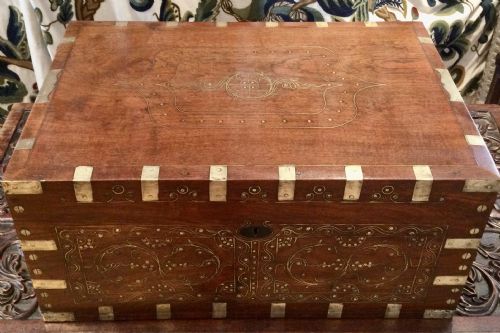
Workshops constructed these vessels using dense hardwoods including ebony, padouk, and teak, which offered durability in tropical climates. Artisans often reinforced the corners and edges with brass banding to withstand the rigours of transit.
Surface decoration frequently involved intricate bone inlay, carved wood, or geometric porcupine quill work set into the timber. Metal mounts, hinges, and campaign drop handles were secured firmly to the main body.
Markers of quality
The distinction between standard utility items and finer examples rests on the precision of the joinery and the complexity of the surface ornamentation. Elaborate carved details and meticulous bone inlay demand greater skill than plain timber surfaces.
Condition of the internal fittings, such as secret drawers and slope lids, also influences the standard of an item. Original brass hardware and intact quill or inlay work mark out superior pieces.
The Anglo Indian Document Box Glossary
- Writing slope
- A portable box with a slanted lid designed to provide a flat writing surface when opened. Inside compartments hold inkwells, pens, and paper.
- Campaign style
- Furniture and boxes designed for military use in the field, featuring recessed handles, brass corners, and folding elements for portability.
- Padouk
- A heavy, durable tropical timber with a reddish hue, frequently utilised in nineteenth-century cabinet making. It resists decay and takes a fine polish.
- Porcupine quill
- Quills arranged in geometric patterns across the exterior of boxes, particularly those originating from Ceylon. They create a textured, contrasting surface.
- Sadeli work
- A form of micro-mosaic craft involving intricate geometric patterns built from bone, horn, and metal. Artisans applied these strips to wooden box surfaces.
Anglo Indian Document Box: Frequently Asked Questions
What was an anglo indian document box used for?
These boxes served to store letters, deeds, and official papers securely while officers and merchants travelled. Their sturdy construction protected important contents from humidity and rough handling.
Many examples included internal compartments and locking mechanisms to keep confidential correspondence private during transit across land and sea.
How do I date a Victorian document box?
Dating relies on examining the timber species, style of brass mounts, and construction methods visible inside the lid. Nineteenth-century pieces often display hand-cut dovetailing and specific regional carving styles.
Makers frequently utilised dense tropical hardwoods like ebony and padouk during the Victorian era, paired with campaign-style brass reinforcement.
Are these boxes suitable for daily use?
Most antique examples function well for storing letters, stationery, or small keepsakes on a desk or shelf. Their internal compartments remain practical for modern organisation.
Care should be taken with delicate exterior elements like bone inlay or porcupine quill work when handling them regularly.
Where were these boxes manufactured?
Craftsmen produced these pieces in workshops across the Indian subcontinent, Burma, and Ceylon, often working to British design specifications. Local artisans applied traditional regional decorative techniques to European furniture forms.
Materials used typically reflected the native timbers available in the specific region of manufacture, such as teak in India or ebony in Ceylon.