



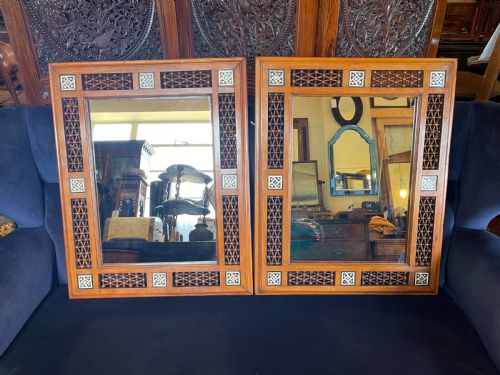


Anglo Indian Carved Mirror
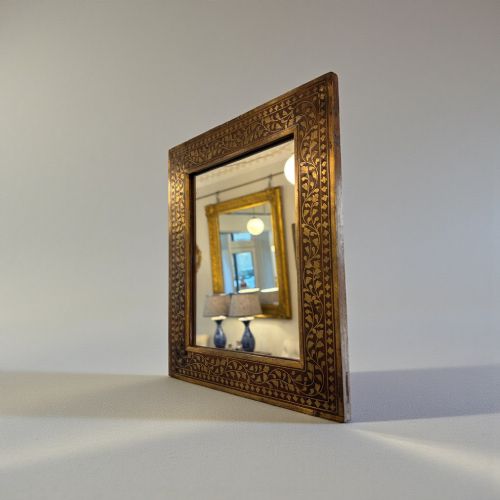
An anglo indian carved mirror brings dense, masterwork woodwork and silvered glass straight into a room.
Anglo Indian Carved Mirror
An anglo indian carved mirror unites traditional South Asian woodworking traditions with British room forms from the nineteenth and early twentieth centuries. These works range from compact hand-held vanity pieces to large wall-hanging frames designed for principal rooms.
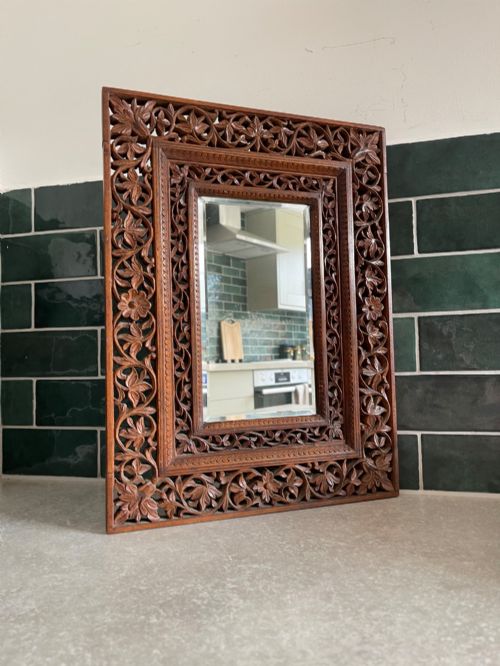
The versions most commonly met on this page belong to the late nineteenth century and the early twentieth century, spanning wall mirrors, dressing mirrors, and paired sconces. Frames frequently display deep foliate carving executed in woods such as teak, rosewood, padouk, and ebony.
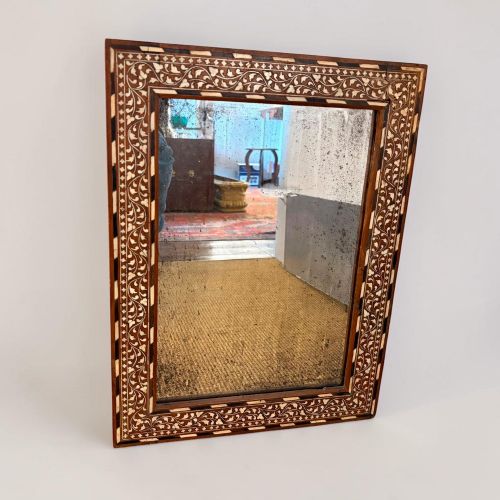
Makers drew upon distinct regional centres of production, notably Hoshiarpur and the Bombay Presidency, alongside Ottoman and Moorish revival idioms. Surviving examples often incorporate contrasting materials like brass wire inlay, bone, or ivory within the wooden borders.
How they were made
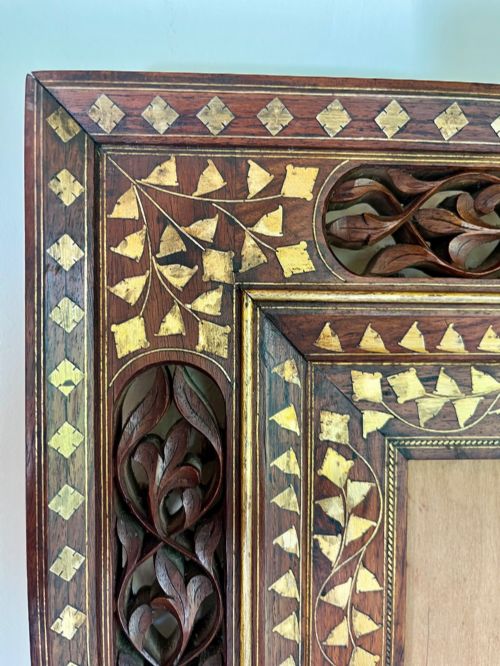
Artisans carved dense hardwoods including teak, sheesham, walnut, and padouk with fine chisels to create high-relief floral and geometric surfaces. Pierced fretwork techniques allowed light to pass through intricate open lattice borders surrounding the glass plates.
Many workshops embellished the wooden grounds with delicate brass inlay or metal wire work, pressing the wire tightly into routed channels. Dressing mirrors and Cheval forms relied on sturdy turned supports and pivoting frames to manage the heavy weight of the wood and glass.
Anglo Indian Carved Mirror Retail Price Guide 2026
Typical asking prices for anglo indian carved mirror among the pieces listed under this phrase on Sellingantiques today, from the lower quarter to the upper quarter. They describe what is for sale here now, not the wider market.
What varies in quality
The depth and crispness of the carving separate standard commercial frames from exceptional artisan pieces. Sharply undercut foliage and clean, symmetrical piercing show the hand of a master carver rather than a hurried workshop production.
The integrity of the timber and the preservation of secondary materials like brass wire inlay define the standard of survival. Heavier timbers such as padouk and ebony hold fine detail better over time than softer woods.
The Anglo Indian Carved Mirror Glossary
- Hoshiarpur
- A district in Punjab renowned for intricate woodwork and inlay using brass, bone, or ivory. Pieces from this centre typically feature dense geometric and floral patterns covering the entire wooden frame.
- Cheval mirror
- A full-length mirror hung in a frame that permits it to swing at an angle on vertical pins. This form stands independently on its own floor base rather than hanging upon a wall.
- Overmantle mirror
- A large horizontal looking glass designed specifically to sit directly above a fireplace mantelpiece. These frames often match the grand proportions of nineteenth-century reception rooms.
- Padouk
- A heavy, durable tropical hardwood with a reddish hue favoured for fine furniture and decorative frames. It accepts sharp chisel work without splintering.
- Sconce
- A wall-mounted bracket holding a candle or light source, frequently incorporating a mirrored backplate to amplify illumination. Pairs of these fixtures are common in the archive.
Anglo Indian Carved Mirror: Frequently Asked Questions
Where did these mirrors originate?
These mirrors originated in various regions across the Indian subcontinent during the British colonial period, combining local artisan techniques with European room furniture forms.
Production centres included Hoshiarpur in the Punjab and the Bombay Presidency, where specialist woodworkers created distinct regional carving styles.
How do I hang a heavy carved mirror safely?
Heavy hardwood frames require robust wall fixings anchored directly into masonry or substantial timber studs rather than standard plasterboard hooks.
Professional mirror plates or heavy-duty Z-bars screwed securely into the back frame ensure the considerable weight of the teak or mahogany is safely supported.
How do I date an anglo indian mirror?
Dating relies on examining the timber species, the style of the carving, the method of mirror plate bevelling, and the construction of the backing boards.
Nineteenth-century examples often feature dense hand-carved teak or padouk, while pieces from the early twentieth century frequently display Hoshiarpur brass wire inlay work.
How should I clean carved wooden frames?
Dust accumulated within deep foliage and pierced fretwork is best removed gently using a soft-bristled artist brush or a low-suction vacuum with a brush attachment.
Avoid liquid furniture polishes and wet cloths, which can darken raw timber and leave residues trapped inside the intricate carved channels.