


Alpine Landscape Painting
These alpine landscape painting works capture towering peaks and glacial valleys, offering a window into rugged mountain scenery that draws collectors to the genre.
Alpine Landscape Painting
An alpine landscape painting captures mountain peaks, deep valleys, and remote high-altitude terrain, often focusing on Swiss, Austrian, German, or Italian vistas. The works on this page span the nineteenth century and the early twentieth century, showing a clear evolution in how artists recorded dramatic topography.
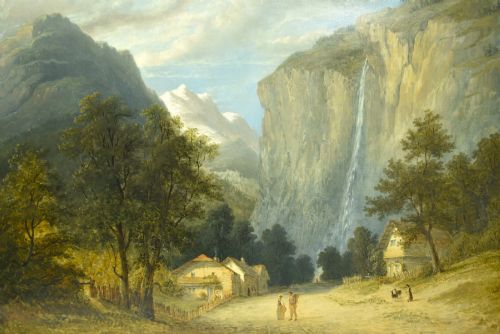
Most examples belong to nineteenth-century romanticism or the Victorian era, depicting familiar landmarks such as Staubbach Falls, the Lauterbrunnen valley, and Bavarian castles. Viewers frequently encounter snow-capped mountains, mountain streams, and still lakes rendered with careful attention to natural light and atmospheric depth.
The assortment includes both large oil paintings on canvas and delicate watercolours on paper, framed behind glass to protect the pigment. Buyers will find individual canvases as well as paired watercolours that document specific journeys through the Alps.
Materials and methods
Artists relied primarily on oil paint applied to canvas or wood panels, alongside watercolour pigment worked directly onto paper supports. Oil paint allowed for rich impasto and layered depth to build up the heavy mass of glaciers and rocky precipices.
Watercolour works required swift, confident washes to capture shifting mountain weather, often finished with fine pencil or pen detail to define distant peaks and alpine chalets.
Recorded supports include canvas, wood, glass, and heavy paper, reflecting the varied field methods nineteenth-century artists used while sketching in the Alps.
Assessing quality
Top-tier works distinguish themselves through confident brushwork that conveys the immense scale and geology of the mountains rather than relying on stiff topographical tracing. The handling of atmospheric light upon snow and water separates a master painter from a routine commercial copyist.
Provenance and legible signatures also elevate certain canvases, connecting specific views to known regional schools or documented artists who travelled extensively through Switzerland and Bavaria.
Karl Herrle·Noel Harry Leaver·A. Michaelis·Hubert Sattler·Axel Nordgren·Max Josef Wagenbauer·Emil Von Ernst·Max Märtens
The Alpine Landscape Painting Glossary
- Romanticism
- An artistic movement emphasising emotion, awe, and the overwhelming power of nature. Works in this style often use dramatic lighting to highlight towering peaks and dark chasms.
- Impasto
- The technique of laying paint thickly on a canvas so that it stands out from the surface. Painters use this method to give texture to snowy crags and rocky outcrops.
- Watercolour
- A paint consisting of pigment suspended in a water-based solution, applied to paper. It provides translucent washes that suit the pale skies and misty air of high altitudes.
- Gothic
- A style of architecture or art characterised by pointed arches and medieval revival details. In these listings, it frequently describes romanticized castles nestled within the mountain terrain.
Alpine Landscape Painting: Frequently Asked Questions
What subjects appear in these works?
The compositions generally feature snow-capped mountain ranges, waterfalls, alpine lakes, and remote valleys. Many pieces specifically record named locations across Switzerland, Austria, Northern Italy, and Bavaria.
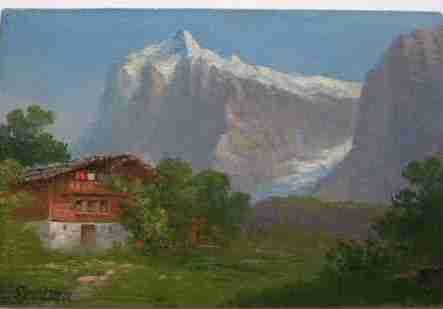
Artists frequently placed small figures of travellers, waterfalls, or wooden chalets in the foreground to emphasise the immense scale of the surrounding peaks.
How do I identify the period?
Dating relies on stylistic clues such as the dramatic atmosphere of nineteenth-century romanticism or the softer palette of later Victorian watercolours. Frame construction, canvas types, and artist signatures also help establish the date.
Archival records and inscriptions on the reverse of the canvas or paper often provide exact dates and regional titles.
Where were these pieces displayed?
Wealthy nineteenth-century travellers originally bought these paintings as mementoes of their grand tours across the European Alps. They hung primarily in formal drawing rooms and libraries as a way to display culture and foreign travel.
Today, collectors place them in studies, living rooms, and hallways where traditional frames complement classic interiors.
How should I care for watercolour versus oil?
Oil paintings on canvas tolerate ambient indoor environments well but require protection from direct sunlight and damp conditions. Keeping the canvas tension correct prevents sagging and cracking of the paint layer.
Watercolours on paper are highly sensitive to ultraviolet light and must hang away from direct sun exposure behind protective glass to prevent fading.