



Agricultural Landscape Art
Agricultural landscape art captures the labour, livestock and harvests of the countryside across the nineteenth and twentieth centuries.
Agricultural Landscape Art
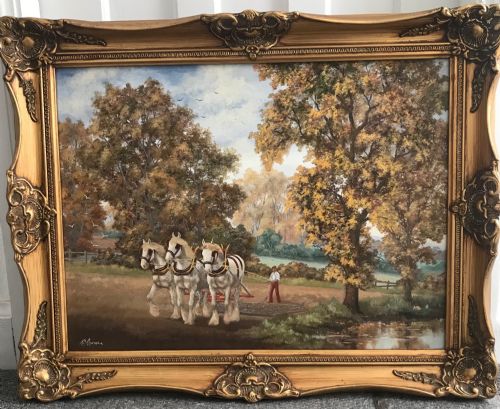
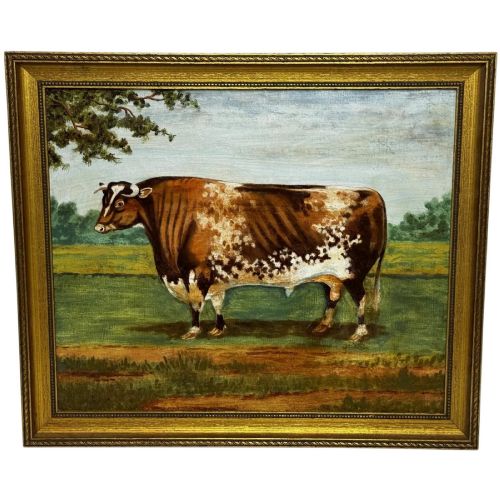
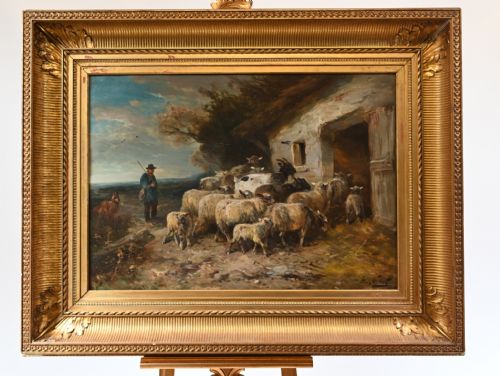
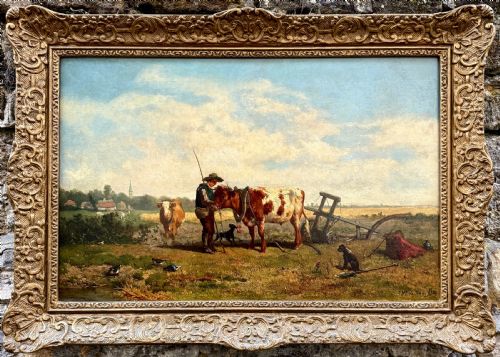
Agricultural landscape art encompasses paintings, watercolours and etchings depicting rural scenes, farmyards, ploughing teams and harvesting operations. When exploring agricultural landscape art, buyers frequently encounter works executed in oil on canvas or watercolour on paper from the Victorian era through the mid-twentieth century. These pieces record the daily realities of farming life, featuring shire horses, cattle and farmworkers across British and European rural settings.
The subjects range from detailed equine portraits of working shire horses to expansive pastoral vistas of haymaking and corn harvests. Many examples focus on specific rural tasks, such as ploughing fields, tending calves or loading hay carts into barns. This genre reflects a deep artistic engagement with the agrarian economy prior to the widespread mechanisation of farming.
Materials and Techniques
Artists working in agricultural landscape art relied primarily on oil paint applied to canvas or wood panels, alongside watercolours rendered on paper. Oil paintings allowed for rich textures and deep colour layering, particularly suited to depicting heavy horses, muddy fields and dramatic skies. Watercolours offered a lighter medium for capturing the atmospheric light of haymaking scenes and rural village life.
Framing played an integral role in the presentation of these works, with many period pieces housed in ebonised frames, gesso mouldings or burr wood surrounds. Etchings provided a graphic method for capturing linear detail in rustic compositions, utilising fine plate marks and ink on paper. The physical construction of the canvas supports and heavy wooden frames reflects the traditional workshop practices of Victorian and Edwardian picture makers.
Listings feature works spanning the nineteenth century through the 1950s, created in oil and watercolour on canvas and paper.
Assessing Quality and Execution
Quality in agricultural landscape art rests upon the artist's ability to render anatomy and movement correctly, particularly in depictions of heavy horses and livestock. Superior works demonstrate a confident handling of light and shadow, distinguishing between the texture of animal coats, coarse straw and damp earth. Weaker pieces often rely on stiff, formulaic compositions with static figures and heavy, uninspired brushwork.
The coherence of the palette and the atmospheric depth of the background landscape separate finer examples from routine decorative paintings. Masterful brushwork brings vitality to farmyard scenes, whereas lesser works display flat application and unconvincing perspective. The preservation of the original canvas, combined with an appropriate period frame, contributes significantly to the integrity of the piece.
Henry Schouten·Johannes de Haas·Herbert Dicksee·Oswald Garside·Raimond Louis Lecourt·James William Booth·Henry Bailey·Herbert Royle·Percival Glenfern·John Atkinson·George Soper·Arthur Winter Shaw·Arthur Charles Dodd·Vernon Stokes·Rowland Henry Hill·Joseph Kirkpatrick·Joseph Paulman·Frederick William Jackson·John Percy Cooke·Arthur Claude Strachan·Ernest Higgins Rigg·Walter Duncan·George Hamilton Constantine·George Cole·William Greaves
The Agricultural Landscape Art Glossary
- Etching
- A printmaking technique where an artist uses acid to cut into the unprotected parts of a metal plate to hold the ink. This process allows for fine, highly detailed lines in rural graphic works.
- Gesso
- A plaster-like mixture applied to canvas or wooden frames as a base for painting or gilding. It provides a smooth, stable surface for decorative mouldings.
- Pastoral
- A genre of art depicting the rural countryside and the peaceful lives of shepherds and farmers. These scenes romanticise traditional agricultural labour.
- Shire Horse
- A British breed of draught horse frequently depicted in agricultural art working the land. Their massive scale and muscular build made them central subjects for equine artists.
- Watercolour
- A paint consisting of pigment suspended in a water-based solution, typically applied to paper. It is prized for its translucent qualities and immediacy.
Agricultural Landscape Art: Frequently Asked Questions
What subjects appear in agricultural landscape art?
These works typically feature working horses, cattle, farmhands, and rural harvest scenes. Common motifs include haymaking, ploughing teams, and farmyard animals.
The focus remains on the traditional practices of farming and rural life before modern mechanisation altered the countryside.
How do I care for an oil painting on canvas?
Keep paintings away from direct sunlight, excessive moisture, and rapid temperature fluctuations. Dust the surface gently with a soft, dry brush without applying pressure.
Avoid using water or chemical cleaners on the canvas or the original frame.
How can I distinguish a watercolour from an oil painting?
Watercolours are painted on paper, usually displayed under glass, showing a thin, translucent application of pigment. Oil paintings use thicker paint on canvas or wood, exhibiting visible brush texture and relief.
Watercolours rely on the white of the paper for highlights, while oils build up light with opaque pigments.
What periods do these rural artworks come from?
The pieces span the late nineteenth century through the mid-twentieth century, encompassing Victorian, Edwardian, and mid-century movements. British Impressionism and 19th Century Realism heavily influence the artistic styles of this era.
Most works reflect the prevailing academic and regional realist traditions of their respective decades.