




Canvas Harvest Wall Art
Canvas harvest wall art brings rural labour and late summer light into a room through oil paint on canvas.
Canvas Harvest Wall Art
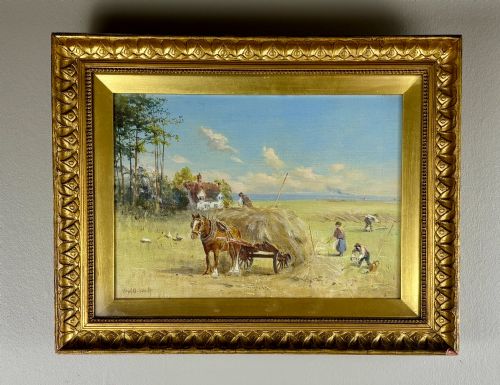
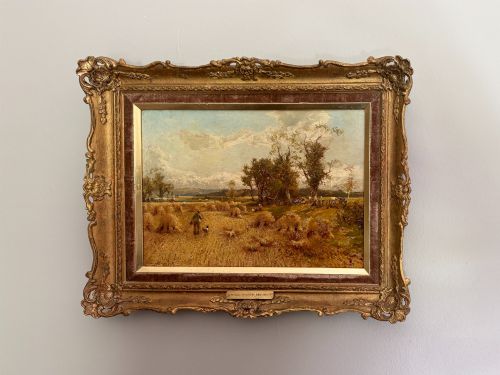
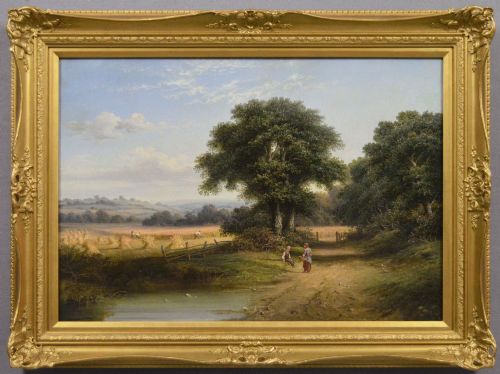
Canvas harvest wall art comprises oil paintings on canvas that depict agricultural scenes, farmworkers, and cornfields from the nineteenth and twentieth centuries. These works range from Victorian pastoral compositions by artists such as Walter Heath Williams and Henry H Parker to later modernist interpretations from the nineteen-fifties.
Buyers look for these pieces to bring traditional agrarian landscapes and scenes of rural industry into domestic interiors. The most common examples on this page are nineteenth-century oil paintings framed in giltwood that capture figures gathering wheat, hay, or corn.
The styles represented span British and Scottish Impressionism, Victorian Realism, and European School works. Each piece records agricultural methods of the past through the medium of oil on canvas.
What varies in quality
The distinction between works rests upon the artist's ability to handle light and atmosphere across the landscape. Superior paintings demonstrate confident brushwork in the rendering of figures, horses, and crops, whereas lesser pieces rely on formulaic foliage and static compositions.
Condition plays a role in assessment, particularly the stability of the oil paint layer on the canvas and the preservation of the original gilt frame. Works by recorded painters with documented exhibition histories command greater attention than anonymous school pieces.
Materials recorded across these listings include oil on canvas, wood, giltwood, and gold leaf.
Walter Heath Williams·Henry John Boddington·William Grant Murray·J.C. Grey·James William Booth·Henry H Parker·Helmut Reuter·Joseph Paulman·Arthur Walker Redgate·George Cole·William Savage Cooper·Joseph Thors·Alfred Augustus Glendening Snr
The Canvas Harvest Wall Art Glossary
- Oil on canvas
- Pigment ground in drying oil applied to a woven fabric support. This combination allowed artists to blend tones smoothly and build rich surface textures.
- Giltwood
- Timber carved and coated with gold leaf or metallic paint. It frames many nineteenth-century works and reflects ambient light onto the canvas surface.
- Victorian Realism
- An artistic approach focusing on everyday subjects and agricultural workers without idealisation. It documents rural life with direct observation of light and labour.
- Impressionism
- A style emphasising open brushwork and the depiction of light in its changing qualities. British and Scottish variations capture the specific atmospheric conditions of regional harvest fields.
Canvas Harvest Wall Art: Frequently Asked Questions
What periods do these paintings come from?
The works span from the nineteenth century through to the nineteen-fifties. Most examples originate from the Victorian period and the early twentieth century.
Key dates represented include the eighteen-eighties, nineteen-hundreds, and nineteen-twenties, reflecting shifting styles in British landscape painting.
How were these agricultural scenes painted?
Artists used oil paint applied directly to stretched canvas using brushes and sometimes palette knives. This medium allowed them to capture shifting light across fields and the textures of crops.
Many of these canvases are housed in their original timber and giltwood frames.
Who painted these harvest scenes?
The collection includes works by identified British and European artists such as Walter Heath Williams, Henry H Parker, and James William Booth. Other pieces originate from the naive school or broader European schools.
Signatures are present on several canvases, attributing the rural landscape studies to specific nineteenth and twentieth-century painters.
How do I hang a canvas oil painting?
Canvas paintings should be hung away from direct sunlight and steady heat sources to protect the oil paint and canvas support. Use appropriate wall fixings that match the weight of the frame.
Ensure the painting hangs level using two fixing points for wider giltwood frames.