


Adjustable Footstool
These adjustable footstool pieces provide a practical rest for your feet, combining period timber and upholstery.
Adjustable Footstool
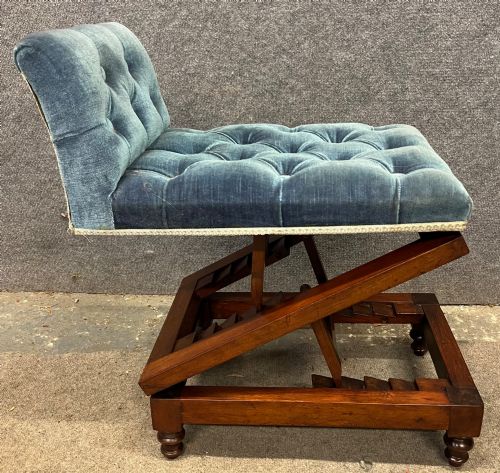
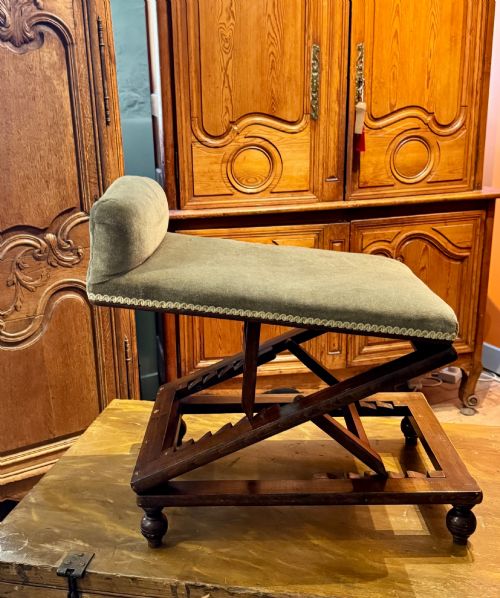
An adjustable footstool serves as a movable support for resting feet or legs while seated, often featuring a mechanism to alter the height or angle. When you search for an adjustable footstool, you encounter forms designed for relaxation as well as specialised tasks.
The selections span the Victorian, Edwardian, and William IV periods, alongside the Aesthetic Movement and late 19th century. Stained-beech, mahogany, walnut, ebonised timber, and beechwood form the wooden frames.
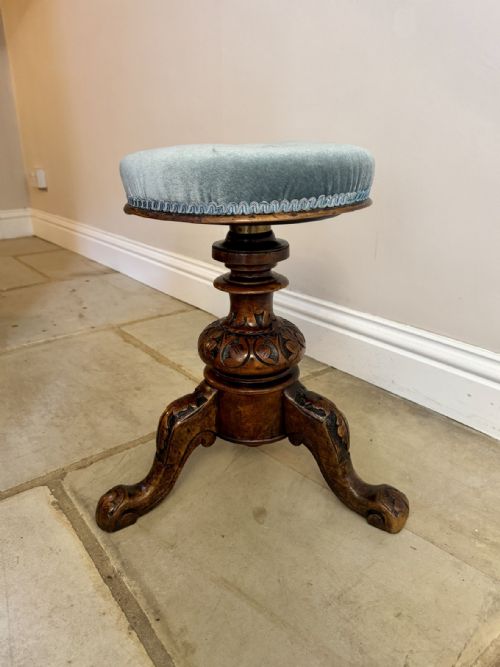
You meet various specific forms among these listings, including gout stools, rocking gout stools, revolving piano stools, and a reclining library reading armchair footstool. Upholstery materials such as velvet, textile, leather, fabric, and tapestry cover the cushions.
How they were made
Cabinetmakers shaped solid hardwoods like mahogany and walnut, carving details into the wood or utilising ebonised finishes. Brass components frequently served internal or external mechanical parts that allowed the stools to revolve or alter angle.
Makers applied various textiles to pad the tops, stretching velvet, leather, fabric, and tapestry over internal stuffing. Frames incorporate turned legs, carved woodwork, and rocking mechanisms built to withstand regular adjustment.
The listings feature velvet, leather, fabric, and tapestry upholstery mounted on mahogany, walnut, and beechwood frames.
What varies in quality
The standard of carving and timber selection dictates the distinction between ordinary production and finer examples. Walnut and mahogany frames with crisp relief carving and sturdy structural joints stand apart from simpler stained-beech versions.
The complexity and smoothness of the adjustment mechanism also affect the piece. Revolving piano stools and metamorphic gout stools rely on well-engineered internal parts that operate reliably without sticking or wobbling.
James Shoolbred
The Adjustable Footstool Glossary
- Gout stool
- A specialised footstool with an adjustable incline designed to elevate and comfort feet affected by gout. These pieces tilt to various angles.
- Metamorphic
- Describing furniture that transforms from one form or function into another. In these listings, metamorphic footstools adjust their height or angle.
- Revolving piano stool
- A seat with a mechanism allowing the top to spin around, helping musicians adjust their height and position at the keyboard. They frequently feature wooden pillars and three or four legs.
- Ebonised
- Wood treated with a dark stain or finish to imitate the appearance of ebony. This dark surface finish appears on Aesthetic Movement pieces.
- Aesthetic Movement
- A late 19th-century design style emphasising visual beauty over narrative or moral content. Pieces in this style often display clean lines and dark finishes.
Adjustable Footstool: Frequently Asked Questions
What is a gout stool?
A gout stool is an adjustable footrest designed to elevate the feet at an inclined angle. People historically used them to relieve discomfort.
These pieces feature hinged platforms that alter position via mechanical supports. The listings include examples from the Victorian and Edwardian eras.
How do piano stools adjust?
Piano stools adjust by spinning the upholstered seat top around a central threaded screw. This action raises or lowers the sitting height.
Musicians utilised this mechanism to achieve the correct posture at the keyboard. Walnut and mahogany serve as the primary woods for these revolving seats.
What materials cover the upholstery?
Upholstery materials on these stools include velvet, leather, fabric, and tapestry. Each textile provides a different texture and visual weight.
Original coverings often show signs of age, while restored pieces feature fresh leather or fabric. These materials were chosen to complement the polished timber frames.
How do I identify Victorian pieces?
Victorian pieces display characteristic timber choices such as walnut and mahogany alongside heavier carved ornament. Makers during this reign produced diverse seating forms.
The period spans the 19th century and encompasses both ornate carved walnut and simpler stained-beech frames. Examining the wood and joinery helps confirm the era.