


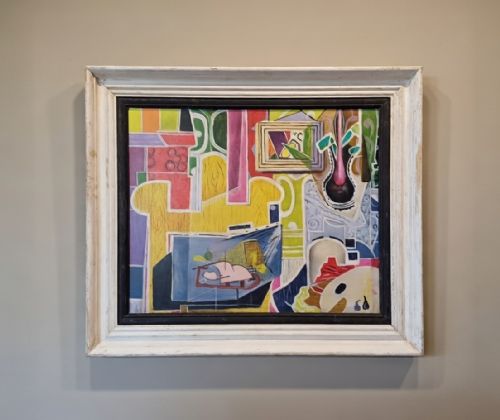


Abstracted Still Life
Abstracted still life pieces capture household objects through the lens of modernism, offering structured compositions that suit contemporary interiors.
Abstracted Still Life
An abstracted still life reduces everyday objects like pottery, fruit, and instruments into geometric planes and simplified forms. These works emerge most frequently from the 1920s to the 1960s, spanning British and French modernist movements.
Buyers encounter canvases and boards depicting kitchen scenes, domestic interiors, and floral arrangements. The compositions often channel cubist or fauve sensibilities, prioritising form and colour over strict realism.
Materials and techniques
Artists apply oil paint directly to canvas, wood, or board, sometimes working with pastel on paper. The brushwork ranges from flat, solid colour blocks to layered pigment that builds tangible texture across the surface.
Support materials vary by period and region, with French and British works utilising stretched canvas or sturdy board panels. Framing often consists of simple wooden surrounds that complement the modernist aesthetic.
The documented dates span from 1920 to the early 1960s, capturing the height of mid-century modernist exploration.
Quality and execution
Superior works demonstrate a confident command of geometry and palette, where the reduction of the subject enhances the spatial tension of the composition. Weaker pieces rely on formulaic arrangements that lack the inventive structural rhythm seen in works by established artists.
The strength of the provenance and the clarity of the artist's vision dictate the standing of a piece within this genre. Works retaining exhibition history or direct ties to known regional schools show greater artistic ambition.
Denis Mitchell·Edward Carter Preston·Nicolas Issaiev·Jacques Carelman
The Abstracted Still Life Glossary
- Cubism
- An early twentieth century avant garde movement that revolutionised European painting by breaking subjects down into a multiplicity of flat planes. Objects are viewed from multiple angles simultaneously rather than from a single fixed viewpoint.
- Fauvism
- A style associated with painters who used bold, unnatural colours and painterly qualities to express emotional intensity. The movement flourished in France prior to the mid twentieth century.
- St Ives School
- A group of artists based in Cornwall who developed significant modernist painting practices from the 1940s onwards. Their output bridged domestic subjects with coastal abstraction.
- Modernist
- A descriptor for art that rejects traditional academic realism in favour of experimentation, abstraction, and new ways of seeing the material world.
Abstracted Still Life: Frequently Asked Questions
What is an abstracted still life?
These works take conventional domestic subjects, such as fruit, flowers, and kitchen utensils, and render them through simplified geometric forms and non-naturalistic colours. Rather than recording visual facts, the artist prioritises composition, balance, and spatial rhythm.
Such pieces emerged strongly across British and European art during the mid twentieth century, breaking away from traditional academic painting styles.
How were these paintings displayed?
Most of these works appear in simple wooden frames suited to mid-century interiors, allowing the bold colours and abstracted lines of the canvas to dominate. They function well as focal points in domestic living spaces.
Collectors generally hang them away from direct sunlight to preserve the stability of the oil paint and canvas supports.
How do I spot a cubist influence?
Cubist-influenced pieces dissect tables, vessels, and fruit into angular facets and overlapping planes. The perspective shifts, showing multiple sides of a tureen or a guitar at the same time.
This technique flattens the traditional three-dimensional depth of the room into a tightly organised surface pattern.
Which periods are represented?
The works span from the 1920s through to the 1960s, capturing the evolution of European and British modernism. Mid-century examples from the 1940s and 1950s appear most frequently.
Post-war French colourist movements and the St Ives circle both contribute significantly to the available styles.