


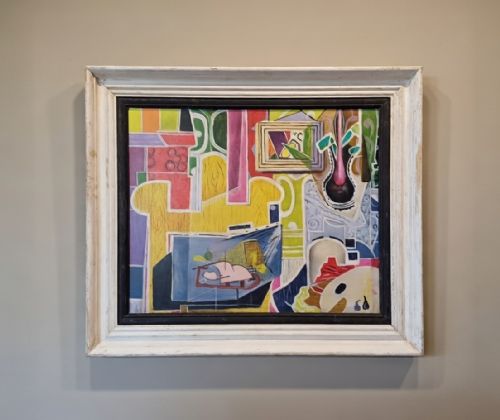


Abstract Still Life Painting
An abstract still life painting breaks everyday domestic objects into geometric planes and expressive colour, bringing mid-century modern character directly to a wall.
Abstract Still Life Painting
When you search for an abstract still life painting, you encounter works that reimagine ordinary domestic scenes, pottery, and flowers through a modernist lens. These pieces belong predominantly to the mid-century modern era, spanning from the nineteen-twenties through to nineteen-sixty.
The compositions on this page range from domestic kitchen geometry and interior scenes to French colourist works featuring fruit and wheat. Artists working in these styles reduce bowls, tureens, and flora to essential shapes and planes rather than rendering them realistically.
You meet both large oil paintings on canvas and smaller works on paper or board. Many examples carry distinct influences from cubism, the St Ives school, and the modernist movements of the twentieth century.
Materials and construction
Canvas and wood board serve as the primary supports for these oil paintings, providing a sturdy foundation for thick application and textured brushwork. Painters also utilised paper for pastels, watercolours, and mixed media compositions.
Oil paint dominates the surviving works, allowing artists to build rich surfaces through layering and deliberate brushstrokes. Some pieces incorporate ink and watercolour alongside oil to achieve lighter, more graphic effects.
Framing often complements the mid-century aesthetic, utilising simple wood mouldings that draw focus entirely to the painted surface.
The documented pieces span four distinct decades, stretching from nineteen-twenty through to nineteen-sixty.
What separates the fine from the ordinary
Quality in an abstract still life painting rests on the strength of its composition and the confidence of the brushwork. The finest works demonstrate a rigorous command of geometry and colour harmony, where every plane supports the overall structural balance.
Provenance and association with recognised artistic movements or significant geographic schools elevate a piece considerably. Works that display a distinct individual voice within modernist or cubist traditions command greater attention than derivative pieces.
Mark Ingram·Denis Mitchell·Edward Carter Preston·Jacques Carelman
The Abstract Still Life Painting Glossary
- Cubism
- An early twentieth-century avant-garde art movement that revolutionised European painting by breaking subjects up into multi-angled geometric planes. This approach discards traditional perspective in favour of showing multiple viewpoints simultaneously.
- Oil paint
- A slow-drying paint made by combining pigment particles with a drying oil such as linseed. It allows for deep colour saturation and varied surface textures ranging from smooth glazes to thick impasto.
- Mid-Century Modern
- A design and art movement spanning roughly from the nineteen-thirties to the mid-sixties, characterised by clean lines, abstraction, and functional minimalism. In painting, it manifests as a rejection of strict academic realism in exchange for expressive form.
- Board
- A rigid flat material, such as wood or masonite, used as a support for painting instead of stretched canvas. It offers a firm surface that resists sagging and accommodates direct, vigorous brushwork.
Abstract Still Life Painting: Frequently Asked Questions
What defines a mid-century abstract still life?
These paintings depict everyday objects like fruit, flowers, and pottery through simplified geometric forms rather than strict realism. They reflect the experimental modernist movements active between the nineteen-twenties and nineteen-sixties.
Artists working in this tradition prioritised colour relationships and structural composition over accurate optical representation. The resulting artworks transform ordinary kitchen scenes into dynamic visual arrangements.
How were these paintings displayed originally?
Most works were framed in simple wooden mouldings suited to contemporary domestic interiors of the mid-twentieth century. Their moderate scale allowed them to sit easily within living spaces and dining rooms.
Today, they function well as focal points on neutral walls or grouped alongside other modernist art and vintage furnishings.
How do I identify a cubist influence?
Cubist-influenced paintings break objects down into flat geometric facets, intersecting planes, and multiple viewpoints simultaneously. You will notice guitars, tables, and soup tureens rendered as arrangements of angles and blocks of colour.
This technique departs from traditional perspective to emphasise the flat surface of the canvas itself.
What is the difference between canvas and board supports?
Canvas is woven fabric stretched over a wooden frame, offering slight give and a textured surface under the brush. Board is a rigid wooden or composite panel that provides complete firmness.
Both supports were common during the mid-century period, often chosen by the artist depending on the desired scale and brushwork technique.