
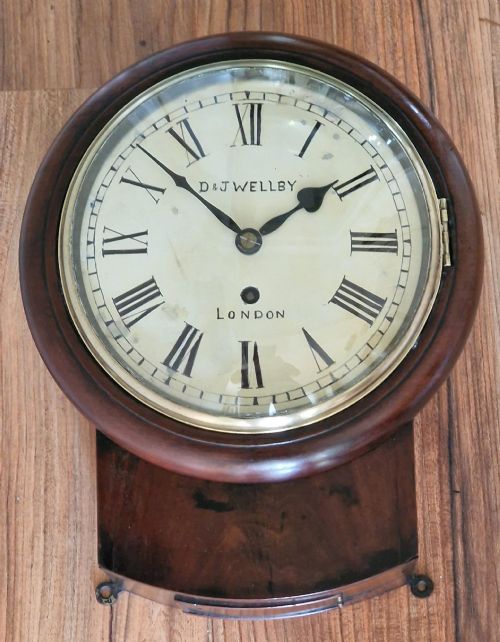
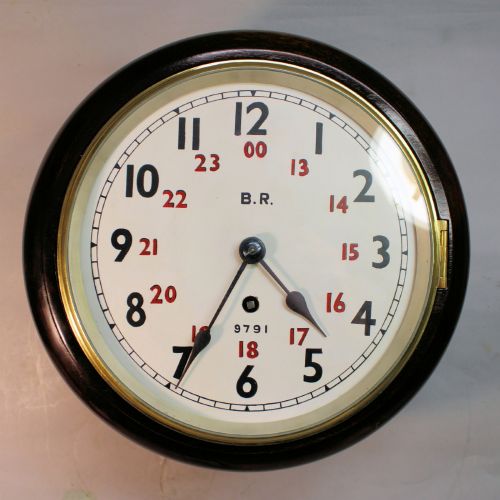
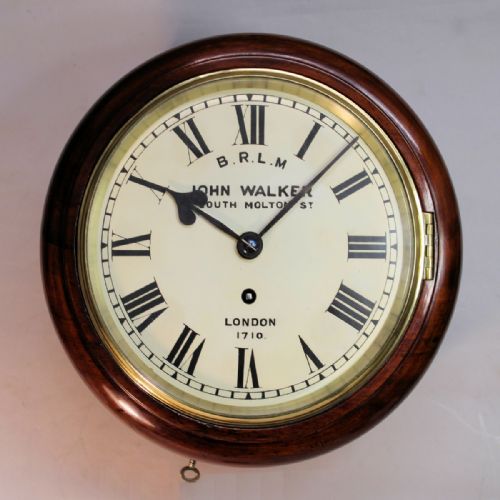
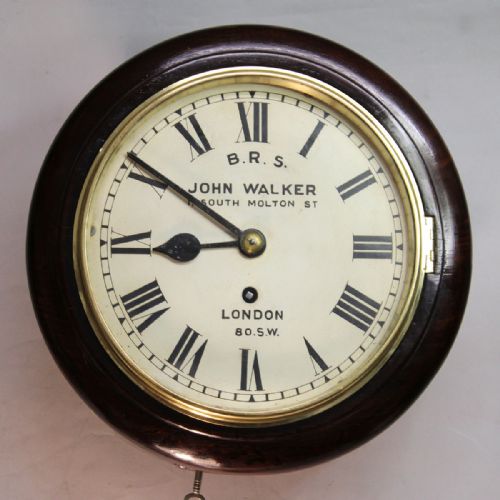


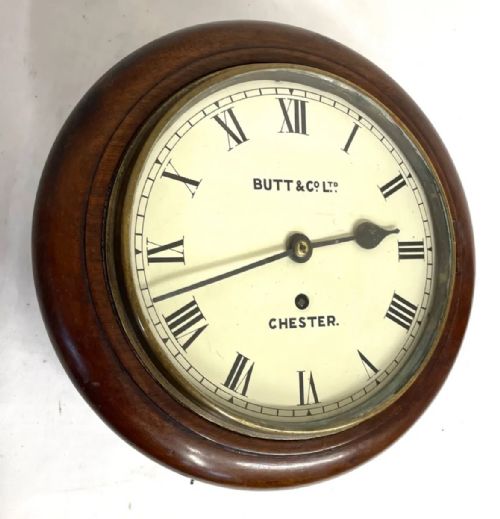


8 Inch Fusee Clock
An 8 inch fusee clock is a compact timekeeper driven by a conical pulley, prized for reliable timekeeping and neat proportions.

8 Inch Fusee Clock
An 8 inch fusee clock is a wall-mounted timepiece housed in a sturdy wooden case designed for clear legibility in domestic and public spaces. The evidence shows these pieces appear in periods from the Georgian era through to the mid-twentieth century, with Victorian examples frequently emerging.
The compact eight-inch dial size makes these items especially suited for smaller rooms or narrow wall spaces where larger dial formats would overwhelm the interior. They frequently emerge as utilitarian railway or postal office timepieces alongside domestic variants.
Materials and construction
Cases utilise dense hardwoods such as mahogany and oak, occasionally featuring rosewood or brass inlay, built to protect the delicate mechanical movement within. The dials are typically painted iron or enamel, protected by hinged glass bezels fitted in brass rims.
The mechanical heartbeat relies on a fusee movement, which uses a cone-shaped pulley to equalise the declining pull of the mainspring as it unwinds. This system ensures consistent torque and accurate timekeeping across the duration of the wind.
Some resilient little railway clocks spent decades keeping weary travellers on schedule in smoky provincial waiting rooms.
Assessing quality and craftsmanship
Quality in these timepieces rests upon the crispness of the case timberwork, the legibility of the dial lettering, and the precision of the brass movement components. Finer examples display careful cabinet-making, such as well-fitted access doors and clean wood grain.
The provenance and maker attribution also influence the standing of a piece, with signed dials from known makers or specific railway companies carrying distinct historical context. The original integration of the glass bezel and the retention of unpolished brass elements further separate standard items from superior specimens.
Richard Jones of Hereford·D&J Wellby London·Joseph Bird of Stroud·John Walker London·John Wilson London·Balbiani Brookley·F W Elliott·Butt Co Ltd Chester·Swinden & Sons Birmingham·Thwaites & Reed·John Meredith of London
The 8 Inch Fusee Clock Glossary
- Fusee
- A conical pulley with a spiral groove that regulates the pull of the mainspring. This clever device ensures even power delivery to the gear train as the spring runs down.
- Dial
- The face of the clock where the hours and minutes are displayed. On these pieces, dials are frequently constructed from painted iron or enamel.
- Bezel
- The ring of brass or wood that holds the protective glass cover in front of the dial. It usually hinges open to allow hand-setting.
- Drop dial
- A clock case featuring a rounded dial top that extends downwards into a shorter trunk or box. This design accommodates the pendulum swing in a compact format.
- Chain driven
- A movement mechanism utilising a fine metal chain instead of a cord to connect the fusee cone to the mainspring barrel.
8 Inch Fusee Clock: Frequently Asked Questions
What is a fusee clock?
A fusee clock is a mechanical timepiece that uses a conical pulley system to maintain even tension on the gear train. This mechanism ensures the clock maintains steady accuracy as the spring unwinds.
Most examples of this type are wall clocks with clear circular dials designed for offices, stations, and domestic rooms.
How do you wind an 8 inch fusee clock?
Winding is typically performed by inserting a key into a small hole directly on the dial face and turning it carefully clockwise. The internal chain or cord winds back onto the fusee cone.
Care must be taken not to overwind the movement, stopping as soon as firm resistance is felt.
Where were these clocks used?
These timepieces were deployed widely across British railways, postal offices, and military facilities to keep strict schedules. Their robust construction also made them popular in domestic hallways and public rooms.
Compact models suited spaces where reliable timekeeping was essential but wall space remained limited.
How do I date an 8 inch fusee clock?
Dating involves examining the construction methods of the mahogany or oak case, the style of the numerals on the dial, and any maker signatures. Railway and postal markings often provide specific operational eras.
Internal movement stamps and the presence of chain versus wire drives offer further clues to the period of manufacture.