
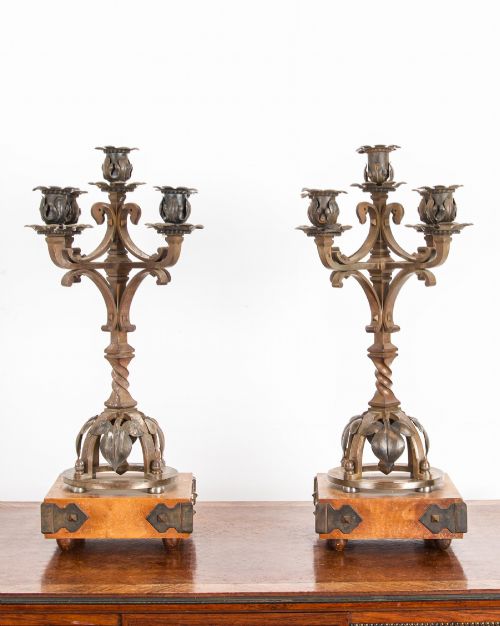


5 Light Candelabra
When you search for 5 light candelabra, you enter a domain of substantial dining table centrepieces and heavy formal lighting built to command a room.
5 Light Candelabra
A 5 light candelabra usually takes the form of a central column rising to a single nozzle, flanked by four detachable branches held on arms. These pieces serve primarily as formal lighting devices for dining rooms and large reception spaces.
The materials span heavy silver plate, cast ormolu, and patinated bronze, rooted predominantly in Victorian workshops and nineteenth-century French ateliers. Buyers encounter sturdy silver plated English examples alongside ornate continental gilt bronze designs.
Makers ranged from large British plate manufacturers to notable Parisian bronze founders producing symmetrical multi-branch arrangements.
How they were made
The foundation of these objects typically involves metal casting, utilising methods such as sand casting for bronze or heavy plating over a base metal core. Individual components like nozzles, drip pans, and arms were cast separately before being assembled and finished.
Chasing and finishing added the fine surface details, where artisans used small tools to refine foliate scrolls or figure work. Gilding or silver plating completed the exterior, providing either a bright reflective finish or a warm patinated depth.
Listings feature pieces spanning from the eighteenth to the twentieth century, constructed from gilt bronze, silver plate, and patinated bronze.
What varies in quality
Quality rests in the crispness of the cast ornament and the weight of the metal used in the construction. Superior examples retain sharp leaf and scroll details without the blurring that comes from worn moulds.
Construction methods also separate standard production from master work, visible in how securely the arms lock into the central socket and whether components are solid or thin-walled.
Hawksworth Eyre·James Dixon·Elkington and Company·Matthew Boulton·Hunt and Roskell·Barbedienne
The 5 Light Candelabra Glossary
- Ormolu
- Gilt bronze, created by applying an amalgam of gold and mercury to a bronze base and heating it. This technique produced a durable and rich golden surface seen on many French pieces.
- Drip pan
- A small circular tray positioned beneath the nozzle to catch molten wax. These components are frequently lost or replaced over time.
- Girandole
- A branched wall-mounted light fixture or mirror with candle arms. These items direct reflected light across a chamber.
- Patinated bronze
- Bronze that has been chemically treated to alter its surface colour, ranging from deep brown to near black. This finish highlights sculptural relief work.
- Nozzle
- The socket at the top of the arm that receives the base of the candle. It supports the candle upright during use.
5 Light Candelabra: Frequently Asked Questions
How do I clean silver plated candelabra safely?
Silver plate requires gentle cleaning with a specialist cloth to avoid wearing through the thin silver layer to the base metal underneath. Avoid abrasive dips or harsh scrubbing brushes that damage chased details.
Keep pieces away from direct heat sources and damp environments to preserve both the plating and any underlying weighted material.
Can I convert these candelabra into electric lamps?
Many nineteenth-century pieces undergo conversion to electricity by running wiring through the central column. This modification allows period lighting forms to function safely in modern domestic settings.
Reversible wiring methods preserve the original structure without requiring permanent alteration to the structural casting.
How do I distinguish French ormolu from English brass?
French ormolu typically displays a deeper, richer gold tone achieved through mercury gilding on a bronze substrate, paired with deeply chiselled surface details. English alternatives often utilise cast brass with a brighter, yellower finish.
The weight and heft of the casting also provide clues, as French foundry work from the nineteenth century prioritised substantial metal thickness.
Why do some branches feel loose when attached?
Candelabra arms often slot into a central receiver secured by a central screw or internal wedge. Over decades of assembly and disassembly, these fitting points experience wear.
Checking the internal thread or peg alignment usually resolves the movement without compromising the structural integrity.