


19th Century Welsh Landscape
When you search for a 19th century welsh landscape, you enter a visual record of rugged mountain ranges and river valleys recorded by Victorian artists.
19th Century Welsh Landscape
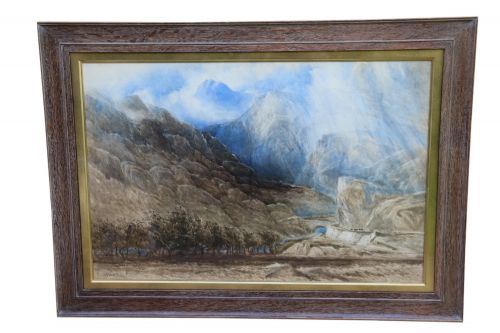
A 19th century welsh landscape captures the dramatic topography of Snowdonia, river valleys, and historic castles through the eyes of Victorian painters. These works document specific locations such as Betws-y-Coed, the Conwy Valley, and the pass of Llanberis.
The selection on this page comprises oil paintings on canvas and delicate watercolours on paper, alongside occasional decorative ceramics and folk art pieces. Most examples originate from the Victorian era, spanning decades from the mid to late nineteenth century.
Subjects range from expansive mountain vistas featuring peaks like Moel Siabod and Snowdon to intimate pastoral scenes with cattle, rivers, and figures by the water's edge.
Materials and Methods
Artists working in oil utilised canvas stretched over wooden frames, applying rich pigments to build depth in mountain skies and shadowed glens. Watercolours on paper capture the softer, atmospheric mist characteristic of valleys like the Ogwen and Conwy.
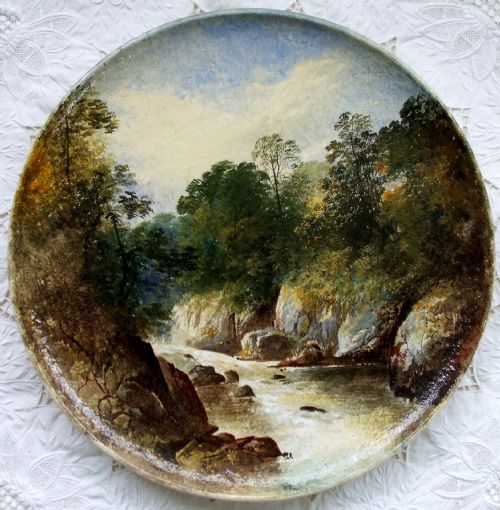
Framing materials such as giltwood and gesso complement the traditional canvases, while specialised items demonstrate alternative media including ceramic plaques and carved Welsh slate.
Distinguishing Quality
Quality rests upon the artist's ability to handle light and atmospheric conditions across complex terrain, distinguishing competent topographical recording from masterful artistic interpretation. Recognised painters command attention through confident brushwork and balanced composition.
Condition and originality also dictate standing, with untouched surfaces on both the canvas and the period gilt frame preserving the integrity of the work.
Sidney Richard Percy·Thomas Spinks·Frederick Waters Watts·William Mellor·John Syer·Harold Lawes·William Langley·John Cuthbert Salmon·Samuel Sidley·Willie Stephenson·Henry Brittan Willis·William Henry Mander·Cornelius Pearson·Walter J Watson·Benjamin Williams Leader·David Bates·Charles France·Carleton Grant·Alfred de Breanski·George Parson-Norman·James Poole·Henry Bright·Harriet Green·W Stanley Jay·William Dean Barker
The 19th Century Welsh Landscape Glossary
- Oil on Canvas
- A traditional painting medium where pigments suspended in drying oil are applied to a stretched cloth support. This combination allows for rich colour blending and textured brushwork.
- Watercolour
- A paint consisting of water-soluble pigments applied to paper, known for luminous washes and delicate transparency. It was widely used by Victorian artists travelling through rural terrain.
- Giltwood
- Wood carved and coated with a thin layer of gold leaf or metallic powder, frequently utilised for Victorian picture frames. It adds a warm metallic sheen around the artwork.
- Gesso
- A plaster-like mixture applied to wood or canvas to prepare a smooth surface for painting or gilding. It provides a stable base for intricate decorative frame mouldings.
- Folk Art
- Objects created by self-taught or non-professional makers using local materials like slate or wood. These pieces reflect regional traditions rather than academic fine art standards.
19th Century Welsh Landscape: Frequently Asked Questions
Where were these scenes painted?
These works focus primarily on North Wales, recording specific locations such as Snowdonia, Betws-y-Coed, and various river valleys.
Artists frequently returned to particular passes and lakes to capture changing light conditions over the mountains.
Are these works signed by the artist?
Many examples bear signatures, monograms, or contemporary inscriptions on the front or reverse identifying the creator and location.
Attributed pieces without signatures rely on documented stylistic traits and period records for identification.
How do I care for an oil painting?
Oil paintings require stable indoor humidity away from direct sunlight and heat sources to protect the canvas and paint layers.
Dusting should be done gently with a soft, dry brush without applying moisture or cleaning agents.
What frames accompany these paintings?
Surviving works often retain their period giltwood or gesso frames, which reflect the framing fashions of the nineteenth century.
These decorative borders complement the palette of the landscape within.