
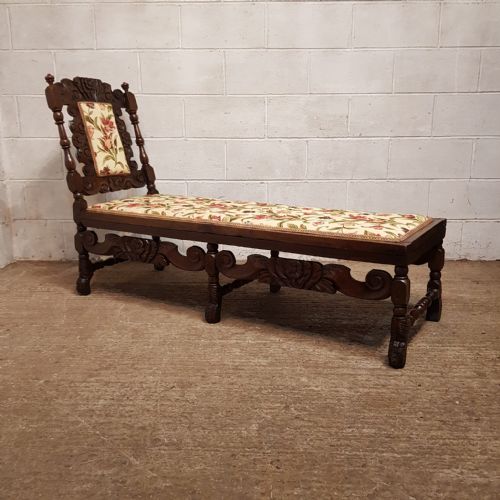
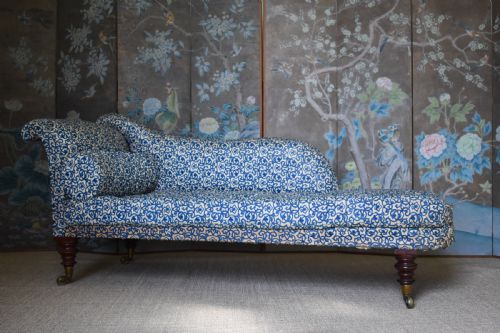


19th Century Upholstered Chaise
These 19th century upholstered chaise pieces offer reclining comfort rooted in Regency and Victorian craftsmanship.
19th Century Upholstered Chaise
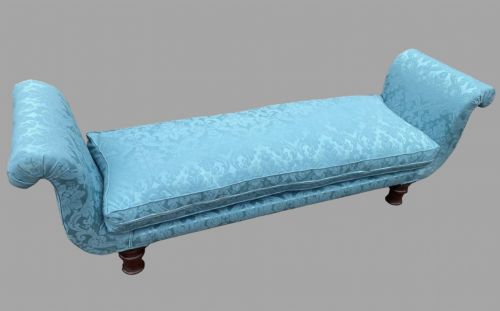
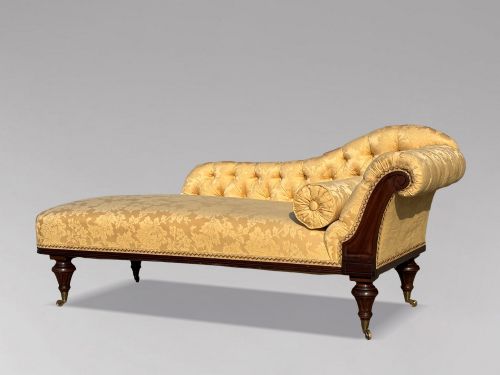
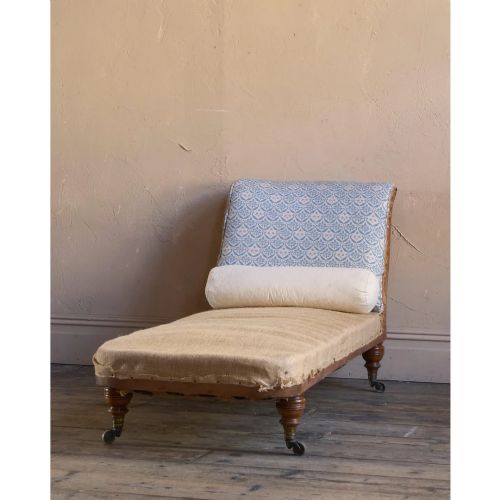
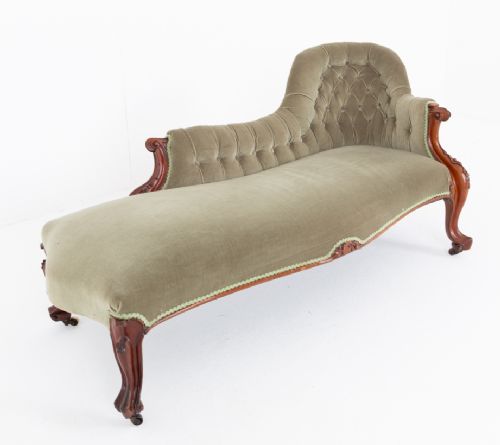
A 19th century upholstered chaise combines the long seat of a daybed with the raised headrest of a sofa, designed for reclining in domestic reception rooms.
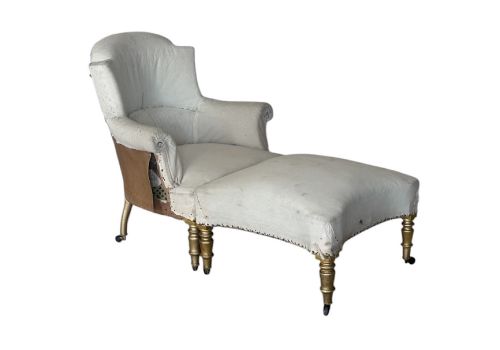
The pieces appearing on this page span forms such as French lit bateau, daybeds, duchesse brisee, and scroll-ended couches.
Makers from the Regency through the Victorian era produced these single-ended or double-ended seats in mahogany, rosewood, walnut, and oak.
Materials and Construction
Timbers such as mahogany, rosewood, and walnut form the structural frames, often shaped with carved scroll ends, spoonbacks, or barley twist details.
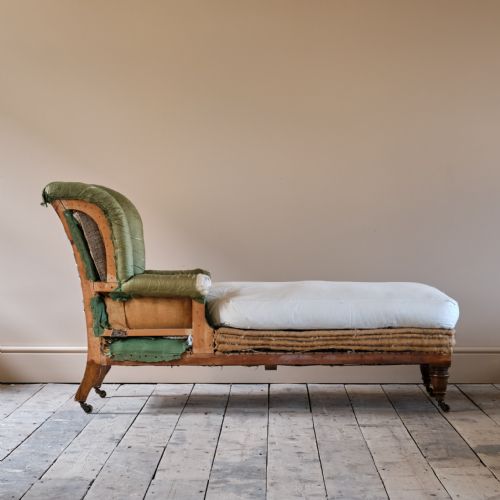
Upholstery fabric, velvet, and brass accents complete the seating surface, supported by internal webbing and stuffing standard to the period.
Coverings recorded on these frames include green velvet and various period upholstery fabrics.
Judging Quality
The distinction between standard production and top-tier workshop output lies in the crispness of the timber carving and the architectural balance of the scroll arms.
Marked pieces or documented attributions to notable cabinet-makers carry distinct craftsmanship signatures that elevate their standing above unmarked domestic furniture.
Howard and Sons·Holland and Sons·Jas Shoolbred·H. Goodall and Sons·Gillows
The 19th Century Upholstered Chaise Glossary
- Chaise longue
- An upholstered sofa in the form of a chair with a long seat for reclining. This long seat allows the sitter to stretch out fully.
- Duchesse brisee
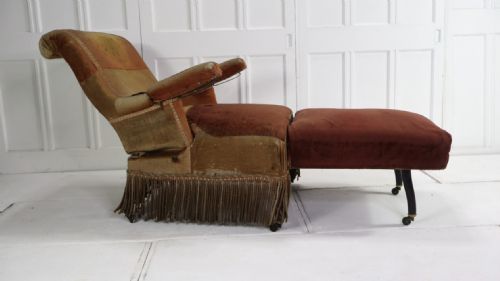
- A multi-part daybed consisting of an armchair and a stool, or two chairs joined by a footstool. This French form provides modular lounging arrangements.
- Scroll end
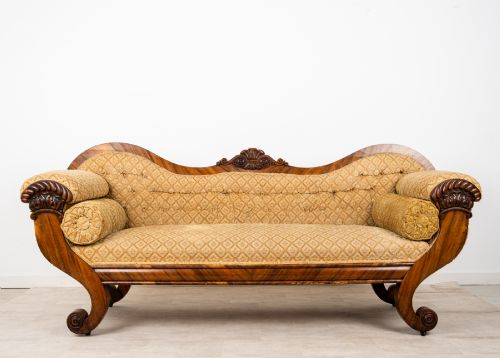
- A rolled timber terminal on the arm or back of a sofa. It curves outward in a volute shape characteristic of Regency and Victorian design.
- Lit bateau
- A boat bed or daybed with scrolled ends of equal or near-equal height. French cabinet-makers popularised this classical silhouette during the nineteenth century.
19th Century Upholstered Chaise: Frequently Asked Questions
What is a 19th century upholstered chaise?
It is a single-ended or double-ended daybed designed for reclining, combining sofa and chair elements.
Craftsmen built them in various revival styles during the Regency and Victorian periods.
How were these daybeds used originally?
Owners placed them in reception rooms, bedrooms, and grand salons for daytime resting and reading.
They served as elegant seating where ladies could recline without ruining their dresses.
How do I date a Victorian chaise?
Look at the timber choice, such as rosewood or walnut, and decorative carvings like scroll ends or spoonbacks.
Earlier Regency examples often feature simpler mahogany lines, while later Victorian pieces show heavier revival ornamentation.
Where should I place a daybed?
Position it against a wall in a living room or study to let the curved back and single armrest stand clear.
Ensure there is enough floor space around the piece to appreciate its length and timber frame.