


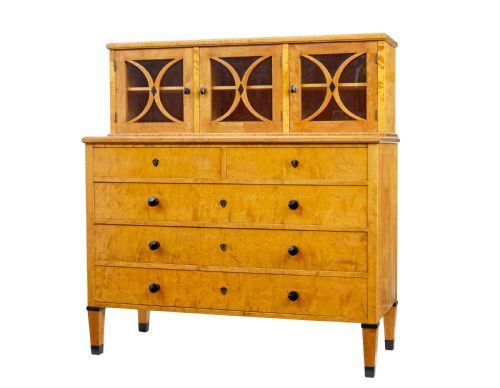


19th Century Satinwood Sideboard
These 19th century satinwood sideboard examples bring pale timbers, fine inlay and classical revival forms into domestic interiors.
19th Century Satinwood Sideboard
A 19th century satinwood sideboard encompasses side cabinets, chiffoniers, credenzas and display cabinets fashioned from pale exotic hardwoods during the Victorian era and the decades surrounding it. These large storage forms were built to display porcelain or store dining linen in grand reception rooms and parlours.
The versions met most frequently on this page combine satinwood with mahogany, walnut or boxwood, appearing in styles ranging from Sheraton Revival and William IV to Anglo-Indian and Neoclassical. Makers of the period utilised serpentine curves, breakfront outlines and demi-lune shapes to create striking focal points.
Many examples incorporate glass doors for display or feature detailed painted floral panels and classical stringing. They serve the same practical function today as they did in the nineteenth century while anchoring a room with distinct historical character.
What varies in quality
The quality of a 19th century satinwood sideboard rests primarily on the grain selection of the timber and the precision of the marquetry inlay. Cabinets with finely matched veneer panels and crisp, hand-cut boxwood stringing sit at the top of the range.
Hardware choice and mount execution also separate standard production from exhibition pieces. Heavy, well-chiselled ormolu mounts and finely painted floral panels indicate workshop standards that required considerable time and specialist skill.
Listings feature pieces spanning the nineteenth century, including Victorian, William IV, 1880 and 1890 periods, constructed in satinwood, mahogany, walnut, ormolu and marble.
The 19th Century Satinwood Sideboard Glossary
- Satinwood
- A hard, durable tropical timber with a lustrous, golden-yellow sheen that takes a high polish. It formed the primary decorative surface for late nineteenth-century revival furniture.
- Credenza
- A low dining or reception room cabinet designed for storage and display, often featuring glazed central doors flanked by curved side cupboards. They became prominent during the Victorian period.
- Ormolu
- Gilded bronze mounts applied to furniture corners, feet and friezes. The technique involves coating cast brass with a gold amalgam.
- Marquetry
- Decorative patterns formed by fitting contrasting pieces of veneer into a prepared wooden ground. Cabinetmakers used boxwood and darker hardwoods to create geometric or floral scenes.
- Chiffonier
- A small sideboard featuring a shelved superstructure above a low enclosed cupboard. These pieces were common in Victorian parlours for holding books and decorative objects.
19th Century Satinwood Sideboard: Frequently Asked Questions
What is a 19th century satinwood sideboard?
It is a large storage and display piece built during the nineteenth century using pale satinwood veneers, often incorporating mahogany, boxwood inlay and glass doors.
These cabinets served as focal points in Victorian dining rooms and salons, combining practical shelving with decorative classical motifs.
How do I identify a Sheraton Revival piece?
Sheraton Revival furniture draws on eighteenth-century neoclassical designs, featuring symmetrical forms, straight tapering legs and delicate inlay.
Look for satinwood surfaces decorated with painted floral swags, urns and contrasting boxwood stringing characteristic of late nineteenth-century revivals.
Where were these cabinets placed in a home?
They stood against principal dining room or drawing room walls to hold serving dishes, silver, linen or porcelain collections.
Pieces with glass doors and display shelves allowed homeowners to exhibit decorative arts alongside functional storage.
What is the difference between a credenza and a chiffonier?
A credenza typically presents a low, symmetrical profile with cupboards and glazed doors stretching across the entire base.
A chiffonier usually incorporates a raised superstructure with shelves supported by small columns sitting atop a compact lower cabinet.