

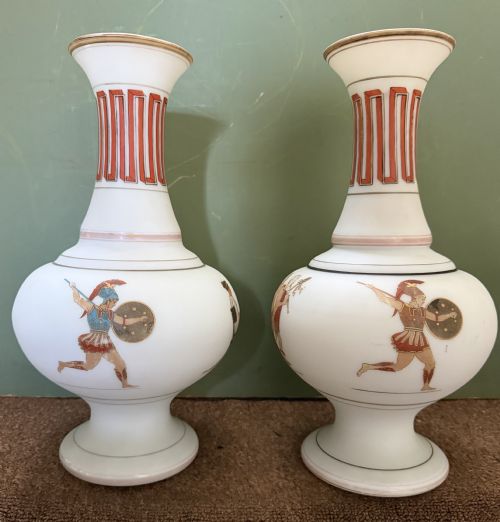


19th Century Opaline Glassware
These 19th century opaline glassware pieces bring dense, milky colour and delicate hand-painted decoration to a room, exactly what a collector wants.
19th Century Opaline Glassware
When you search for 19th century opaline glassware, you encounter decorative objects made primarily from opaque or translucent white and coloured glass that mimics porcelain. The selection on this page consists largely of vases, alongside specific forms such as egg cups, decorative baskets, and bells.
The periods represented span widely across the nineteenth century, including Georgian and Victorian examples, as well as specific decades like eighteen-eighty and eighteen-ninety. French and English origins dominate, with several pieces showing strong French Empire, Neoclassical, and Aesthetic Movement influences.
Vases appear most frequently among the listings, often decorated with painted figural vignettes, raised leaf and floral designs, or gilt highlights. Alongside standard white opaline, the materials encompass cranberry glass, milk glass, cobalt glass, and Nailsea combed glass.
How these items were made
The objects are produced from blown glass, shaping molten material into vessels like vases and baskets before applying various decorative treatments. Artisans utilised techniques such as combing glass while hot to create distinct patterns like the Nailsea pipe.
Surface decoration frequently involves enamel painting, creating figural vignettes around the bodies of classical vases. Guilding and applied gold leaf add metallic detail, while contrasting rims in pale blue or white complement body colours such as cranberry and cobalt.
19th Century Opaline Glassware Retail Price Guide 2026
Typical asking prices for 19th century opaline glassware among the pieces listed under this phrase on Sellingantiques today, from the lower quarter to the upper quarter. They describe what is for sale here now, not the wider market.
A white combed glass pipe allows you to admire the whimsical side of nineteenth-century glassblowing without ever lighting tobacco.
What varies in quality
The refinement of the glass body and the precision of the hand-painted details separate standard examples from finer pieces. Crispness in raised leaf and floral designs indicates careful craftsmanship during moulding and decoration.
Painted figural vignettes and applied gold leaf show variation in artistic execution and preservation over time. The integration of mounts, such as silver work on baskets, also influences the character of the piece.
Baccarat, France
The 19th Century Opaline Glassware Glossary
- Opaline glass
- A type of semi-opaque glass, usually white or pastel in tone, developed in France during the nineteenth century to imitate porcelain. It serves as the primary medium for the vases and decorative items listed here.
- Cranberry glass
- A rich red transparent glass produced by adding gold to the molten batch. It appears on this page in items like bells.
- Nailsea glass
- Glassware characterised by looped or combed white patterns embedded in a clear or coloured background. It originates from English glassworks associated with that name.
- Gilding
- The application of gold leaf or gold paint to the surface of the glass for ornamentation. It frequently highlights rims and moulded designs.
- Aesthetic Movement
- A late nineteenth-century design style emphasising visual beauty over narrative content. Pieces from this period incorporate refined decorative forms and silver mounts.
19th Century Opaline Glassware: Frequently Asked Questions
How were opaline vases used?
They served as decorative mantelpiece ornaments or display items in nineteenth-century drawing rooms rather than utilitarian vessels. Their painted vignettes and gilded surfaces made them focal points in formal interiors.
Pairs were commonly produced to flank clocks or mirrors on a fireplace mantel.
Where were these pieces made?
The evidence points primarily to French and English workshops and factories, including notable production in Baccarat. Regional styles like Nailsea also contributed distinct combed glass techniques.
French pieces frequently display Neoclassical or Grecian revival influences.
How do I live with opaline glass?
Place these items away from direct sunlight and areas of heavy household traffic to protect their delicate enamel and gilt surfaces. Gentle dusting with a dry cloth keeps the glass clean without risking abrasion.
Display them where natural light can pass through the translucent body.
How do I identify the period?
Look to the stylistic cues, such as Grecian vignettes, Aesthetic Movement silver mounts, or Regency forms, which align with specific decades in the nineteenth century. The presence of hand-painted details and specific material combinations like cranberry and milk glass also assist in dating.
Maker attribution, where present, provides a firmer production window.