


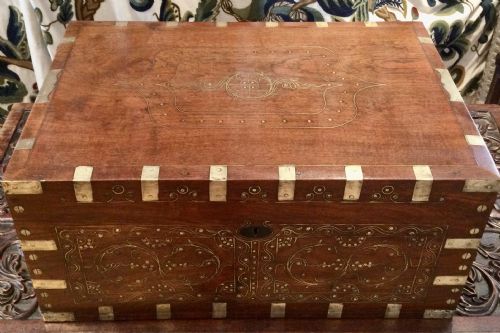


19th Century Inlaid Trunk
These nineteenth century inlaid trunk examples offer robust storage and decorative marquetry, bringing nineteenth century craftsmanship directly into your home.
19th Century Inlaid Trunk
A nineteenth century inlaid trunk provides practical storage combined with decorative woodcraft from the Victorian era. These pieces arrive in forms like teak campaign chests and continental walnut dome coffers, showing the diverse functions these receptacles served.
Most examples originate from the broader nineteenth century period, constructed from dense timbers such as teak and walnut. Buyers meet Dutch colonial variations alongside English country house pieces, each reflecting distinct regional tastes in surface ornamentation.
How they were made
Cabinet makers utilised heavy hardwoods including teak, rosewood, walnut and mahogany as the structural foundation for each trunk and chest. These durable timbers provided a stable base for detailed surface decoration.
Artisans applied intricate marquetry inlay, frequently combining contrasting woods, brass mounts and mother-of-pearl details into the timber surface. This technique demanded precise hand-cutting to achieve flush, decorative patterns across the lid and sides.
Early nineteenth century travellers trusted these sturdy wooden chests to survive long sea voyages while keeping their Sunday best safely away from sea spray.
What varies in quality
The precision and complexity of the marquetry inlay determine the visual merit of the piece. Finer examples display tightly fitted contrasting woods and delicate mother-of-pearl detailing that remains secure within the surrounding timber.
The choice of primary wood and secondary framing timber dictates the structural integrity. Superior items employ dense tropical hardwoods or richly figured veneers coupled with robust internal construction that withstands decades of use.
The 19th Century Inlaid Trunk Glossary
- Marquetry
- Decorative veneer applied to a wooden structure in patterns and pictures. This technique uses thin slices of various woods to create pictorial designs on the trunk exterior.
- Campaign chest
- A split-carcass chest designed for military officers on the move. These items feature brass corners and recessed handles for transport.
- Coffer
- A large box or chest used for holding valuables or textiles. They often feature hinged dome lids and heavy timber construction.
- Mother-of-pearl
- The iridescent internal layer of mollusc shells. Craftsmen cut this material into thin pieces to inlay floral or geometric motifs into wood.
19th Century Inlaid Trunk: Frequently Asked Questions
How do I clean an inlaid trunk?
Dust the exterior regularly with a soft, dry cloth to protect the delicate wood surfaces and marquetry. Avoid modern liquid polishes that might seep beneath loosened veneer.
Feed the timber periodically with appropriate wax to maintain the moisture of the wood and the security of the inlay work.
Where were these trunks used?
These items originated in various domestic and colonial settings, from English country houses to Dutch colonial outposts. They stood in hallways, bedrooms or offices for secure storage.
Travel versions accompanied owners on voyages, while heavier coffers remained stationary inside stately homes.
How do I identify a Victorian piece?
Victorian items often display characteristic nineteenth century timber choices like rosewood and walnut, combined with specific hardware styles. Look at the construction methods and the style of inlay to gauge the era.
Consult makers' marks or regional building traits when available to narrow down the decade of production.