
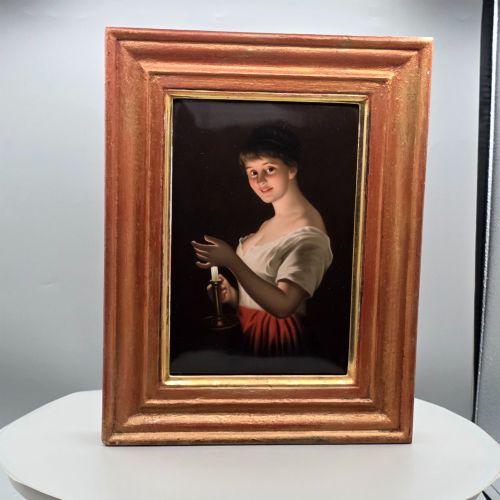


19th Century Enamel Panel
A 19th century enamel panel brings rich colour and meticulous miniature painting into domestic interiors through clocks, plaques and furnishings.
19th Century Enamel Panel
When you search for a 19th century enamel panel, you encounter decorative works produced across Europe, the Middle East and East Asia during the Victorian and Second Empire eras. These pieces appear inset into the cases of carriage clocks, crystal regulators and mantel clocks, or mounted as standalone wall art, plaques and table tops.
The objects take many forms, from French repeating carriage clocks and Sevres style mantel clocks to Syrian copper panels and Japanese centre tables. Most examples on this page reflect French taste of the 1870s and 1890s, where hand-painted or cloisonné enamel plates decorate gilt brass, bronze and glass frames.
How they were made
The makers of these items fused powdered glass onto metal bases such as copper, brass or gilt bronze through repeated kiln firings to achieve durable colour. Craftsmen then applied fine metallic details or raised gilding, particularly visible in Limoges plaques, Viennese works and cloisonné chambers.
Supporting structures combine cast and engraved metals like gilt brass and gilt bronze with inset glass panels, porcelain and gilded wood. Complex items integrate mechanical clock movements behind crystal housings alongside the decorative enamel elements.
A Molière portrait plaque on a gilt bronze clock allows you to keep seventeenth-century French theatre quietly present on your mantelpiece.
What varies in quality
Quality rests upon the precision of the miniature painting and the clarity of the vitreous colours fused onto the plate. Finely executed portraiture, vibrant celestial motifs or sharp cloisonné wirework distinguish superior panels from simpler decorative elements.
The standard of the surrounding metalwork also defines the piece, with deeply chased gilt bronze and engraved brass cases elevating the overall manufacture far beyond standard production items.
Margaine Of France·Samson·Alfred Drocourt
The 19th Century Enamel Panel Glossary
- Enamel
- A glassy substance fused to a metal or ceramic substrate through high-temperature firing. It provides a durable, glossy surface that retains its rich colour across decades.
- Cloisonné
- An ancient technique where thin metal wires are soldered to a base to form compartments, which are then filled with enamel paste and fired. This creates distinct outlines between different coloured sections.
- Limoges
- A French city renowned for its production of painted enamel plaques and vessels. Works from this tradition often feature detailed figural scenes and celestial subjects against dark backgrounds.
- Crystal Regulator
- A distinct type of French mantel clock featuring glass panels on four sides that reveal the internal movement and pendulum. They frequently incorporate painted enamel dials or corner panels.
- Gilt Bronze
- Bronze metal that has been coated with a thin layer of gold using mercury amalgamation or electroplating. It provides a warm, enduring metallic sheen common in French luxury goods.
19th Century Enamel Panel: Frequently Asked Questions
Where were these enamel panels made?
Production centred heavily in France, particularly Paris, alongside notable regional centres such as Limoges and Vienna. Other origins represented include Syria and Japan.
European pieces typically align with revival styles and Grand Tour aesthetics, while Middle Eastern and East Asian items utilise distinct regional enamelling traditions on copper and carved wood.
Are clock panels original to the piece?
Most carriage clocks and crystal regulators retain their original matching enamel dials and decorative side plates fitted during initial manufacture in the Victorian period.
Close inspection of the mounting bezels and internal movement fit helps confirm that the enamel panels belong to the original housing.
How do I date a crystal regulator?
Stylistic indicators such as the shape of the brass case, the use of specific enamel colour palettes like pink or blue, and maker signatures help narrow the production window.
Many French examples date from the 1870s and 1880s, reflecting the popularity of glass-cased mantel pieces during the late nineteenth century.