
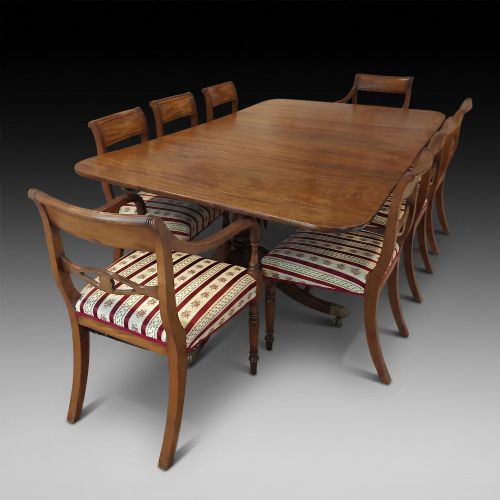


19th Century Dining Suite
A 19th century dining suite gathers guests around substantial timber tables accompanied by matched seating from the Georgian, Regency and Victorian eras.
19th Century Dining Suite
A 19th century dining suite typically comprises a large timber dining table paired with a matching set of chairs, sometimes including carvers or throne armchairs. These ensembles originate from periods spanning the Regency, George IV and Victorian eras.
Buyers commonly encounter sets of eight to sixteen chairs alongside extension tables measuring up to twelve feet in length. Object types range from comprehensive dining suites and salon suites to specific groupings of dining chairs and tables.
Stylistic influences vary from classic Regency lines to elaborate Victorian balloon backs and carved Elizabethan Revival designs. Sets frequently incorporate matching carvers or throne armchairs alongside standard dining chairs.
How they were made
Cabinet makers utilised dense hardwoods such as mahogany and oak, building tables and chair frames to withstand heavy daily use. Pollard oak and painted finishes also appear across specific regional and revival pieces.
Seating frames incorporated upholstered fabric seats, sometimes supported by metal or brass details. Carved ornamentation such as lion motifs and barley twists decorated the sturdier oak and mahogany frameworks.
Listings feature mahogany and oak as the primary timbers, accompanied by fabric upholstery and brass details.
What varies in quality
The distinction between standard gatherings of furniture and superior suites lies in the uniformity of the timber and the crispness of the carving. Original matched sets demonstrate greater cohesion in wood grain and proportion than assembled groups.
Substantial table lengths and larger quantities of matching chairs indicate ambitious original commissions. The presence of specialised seating, such as throne armchairs within a larger suite, elevates the formal status of the set.
The 19th Century Dining Suite Glossary
- Carver
- An armchair designed to sit at the head of a dining table, featuring supportive armrests. These pieces frequently match the smaller standard dining chairs in a suite.
- Balloon back
- A chair back style shaped like a rounded oval resembling a balloon, popular during the Victorian period. This design offers ergonomic support through curved wooden framing.
- Elizabethan Revival
- A nineteenth century stylistic movement drawing inspiration from sixteenth century architecture and furnishings. Pieces in this style typically display robust oak construction and deep carved detailing.
- Barley twist
- A spiral turning technique applied to wooden furniture legs and vertical supports. This decorative form creates a dynamic sense of movement along structural components.
19th Century Dining Suite: Frequently Asked Questions
How many chairs come with these suites?
Complete dining suites generally include anywhere from six to sixteen chairs, depending on the original scale of the commission.
Larger configurations frequently incorporate specialised seating such as carvers or throne armchairs to accommodate formal dining arrangements.
What woods were used for these suites?
Cabinet makers predominantly worked with mahogany and oak to construct both the tables and the chair frames.
Alternative finishes such as painted surfaces and pollard oak also appear in specific regional or revival examples.
How do I identify a Regency set?
Regency furniture draws on classical neoclassical forms, typically displaying refined proportions and dark mahogany timber.
These pieces predate the heavier ornamentation associated with later Victorian and Elizabethan Revival suites.
What is an Elizabethan Revival suite?
This nineteenth century style revives sixteenth century decorative motifs, utilising robust oak and deep carving.
Such suites often feature elaborate elements like lion details and barley twist uprights.